Showing posts with label arizona. Show all posts

Sunday, February 24, 2013

Camelback Mountain's Praying Monk Christmas Garbage & Other Camelback Trash


Merry Trashmas

Someone put up another Christmas Tree on the Praying Monk this year. This time it didn't work out so well.

I'm no longer mentioning names, but they wrote about it online:

"Somebody cut the lines it was rigged with, tossed the tree off the Monk, and took the gear that I anchored it with. The tree was broken into little bits, and was very difficult to carry down. "

Coincidentally, I noticed Christmas garbage strewn all over the Praying Monk plateau during two separate scrambling sessions in January. The people who put the tree up in the first place are responsible for the trash, even if "somebody" else cut the tree down.

The tree was gone during my climbahikes, but broken and intact ornaments could be seen scattered around the Monk's base. (I didn't pick them up, having no pockets or a bag to put them in, but I'll get them eventually if no one else does.)

Several gear tags were lying around. Hundreds of tiny, green pine tree needles were littering the chute leading from the plateau to Rappel Gully. They appear to be plastic and not biodegradable -- if so, they'll be up there for quite a while, mixed with the gravel. Annoying.

For years, I've also been bugged by the goofballs who decorate the top of Camelback Mountain with holiday decorations and a Christmas Tree each holiday season. I've noticed holiday litter at the summit in past years, too.

If you feel compelled to spread Christmas cheer to every mountaintop, literally, ask yourself if Jesus would want you to celebrate his birthday by trashing one of the few natural areas in the city.


Climbing Litter

Now, when I see an empty Gatorade bottle or crumpled snot-rag or other trash along Echo Canyon or Cholla trails, it's expected because of the sheer number of people on Camelback Mountain. The mountain is usually quite clean, but it only takes one litterbug out of every 10,000 hikers to make a mess. Very few people, relatively, scamper up the Headwall to the Monk plateau. So when I see garbage up there, it's more disappointing because it means that a much smaller proportion of the climbing population than hiker population is littering. Yet climbers, in my humble opinion, should be much better stewards of the land than average hikers. They visit more pristine, sensitive areas, and they should know those areas are less likely to ever be cleaned up by anyone, being more difficult to access and to move and up and down the slopes and cliffs with trash bags.

Most climbers believe strongly in self-reliance, and this ethic extends to the idea that you pack out all trash, barring some good reason not to. This applies to old webbing and other climbing-specific trash. Yes, climbers may leave webbing tied around boulders or trees after using it as a rappel anchor. That's not littering -- it's survival, and not the same thing as leaving sliced, sun-decayed webbing lying at the base of a popular climb.


More annoyances

Next, an example of Camelback graffiti. Fortunately, this sort of thing doesn't appear on the rocks as frequently as it could. Phoenix doesn't have an excessive graffiti problem in general. If I had to guess, I'd say "SL" stands for S*%^ Licker:


The Ultimate Garbage Sin

Finally, I must bring up the trashy act that makes me more furious than any other: Leaving dog poop on the side of the trail in a tied-up plastic bag. I mentioned this in a previous post but it's worth talking about again because so many people do it. I come across these poop bags on the trail once every two or three times up the mountain, and sometimes see two on the same day, in different types of bags, meaning more than one of these boors had been there. I've never caught anyone doing it, but would certainly say something if I did.

The poop-bag method is even more annoying to me than the idea of dogs pooping freely on the ground. While it's possible that some of the poop-heads who do this plan on picking up the bag on their way down from the mountain, most clearly don't. They leave it there, believing falsely that if they have housekeepers, groundskeepers and janitors at their beck and call, so does Camelback Mountain.

Last time at the mountain, a couple of weeks before the Echo Canyon closure, I talked to a ranger about this strange and obnoxious behavior.

"Hey, thanks so much for the service you guys provide -- picking up all those little bags of dog poop that people leave," I said with a smirk.

She got my drift right away and she snarled, "Oh, there's no service! They think there's a service, but there isn't. I don't pick them up!"

"I know! What is wrong with those people?"

"Actually, I do pick up the bags, sometimes," she confessed. "But only when I'm positive that no one is around, so no one sees me do it. Otherwise, they'll think there really is a service."

Listen up, poop-baggers: Do NOT leave your animal's crap on the trail, even for a minute. If you have a plastic bag, that's wonderful -- take it with you, whether you're hiking down or are still on your way up. There is no valid excuse for doing otherwise.

Saturday, December 24, 2011

Holiday Greetings From the Summit of Camelback

Our Christmas Eve hike. What a beautiful day. Perfect weather. Another summit for the kid.

Sunday, December 11, 2011

Claud the Water Guy


This picture was found on a blog post written by photographer/"footballer" Jason Johnson.

Jason, a U of A grad who's from Seattle, runs into "Claud the Water Guy" and hikes to the summit with him. Claud juices up Johnson's short and entertaining description of the hike. Especially nice is his use of dialogue. He mentions how Claud tries to hand out water to "everyone he meets" has Claud saying, "It's a dangerous hill ... These city-slickers forget how hot it is. People die here... in the summer it will get to one-sixteen and they don't even bring water!"

Johnson surmises that all regular Camelback hikers have met Claud -- I certainly have, though I've never chatted with him for as long as Johnson did and didn't know his name was Claud. He hikes Echo Canyon a lot, that's for sure; he's in the top 10 of regulars I've noticed, probably because of his outfit. He's asked me several times if I needed water.

I suppose every mountain needs a self-appointed savior of foolish and unprepared hikers. Claud takes his job of Trail Police seriously.

About a year ago, I departed from Echo Canyon Trail to explore the base of some 40-50 foot cliffs above the saddle between hump and head. The gully turned bushy and I began scampering on a sidewall, having fun, when I heard a concerned voice far behind me shouting, "HEY! HEY! THAT'S NOT THE TRAIL!"

I tried to ignore him for a moment, hoping to climb out of his sight, but he kept it up: "TURN BACK! YOU'RE GOING THE WRONG WAY!"

I looked up at Claud, who was several hundred feet back and up at curve in the trail, wearing the same hat and having the same general appearance as in this picture, but appearing less than an inch high to me from that distance. "IT'S O-KAY!" I yelled back. "I'M NOT LOST!"

Then I turned around and resumed traversing. He yelled one more time before giving up. I found a great spot to free solo in the class-four range for about 20-30 feet before coming to a section that I didn't want to do without protection. The downclimb was just tricky enough to put a smile on my face.

I passed Claud on the way down.

"Nice rock-climbing there," he said graciously.

Thursday, August 18, 2011

Climbahiking


Hiking at Camelback is an adventure every time. One doesn’t hike Camelback as much as climb it. The rock-steps on Echo Canyon trail are of varying height and shape, and sometimes loose. The trail includes slick-rock and gravel and high-steps and steep drop-offs and shortcuts and tree-grabs and semi-vertical faces and boulder fields and railroad ties that are fun to bound down and handrails (I have personal rules about when they can be used). Cholla’s not bad, either, with its scrambly top. Both trails have some of what I would consider Class Three terrain.
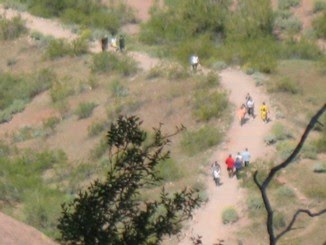
I notice sometimes that the technique I'm using when I go down Camelback is the same monkey-careful gait that I employ on more-serious mountain hikes. It’s hard to describe, and it doesn’t look all that different from mere hiking down a steep slope, but it is different. It’s more like climbing down with my feet. I’m more centered in my gravity, more balanced in the arms, more ready in case I slip than when hiking down an easier trail.

I'm not one to usually say "I'm going to climb Camelback today" when I mean I'm going to hike to the top. For me, climbing at Camelback means rock-climbing. But to hike Camelback is, in many pleasurable ways, to climb it.

Saturday, August 13, 2011

Yosemites in Our Backyard


This guy at the summit recently told me he was going to Yosemite in a few days and we chatted for a moment about the waterfall deaths. That was in mid-July. Since then, the total number of fatalities has increased to 14 this summer, with a woman plummeting 600 feet after slipping on the cable route. That's the park service number. Another person, a teen, slipped on Mist Trail and suffered a fatal injury, but he didn't make the official tally because he died at a hospital outside the park.

I’ve ascended the cables twice and descended three times, (once following my ascent of the Snake Dike route). Those cables can get crazy-slippery. Each time I made some use of the gloves that pile up on the top and bottom of the cable route, and each time realized that the gloves may help the hands in terms of endurance on the thick twists of metal and soak up some sweat, they aren’t all that grippier. In ’91, my friend Kent and I descended the Dike in a thunderstorm. We topped out on Half Dome in a white-out. It hailed, then poured. Most of the hikers caught at the top were under-prepared, a few in nothing but shorts and a T-shirt. What the heck, it was July. Kent and I wore Gore-tex rainjackets (and our backpacks with all the climbing gear, including an extra rope we hadn’t needed), and would have been fine except for one of the hikers ahead of us was not only freezing-cold, but near-frozen in terror. A man, perhaps he was with her, had to resort to moving her hands down the cable for her – for a few tense moments, she could not do it on her own. We and others trying to get down the 400-foot cable-and-wood-slat ladder grumbled in frustration. The longer we lingered, it seemed, the greater the chance of losing concentration or getting struck by lightning. I had to remove the gloves at one point, worried that their surface had grown too slick. I’ll never forget the feel of that wet cable as I gripped it, hard, that sense that I wasn't grasping it hard enough and applying more power to my hands. It took serious effort, and my fingers were stiff with the cold. All the while, I was more than aware of the steep grade and how we were still very high up, above the tips of the tallest redwoods near the base of the cable route.

Spooky. But overall, a fantastic time.

The reaction of the Yosemite park rangers to the record number of fatalities this year is just what I prefer to hear from local officials – and so far, thankfully, have been hearing – every time someone gets hurt or killed at Camelback and other mountain parks. Their message: Risk, yes -- restrictions, no.

I find that refreshing.

Despite tragic deaths like that of Clint McHale’s, an even greater tragedy would be to try to clamp down on adventuring in wild places. Camelback is one of those wild places. It’s in the middle of the 5th largest city in the United States, but that fact means absolutely nothing when you’re leading, soloing or free-soloing a climbing route there. I’ve had adventures at Camelback that rival those I’ve had in Yosemite, and more of them, since it’s only 10 miles from my home. Some of these adventures were had when rock-climbing was new to me and my friends and I practiced a form of it that focused, in an amateurish and unathletic way, on the sheer thrill, exploration and independence from any authority. When winding through one of the maze-like slots of August Canyon, battling thorny Palo Verdes, mesquite and various cacti, searching for the rap-down on Pedrick’s Chimney after having just ascended a multi-pitch route like Suicide Direct -- I’ve felt downright astronautic. As in, I’m walking on the moon. Mind, body and soul are brought together by wilderness, risk and achievement.


Camelback is one of our local Yosemites. So are the Supes. A few words about the Superstition Mountains: If they weren't so darn far away from the central Valley, I'd love to live in the shadows of the western cliffs of the Superstition Mountains, the little community over by the Mining Camp restaurant. Older homes, lots of variation, zoning free-for-all on county land, some properties requiring water to be trucked in. A somewhat weird place, just east of Apache Junction. But the ability to walk out of my home and into the Supes, a federal wilderness area... Wow. I mean, this is a place where I've seen whole herds of javelina. The trails are tough and rewarding, and going back just a few miles leaves 99 percent of the people behind. The walls there are humbling because even when you're really high up, they go even higher. Unfortunately, the rock quality isn't Yosemite-like: Instead of miracle-granite, you get so-so volcanic. Some spots are solid, others crumbly. Many of the biggest walls on the western flanks of the Supes contain unclimbable coffee-cake-like rock. Whenever I hike up Siphon Draw Gully trail, I stare up in awe at the Spiderwalk wall, that behemoth, conical mass of beige stone the size of a 50-story building that I and a friend climbed one day long ago. The stunning view from the saddle of Weaver's Needle at the end of Peralta Trail is also Yosemite-esque in its grandeur. The preserve is so big and rugged that two years ago, a guy looking for gold disappeared in there without a trace, and last year, the same thing happened to three other guys.

No question: Yosemite’s beauty and climate far surpasses Camelback’s or the Superstitions. But for outdoor adventure, it sure is great to have a couple of little Yosemites in our backyard.


Thursday, June 30, 2011

Annabelle's First Time to the Summit


On a gorgeous winter day this year, January 29, I experienced a sublime proud-Dad moment: Annabelle and I summitted Camelback together. I'd been dreaming of that moment since Annabelle was born almost ten years ago, and then, sniffle, sniffle, there it was.

When kids get older, parents see fewer and fewer of those precious, significant "firsts." Being with Annabelle at the top of my favorite hill and seeing how excited she was to do it was just as awesome as watching her ride a bike without training wheels for the first time. It's certainly a day I'll never forget, and, hopefully, it's also a major milestone in her life in terms of her self-esteem. We passed several people who were struggling, and that made her feel like Superwoman.

"Daddy, those people are adults," she whispered to me as we advanced past a few twenty-somethings. She could hardly believe she was doing something so seemingly advanced. True, I've seen people as young as four make the summit, but I've noticed a pretty large range of physical strength and ability among children. Annabelle did it when she was ready, without a lot of pushing from me. We'd been hiking on the mountain several times before, and before the summit day, she'd actually asked me if we could go for it that weekend. Some of that was just trying to please me (oh, please, let her never grow out of that!) but she genuinely wanted to reach the top.

We've been hiking "A" Mountain regularly this year, and I'm quite sure we'll do Camelback again soon -- when it cools off. I'll be back out there this weekend, on a day when it's supposed to top out at 117. It was deathly hot last Saturday, worse than the previous week with the fellows, but I started that day at 11 a.m.. This weekend I'll start earlier. I don't want Annabelle to do it when it's this hot. Not only is safety a factor, but she might associate the hike with the heat, which could be a negative incentive. Kids, my kids anyway, don't really understand the concept of "no pain, no gain" or the little aphorism I thought up, "the more miserable, the more memorable."

I still don't know if my youngest, who has Down Syndrome, will ever see the summit. I hope so. She's become a decent little hiker on all sorts of terrain. It's one of my goals to get her up there someday, but it has to be one of hers, too. We'll see.

Here are a couple of shots of the kid from a different trip last year:


Just for the halibut, I'm also including here a "pyramid shadow" picture I took that's sort of like the one I ripped off another Web site for a previous post. I took this a few months ago, not on the hike with Annabelle.

Friday, June 24, 2011

Summer's Here


Summertime -- and the living is easy.

Unless you're from Chicago, you've never before experienced real Sonoran heat and you're crazy enough to follow a desert rat like me up Camelback.

Our friend and co-worker Greg exclaimed, "This is harder than I thought it was going to be!" about halfway up. (I mean the Echo Canyon side, of course. All hikes to the summit referenced in this blog will be from Echo unless noted.)

Funny, because he's half my age and in better shape, overall. During one of our many, mandatory stops for rest and water on the way up, I told him I still had no doubt he could kick my ass at one-on-one b-ball.

I had found the going remarkably easy and, much to his chagrin, couldn't help continuously commenting how cool it felt.

We'd started at 2 p.m. on June 4. The temp about 105. But this was a classic dry-heat day. My guess is 2-3 percent humidity. Best of all, it was breezy. With wind chill, I was feeling like it was about 80-85. Gorgeous. And I've been hiking a lot lately, so the whole way up I felt like a coiled spring. Normally, on a beautiful day like that, I wouldn't have stopped once. That day I probably would have topped out in just over a half-hour. Still not prime form, but a good summit time for me. Instead, we pushed it near the 70-minute mark. And poor, Greg -- he just flopped to the rocks when we arrived on top.

He did well for his first time, actually. He's leaving for Minnesota in another week.

I'll be here, though -- my home for the past 34 years. The Stern family crossed the border from New Mexico, on our way out from Queens, on July 4, 1977. Nearly two weeks passed as my parents searched the Valley for a decent apartment and a possible home site, and in the interim my sister and I experienced Phoenix heat like I've never experienced it before. We lived in our family's tent-trailer in the Pony Acres Trailer Park near Apache and McClintock, (which, by God, is still there -- though catering to a slightly less middle-class clientele now), without the slightest trace of air-conditioning at night. Back then, the heat-island effect wasn't as pronounced and the nights were slightly cooler. But only slightly. We spent our days sitting in the trailer park's not-quite-cool pool and felt truly comfortable only when going inside the park's clubhouse or in stores or the model homes my parents kept touring.

That was my first summer.

And here it is now, my 34th.

The mercury is expected to rise to 113 later this week, NPR told us this morning at about 8:30 a.m., when it was 92 degrees out. No more cool hikes up Camelback until September.

That's just fine with me.

Thursday, September 30, 2010

Camelback Livens the Spirit

The weird thing is that it really looks like this sometimes.


The shot was "Posted by Julie ... at 2:56 AM" according to the Web site ScottsdaleDailyPhoto.com. One of the commenters notes that it looks like Mars, which I think is true. Reason No. 1,000,001 why I love Camelback: The way the pink rock of the Headwall turns into a glowing, reddish orange at sunset. No other mountain in Phoenix compares, as far as I can tell. Papago appears to have the same geologic mass of red, and it looks beautiful during some sunsets, too. I just don't recall this same effect -- though perhaps I've not as observant of the rolling lumps of conglomerate that make up Papago.

Next up we have a shot by "Bill," who writes a blog called Endurance Event Training:


The perfect shadow of a pyramid-shaped mountain captured in this picture tickled my fancy. But I also like how Bill, an accomplished athlete who rode 1,700 miles on a bike in 30 days this past summer, praises Camelback for its ability to give him a good workout on a 110-degree day.

Bill made the hike on September 10. Five days before, members of the "Galat Family" tried to slog to the top in weather that was nearly as hot. The family was on a furlough from their work in Africa as missionary doctors. It's so fascinating to see life through the eyes of people like Dr. Galat, thanks to the Internet. Especially interesting to me is to see how physical struggles in the context of a quasi-wilderness setting can be spiritually enlightening to people in a way that sitting on the couch watching the boob tube isn't. Yes, deep thought occurs during workouts in the gym -- there's a certain boredom, or rather, a lack of the constant over-stimulation of modern society, that is inherent in exercise regimens -- but combined with the natural ouevre of a mountain hike, seems to bring out a deep-seated, ancient survival mechanism in people. Especially when it's over 100 and hiking Camelback isn't something you do often. I've seen some of these religiously oriented bloggers take the same tack as Galat, translating their perceived risk of this hike into a confirmation of their particular faith. I mean, here we have a father and health care worker taking something one of his kids said about the strength of their family on the hike and he ends up quoting Corinthians and immersing himself in "truths" like "for when I am weak, then I am strong." Camelback has the power to grab hold of your soul, at least metaphorically speaking, and I think that holds true no matter what your beliefs -- or lack of belief.

Saturday, July 24, 2010

Camelback Hikers Brave the Summer Heat, but Not Always Successfully


Camelback's been in the news and mentioned in blogs quite a bit in the last few days, so I thought I'd catch up.

First off, several notable mountain rescues occurred due to the heat. This enabled me to mix business and pleasure by publishing a blog post in Valley Fever about the incidents, and a follow-up making fun of a local TV reporter. (Sorry, Kevin!) The news coverage of the rescues also spurred message threads like this one. I'm hoping the 13-year-old kid whose parents took him up the mountain without enough water is okay.

Seeing these incidents and the community's response to them, as heart-breaking as it may be to see anyone hurt, gives me confidence that liberty still rules the day. For all this talk about the feminization, wimpification, or whatever you want to call it, of modern society, the freedom to roam on our local mountains -- up its steep cliffs and in all conditions -- trumps notions of perceived, relative safety. It's 105 degrees and you're 73, from much-cooler Wisconsin, and aren't packing enough water? Nobody's going to stop you at the trailhead and tell you not to do it.

The firefighter interviewed in the Channel 10 report on the rescues, Captain Tony Mure, (they spelled his name wrong in their caption), says "I don't care what kind of shape you're in -- the human body cannot tolerate this kind of heat and this kind of exertion." That's simply not true and plenty of people who work outside prove him wrong every day. (Tony's a good guy -- the authorities often take a scolding tone with the public when it comes to these things, to try and warn people away).

I've hiked Camelback dozens of times in temperatures of 110 degrees or higher and only once did I feel like I'd made a mistake -- (4 p.m. hike, 117 degrees). The trick is to sweat a lot, which results in a "wind chill" (ha!) factor of much less than the air temp. This is difficult to achieve when the sun is directly above, so most of my 110-plus hikes have NOT taken place between, say, 10 and 3. Most often, those hikes were in the evening -- after 6.

Hiking in the sun, (even outside the hours of 10-3) requires extra precautions, like packing 2 bottles of icewater instead of one and wetting my shirt before heading up. Sunscreen is mandatory, naturally. Some people wear long-sleeved shirts. Once, while hiking at about 4pm on a 110-degree day, I ran into a guy coming down in full camo gear, long pants and long-sleeved shirt, with undershirt, calf-high boots and a backpack stuffed with unknown gear. This guy has the audacity to stop me and say, "Excuse me, can I ask you a question? Are you wearing sunscreen?" I told him I was, and asked him why he was dressed up like that. He said he was training for officer candidate school.

Meanwhile, plenty of people besides me made it to the top this summer without nearly dying. My next featured post is from a blog called "Daily Nuggets." The picture is of the blogger's "cousin Rob" making it to the top; my screen capture includes their text as well.


I also like this one from "DaSmith Foursome" blog. They met for their Father's Day hike at 4:15 a.m. (that's their picture below). Whoa! That's early. You go, girls. They all made it to the top.

I failed to summit the first time I hiked Camelback, I must admit. I was 18 and unfamiliar with mountains back then, though I was in better shape than I am now. The defeat was 100 percent mental.

I'd been by myself, huffing and puffing up the steep trail for a while, thinking I was getting somewhere. After I cleared the headwall area, the summit still looked very far, far away. I went a little further, and it still looked far away. I realized the only thing holding me back from cool comfort was a decision. And I made the wrong decision -- I decided to turn back. It had been warm, but not that bad. I'm pretty sure I'd brought a water bottle, but I forget what my water situation was that day. Probably not good. Still, I have no doubt now that I could have made it.


Anyway, my search this morning for mountain rescue photos led to a cool January report by Channel 3 I hadn't seen about rescues. The anchor keeps referring to dramatic scenes of firemen climbing the Headwall and of a helicopter as similar to a Hollywood stunt. I hadn't heard about the accident, in which a climber on the Monk fell 25-30 while rappelling, fracturing both legs. Holy ouch, Batman! I took this screen-grab of the shot of a helicopter next to the Monk.

One last note today: As the oppressive heat of July wears on, much as I love it, the green hills of the "other" Camelback Mountain featured in many Internet sites this summer makes me wish for a vacation there. I found a "SummitPost" posting from 2006 recently in which somebody crowed about the "great-tasting blueberries and rasberries" they picked, as well as the "amazing views." That sounds pretty good.

Tuesday, June 8, 2010

The "Other" Camelback Mountain

Sometimes it seems like half the info on the Web about Camelback Mountain is about the "other" Camelback Mountain, also known as "Big Pocono."


In my former life as a Queens boy, I knew that my parents had their honeymoon somewhere in the Poconos, but that's about all I knew of the place.

Thanks to my obsession with our local rockpile, I now know that part of the Poconos includes the Camelback Mountain Resort in Tannersville, Pennsylvania. It's a popular ski area that's filled with folks from New Jersey and New York City every winter. It looks like a great place to have fun in the snow.

By Western standards, the other Camelback is what I'd call a cute, little bump of a ski hill. The vertical drop is only 800 feet. Sunrise has an elevation gain of 1,800 feet, Snowbowl more than 2,000. (Phoenix Camelback = 1,200.)

Poconos Camelback rises to 2,113 feet, says Wikipedia (other sources put the max elevation at 2,050). That's much shorter than Phoenix Camelback, which tops out at 2,706.

Of course, our Camelback is a good deal south of Pennsylvania, and it's in the middle of a desert. Snow that falls on Phoenix Camelback melts quickly (it happens once every few years), so the Poconos provide much better skiing conditions.

In the summer, the Poconos don't bake at 115 degrees or more, either, meaning you can go splashing through mud puddles on a Segway or run a zip line through the trees.


Summer or winter, the other Camelback looks like my kind of place.


(Pictures from www.skicamelback.com)

Thursday, June 3, 2010

Bee Attack Panics Man, Causes Knee Blow-Out and Mountain Rescue


Hiker Tom Tenkler made the news yesterday after blowing his knee out while running away from some bees.

Several media outlets picked up on this one, and as usual, most ticked me off by failing to include decent info. At least the local Fox affiliate reported that the incident happened on Cholla Trail, which even the so-called paper of record did not.

Firefighters from Phoenix's TRT and Tempe FD took the guy down some sections on a Big Wheel, with rope assist, before flying him out via helicopter on the Cholla side.

I'd rather get stung 50 times and limp with a broken leg off the mountain rather than suffer the indignity of a mountain rescue and the obligatory TV news coverage. But that's just me. Besides, Tenkler may not have summoned rescuers himself. I tried to find his phone number, but neither online White Pages nor Yahoo People Search have a listing for a Tenkler in AZ. Fox was the only outlet that reported the guy's name -- maybe they got it wrong.

Tuesday, June 1, 2010

Camelback Chuckwalla

Late-spring hiking at Camelback this year has been different: Fewer parking spaces because of the great weather, less time to hike with the new closing hour of 7 p.m. (Jeez, they've gotta to change that!)

One thing is the same: The annual appearance of the friendly chuckwalla.

These handsome, large Sonoran-desert lizards come out when the ground heats up. Last month, On a recent day, I saw what looked like two baby chuckwallas. A couple of weeks later, I spotted this bad boy.


Don't try to catch one or you might hurt it. To escape predators, chuckwallas slip between cracks in the rock and puff up their bodies, wedging themselves in tight. This may work for coyotes (who may just get a drumstick instead of the whole thing) but determined humans would have no problem messing with them.

Seeing a chuckwalla at Camelback is a special treat for nerds like me and out-of-town visitors, some of whom probably wonder if they're Gila monsters. Chuckwallas are much bigger then common fence lizards, more colorful and all-around cooler-looking. They blend in beautifully with Camelback's orange-red hue.

Another neat thing about chuckwallas is their name. Though it sounds like something a hayseed from the Midwest might have thunk up, Wikipedia says it's derived from a Spanish bastardization of a couple of words for the lizard used by two Native American tribes.

The Hohokam, (the group of Native Americans who lived in the Phoenix area for about 1,000 years before leaving a few decades before Columbus' arrival) probably considered chuckwallas a delicious treat -- the Hohokam also ate cholla.

The Wiki article told me something I always suspected: that chuckwallas are basically desert iguanas. No wonder I like them so much: I used to have a pet iguana as a kid. Its name was Whiplash, because it liked to whip people with its tail so hard that it would leave a mark. It also bit me on the nose once. I sold it back to the pet shop I'd bought it from a year later, and found it had gone up in price like a rare coin. I was happy to have the extra money instead of the iguana. But I can't get those sweet little lizard faces out of my head. They're so cute!

Wednesday, May 26, 2010

Hart Route Freesolo Pt. 2 -- The Ascent


This was to be a grand day of adventure. The weather was outstanding -- high 60s rising to low 70s. (This was in mid-April, if you'll recall from Pt. 1). I had all morning and then some -- more than enough time. And I had a new rope and harness, something I'd been planning on buying for the last few years. In the back of my head, thoughts lurked of turning back. No matter what, I promised myself, I would climb with caution and reversibly -- I would back down all the way or rappel down if need be. At no time did I want to find myself on super-sketchy terrain. Yet I was also 100 percent committed to the attempt.


I took my small backpack, cleared out of all work stuff and loaded with icewater, an apple and a banana, the A630, some slings and a couple of small cams. At the base of Hart Route, I attached the climbing gear to my new BD harness and tied into the new rope. The rope would be in a coil at the base as I climbed, which is much easier than hauling the whole thing up at once. Doing that presents a small risk of a rope-stuck situation, but the first pitch is fairly vertical and has no rope-eating cracks.

The beginning went well, and soon I was at that nasty little crux before the ledge. As before, on the recon trip, I didn't like the looks of that last couple of meters, which require sort of pulling into vegetation, feet in a stemming-type position that heightens the exposure and potential for falling all the way to the deck. The right was more of a series of face moves. I decided the rock quality was decent enough to attempt it. A minute later I was finished with the first pitch, feeling like I'd discovered the easy topout I'd hoped would be there the week before. My beautiful, new, green 9.8 mil rope (Petzl Nomad) pulled up easily behind me. As I made my butterfly coil, my lack of companionship seemed acute -- nobody was at the other end of the rope.


Despite the bitchin' weather, Echo Canyon wasn't as crowded as I would have expected. It seemed quieter than usual -- or maybe my mind was just making it seem like that way. No other climbers were out on Gargoyle Wall, which Hart Route is part of, and no one was on the Monk. I had everything above the Headwall to myself. Which was just fine, for this trip, anyway.

The first pitch felt like solid 5.2 to me, especially compared to the 5.0 that I usually freesolo to get the top of the Headwall. That's the route just north of the class 4 section which is also freesoloable. The 5.0 is the one with the palo verde about 3/4 of the way up. It has a slightly sketchy top-out, but there are plenty of footholds, unlike the top of p1 of Hart Route. That makes a huge difference when you're unroped.

After topping out on p1 during the recon, a glance at the beginning of p2 caused more doubts to enter my mind. Those doubts were still with me as I prepared to go higher on the freesolo. If you zoom into the picture from Pt. 1, you'll see the bloke I pictured leading the start of p2. The section just under him is tougher than it looks, and I found the spot where's he's at in the picture a bit exciting, too. Plenty of handholds but it keep you off balance in places. Halfway up is a traverse to a left-facing fracture -- all good. Some rests requires an awkward foot stuck in the crack, but the rests were mainly to get my bearings and prepare the next few feet of slow, static freesoloing -- not the desperate rests needed during an intense lead. Still, adrenaline leaked into my veins as if from an IV drip.

From the top of pitch 2, you need to go up and right to access the start of p3. As I began to do this, I heard what I hoped I wouldn't hear: Buzzing. The hive was nearby, for sure. I tried to walk on the sloping ledge as quietly as possible, holding the heavy, coiled rope in one hand. Then I could see the hive -- it was about 40 feet away, up and left, in the same spot where it had been some years ago, when I climbed Hart Route with Scott. The hive thrummed with activity; in fact, the bees seemed a bit agitated and not just simply flying back and forth on pollen runs. Every few seconds, a small, black streak would zip by me, coming or going to the hive.

The bees hadn't noticed me -- yet. My apprehension was higher than it had been since I started the climb 45 minutes earlier. The rope was coiled neatly -- but could I set up an emergency rappel if the bees began stinging me? One reason Abbe and his partner, Jeff Passage, couldn't get the rappel going was that the rope was somewhat tangled. But if I was under attack, would my rope be tangled, too, thanks to Murphy's Law? Sure it would. I became convinced that if a swarm attack began, it would be a miracle if I could get the rope anchored and thrown down without tangles as stingers were plunging into my eyes and face. As on George Route, my guts fluttered as I imagined a full-on killer-bee attack, how I'd be stuck on the crag and praying for death to come sooner rather than later.

My fear level shifted into high gear. Fear is a requirement on a climb like this -- but managed fear, a useful tool to keep my senses as sharp as possible. Now I was re-thinking the whole endeavor. I stepped back to the false safety of the p2 ledge, where I couldn't see the bees. I started visualizing the two rappels it would take to descend the pitches I had just climbed, planning to bail. Dammit, I thought, who's the dominant species here!

I was on a mission. After a few minutes of pondering, I decided that I would risk the bees to complete what I had started. I was very much looking forward to the p3 face and successful summit. As quiet as a gecko, I tip-toed up and right, keeping my eye on the hive and trying to gauge the bees' mood. They didn't seem to notice. Without hesitation, I began pulling up the start of p3, which is a face but has plenty of fractures and cracks to hold on to.

Having led and seconded Hart Route a few times, I remembered the 3rd pitch quite well -- it's all sweet and fun, compared to most face routes. It's a relatively low-angle friction pitch, with lots of Camelback pinchers and finger holds and very little dicey rock (as long as you're on-route). The first 25 feet went very quickly; my tinge of panic made it feel like my climbing shoes had rocket thrusters attached. But as I got higher, I grew less concerned that I might piss off the bees. If they respond only to threats, they would have known when I was halfway up the pitch that I had no way of messing with them, even if I wanted to. After a while I forgot about them and concentrated on the somewhat nutty task at hand.

The first half of p3 is really easy, definitely 5.0 or less. I thought the whole thing might be a 5.0. But to my chagrin, the very last couple of moves of Hart Route are the crux of the whole climb. The third pitch is rated 5.2, but I didn't know that at the time. I thought the first pitch had the 5.2 and the last pitch was 5.0. That's what I get for not properly researching the beta.


(Above, P3 with crux marked. Below, the Monk.)

One last bolt before the crux tempted me enough to throw a sling on it. I thought maybe I could hold onto the sling if I fell as I made the last couple of moves. But my sling was much too short. I could not hold on to it and make the moves to gain more height. Plus, I knew that falling on static webbing -- compared to a dynamic climbing rope -- could easily generate enough force to rip the bolt out. Embarrassed with myself for wasting time, I took the sling off and steeled myself to do the last moves. They're easy, but it's Camelback face -- the poor rock quality adds significantly more risk.

I reached as high as I could and found something to pinch. I caressed the rock as I settled into the strongest handhold I could muster, looking for positive edges and the right directional pull. Once I found them, all I needed to do with get my feet up. This was a long way up and p3 had turned spooky, getting steeper and harder. I brought a left foot up higher and tried to move my right foot. Suddenly, my right leg decided to stop working that well. I tried to place my right foot in an adequate, though marginal hold - and felt a spasm in my thigh. Whoa, I thought, realizing that a fall here would probably mean death. Get it together. Calm down. Fear can make your worst nightmare come true -- or it can be channeled into action. I chose the latter.

I calmed my mind but could not completely convince my right leg that everyone was going to be fine. Still, everything worked nicely and a minute later I was done. Success!

I was ecstatic I had decided to ignore the bees. I had just done something I'd thought about doing since I was 23. Now, 20 years later, I have the experience and confidence to pull it off, so I did. It feels good.


I lingered a very long time in August Canyon, checking out its mysteries. I'd like to spend much more time there and maybe even spend the night. Then I rapped down Pedrick's and -- with much relief -- took off my climbing shoes and put my hiking shoes back on. My legs and feet felt strained from the few tense stances on the way up. Yet I still had plenty of energy, so I decided to summit Camelback. Hauling the backpack (with the rope inside) was more weight than I usually carry up the Echo Canyon trail; after that, I was finally tired.

So what's next for freesoloing at C-back, if anything? Well, there's always the Monk, if I want to scare the bejesus out of myself. It's got at least one kind of blank section for the feet that requires a friction smear -- the problem is, friction smears and freesololing don't go along - not in my book, anyway. One slip could mean curtains. But I would consider pushing up the first half of the Monk without a belay, then backing down at the smear foothold. Then there's... let's see -- how about Hanging Gardens in the McDowells? Probably not -- that's a solid 5.5 and has some very sketchy granite face moves that would be be terrifying. The good thing about doing Hart Route is that I now don't feel compelled to freesolo anything for the time being!

All in all, this was a day to remember. I would consider freesoloing Hart Route again before leading it. It's too easy on rope!


Tuesday, May 11, 2010

Piestewa Break


I hit the trail at Piestewa Peak after work today – truth be told, I left a bit early following completion of my next cover story. I was jonesing for a hike-workout and summit after the unsuccessful Humphreys Peak bid on Saturday. But it was really the weather that made me do it. Right now is so beautiful I can hardly believe it. Seems like February or March. And tomorrow’s supposed to be eighty-four, tops. Amazing.


I crushed Piestewa (still want to call it Squaw), as usual. Because there are more people, I’m always happier when no one can pass me here. My time up was excellent today – 25-30 minutes, I think. Should have timed it.


The sunset in the Phoenix Mountain Preserves always captures my eye – in a way, it’s that typical Sonoran desert look I love so much. The rock here has a brown hue that absorbs the sunlight in a warm way pleasing to the eye. (This doesn’t apply in the summer, obviously, when you could almost fry a steak on that rock). Vegetation is plentiful with lots of green from all the rain we’ve had this year. The wind is blowing well – a good day for sailing. No water here, but the palo verde trees and creosote branches are waving back and forth.


Perhaps the best thing of all about hiking Piestewa: The view of the western flanks of Camelback Mountain. Especially at sunset. Then, the magical pink-orange Camelback rock glows, while the dark shadows of the folds and crevices of the Head provide rich context. The greenbelt of the western edge of August Canyon extends across the Headwall like a terraced, though haphazard, ancient garden. The giant, whitened half-bowl beneath the crux of the George Route is like a fingernail. Homes worth millions of dollars apiece lie nestled in hyper-luxurious Sonoran flora, the ones on the PV side surrounded by acres of buffering land.


Hiking down Piestewa, like hiking up it, isn’t as tough as Camelback. When I choose to leap forward in speed, running down the flatter parts and bounding down some of the stair-like sections, I find there’s far less gravel where I’m stepping. The only problem is that the trail is narrow in places – it may even have more narrow spots than either Echo Canyon summit trail or Cholla. That wasn’t a big deal today, but it does on the nicest days, when the place turns into an anthill.

Friday, April 30, 2010

Hart Route Freesolo Pt. 1 -- Recon


Six-and-a-half hours of pure, kickass adventure in Camelback last weekend. I freesoloed Hart Route -- something I've been thinking about doing since the first time I climbed it back in 1989. (Click on picture for close-up, with dotted route-line). I went on a recon mission to the place a few weeks ago, climbing up the first pitch after being invited to climb through by some folks who'd gotten up earlier than me. The pitch is rated 5.0 in some guide books, but it's really a 5.2 by today's standards. It's hard to know what to compare Hart Route to -- there are relatively few climbs out there rated 5.0 to 5.4, and they're usually underrated instead of overrated. Unlike a gym climb, it's not sustained, and it's not always vertical. But each of the three pitches on Hart Route has moves that would be rated 5.2-5.7 in the gym. Add in the diceyness of Camelback rock and the quality exposure of each pitch, up to the top-out at 150 feet or so, and this climb becomes something quite unlike any gym or shorty sport climb. It gives me the same feeling I get while on trad lead, or even trad seconding -- an hours-long rush of adrenaline, fear, happiness, mental control and physical satisfaction. Freesoloing anything allows me to reclaim my human-animal roots, the need for excitement missing in daily modern life. And Hart Route is a good freesolo for me -- not too hard, nothing to keep me up at night when I'm done. It's extreme, by the average Camelback hiker's standard, but not too extreme for people who feel comfortable running out a lead in the 5.6-5.8 range, which includes me.


Spending time like this at Camelback is a fantastic mountain escape.


But I digress.


The first pitch of Hart Route is quite easy, to the big hole 3/4s of the way up. After that, footholds on the left become trickier at the same time the handholds get thinner. On the recon day, at that section, I angled left to a spot with bushes and a moderate overhang. Climbing in full static mode, as I do sometimes when I freesolo so that I can reverse the moves without much thought, I pulled myself into the final moves after a bit of leg shake. I'd initially felt like a total badass after the guy in the picture told me to come up -- another guy and a woman were waiting to top rope and I figured my unroped ascent looked kind of impressive. Then I ran into that muck at the top and looked like a wanker. Truth be told, I only topped out on that shite because, in the back of my head, I figured I would ask the guy for a lower-down so I didn't have to down-climb that last part with my ass 50 feet above the deck. I hate down-climbing overhangs on freesolo and try to avoid climbing up them in the first place, ever since my hardest all-unroped climb -- my freesolo of Rappel Gully (5.4) back in the 90s. That one has a nasty little overhang right at the top, about 70 feet up. It wouldn't have been a big deal -- except I'm too familiar with Camelback to think I can safely trust my life to any one hold. When I talk about climbs that keep me up at night, that's one of them. On Hart Route, had the bloke with the belay not been there, I'm sure I could have downclimbed the upper part of the first pitch, but it would have been scary.


I snapped this picture of the guy, then asked him if he'd lower me. It turned out that a purple biner I'd found at the base of the headwall was his, and I gave it back to him when he asked if I'd seen it, so you could say he owed me one. (I never would have used it, anyway. You don't know where found biners have been -- if found at the base of a crag, like this one, I assume it probably fell and might be damaged, even if I can't see any evidence of a crack, scratch or dent). I forgot to mention that for the recon mission, I only had my rock shoes and chalk -- no rope or harness. The guy asked me how I wanted to do the lower. I tied a figure eight on a bight in his rope, clipped a biner on it for a handhold, then asked him to lower me down to the easy part at the big hole, which he did.

In spite of the assisted downclimb, the whole experience got me thinking seriously about freesoloing the whole thing. I'd been playing around with the notion in my head in the days before the recon mission. Of course, I'd have to bring a rope with me in case I needed to bail, and for the convenient rappel down Pedrick's Chimney when I was done. Now I knew the top of the first pitch was sketchier than I really wanted, but having climbed it without a rope made me confident I could do so again. I stuck around awhile, trying to learn something from the blokes belaying up Hart Route, but they took so long to move I had to bail off the headwall area before they reached the top of the second pitch. That meant I'd be doing the freesolo without beta on the second biggest objective danger (the first being gravity) for any climbers on Hart Route: the deadly beehive. I only wish the adjective was an exaggeration. A few years ago, a guy named Keith Abbe  died on Hart Route after he and his partner were attacked by the bees that live on top of the second pitch. Abbe didn't die from the stings, though he was stung about 100 times, if memory serves. He died because he and his partner were not skilled enough to set up an emergency rappel while under the insect bombardment. I have no idea whether I am, for that matter, and I hope I never need to find out. The partner, whom I interviewed for an article in the East Valley Tribune about the tragedy, told me that he made a command decision as the leader of their expedition that they should untie the knots from their harnesses and downclimb as fast as possible. Abbe apparently didn't get very far before he slipped and fell at least 50 feet to his death.

Three weeks after freesoloing p1, I found myself at the base of Hart Route again, ready to push as high as I felt safe in doing.

Click here for Part Two: The Ascent

Thursday, July 31, 2008

Slouching toward the summit at 111 degrees


Started at 6:40 or so and was surprised to see so many people in Echo Canyon considering how warm it was. Perhaps the breeze had brought them - it was fairly nice, at first. Extreme heat brings out the hard-folk, and today was no exception, though there were a lot of them. Parking lot was nearly full. The heat was intense. I burned through the trail with my Ipod on shuffle. Suppose I looked weird with my bandanna tied around my head -- nobody seems to do that. But I like it because it keeps the sweat out of my eyes. Few people wear hiking boots as sturdy as mine, either. I had my Danner Mountain Lites on, my typical Camelback shoe. Slowed down a whole lot about 3/4 of the way up, going into my plodding, low-energy climb mode. Had to stop and take a water break; I only do that on the hottest days, and this was one of them. Took a few pictures with the A630. Gorgeous red sunset.


On the way down this dude tells me to watch out for a rattlesnake he saw "just around the bend." I asked him to clarify that and he sounded like he didn't know what he was talking about. Told him I thought I'd like to see a snake tonight. "Well, watch out," he said with rising drama in his voice. "They KILL!" I couldn't help but laugh and I wanted to say something and what came out was, "They only kill you if you mess with them." Not sure if he was just screwing around or what, but I didn't hear or see anything. I was kind of disappointed, since I had my camera on me. I've seen a handful of snakes at Camelback, and I know to watch out for them. Pretty much as long as you don't surprise them you'll be okay. It's a good idea to avoid stepping right in front of small, overhanging rocks where snakes could be hiding, not that I always follow that rule. Most of the snakes I've seen anywhere in the Sonoran desert give you a good warning rattle when you get within 10 feet or so, just like they're supposed to. But they don't always follow that rule. It's just prudent to always keep your eyes wide open, especially when hiking in the dusk, like I was tonight on the way down. Saw no wildlife at all except for these big horseflies buzzing around like angry bees. Though it was truly hot, though not scorching because the sun was at such a low angle, I started feeling like I always do when I hike Camelback: Awesome. I haven't climbed it in a couple of months and despite some joint issues, in particular a troublesome wobbly right knee (the site of my nasty ACL replacement surgery in '93), things went well. Felt a little guilty about the time factor - everything I do these days seems to mean a sacrifice of something else I should be doing. But it was worth it, as usual.