Showing posts with label rock climbing. Show all posts

Monday, April 1, 2013

Bob Owens on Camelback Mountain's "Suicide Cliff" and the Kachinas, Arizona's Legendary Climbing Club


Bob Owens, 1948
Following my review of Camelback Mountain's Suicide Direct climb, I received three messages correcting info I'd passed on about the route's first ascent.

One was an awesome comment by Roger Banan, who wrote that he climbed the route in 1969, with Dane Daugherty, who'd said nothing about establishing the first ascent. That would seem to contradict the word of Steward Green in Rock Climbing Arizona. Plus, Banan's description makes Dane too young in 1969 to match up with the 1949 date given for the FA by Dane and his brother in Waugh's climbing bible, Phoenix Rock.

The second and third messages were from Bob Owens, an 84-year-old from Utah and member of the legendary, post-WWII climbing arm of the Boy Scouts, the Kachinas. As many local rock climbers know from the guidebooks, the Kachinas pioneered modern rock-climbing in the Phoenix-area and other parts of the state. The group led the Phoenix Explorer program, the Arizona Mountaineering Club and the Central Arizona Mountain Rescue Association, says CAMRA's website.

Kachina badge
Owens put a message on a quickie blog post I did about chuckwallas, saying he and other Kachinas climbed "Suicide Cliff" in 1947, and that he led it again with Gary Driggs (first ascender of the Praying Monk and author of the top-notch coffeetable book, Camelback: Sacred Mountain of Phoenix) in 1950.

Owens also sent me an email that was cc'd to Ben Pedrick. Yes, that Ben Pedrick - the guy whose name is immortalized in two routes at Camelback, Pedrick's Chimney and Pedrick's Split.

Here are some excerpts from Owens' letter to Pedrick:


This is just an update glimpse on status of Kachina Legacy in Arizona.

I've heard no more from Greg Opland, who was working on a history of climbing in the Superstitions, and to whom we furnished some photos and material.

I checked the web yesterday, since it's been 8 years since our last Kachina reunion, and used the search term "SUICIDE CLIFF, Head of Camelback",  which turned up some interesting stuff. An excellent book entitled "ROCK CLIMBING, ARIZONA" By Stewart M. Green was published in 1999 in the Falcon Guide Series, which I think I was not aware of at the time of our 2004 Reunion.  About half of it is online, and it seems to slight the Kachinas big time, in the portions I read.  We gave a lot of material to Karabin and Opland in 2004, but too late to find its way to Green's book, obviously.  Example:  It seems to credit  Dane and Lance Daugherty for the "first ascent of Suicide", and never mentions us.  Do you know them? Rock climbing and mountain rescue was still our default monopoly in 1948, which rapidly changed in the next few years, as Kachinas left for college and military.

This Daugherty credit has been recently picked up and repeated by Ray Stern, a reporter for the Phoenix New Times... [Note: Camelback Phoenix is my own website. -RS]
Owens & friend on top of 1st pitch of Suicide Direct
I will attach some of these purloined photos and materials for you, since I know you have a love for ancient history and fossils.
Also, the Internet has some nice, color graphics of the route itself.  Do they match our route?  My memory after 64 years says, yes.  It is called "Suicide Direct" now.  Marty Karabin also has created his own  route, to the right of ours. The labeled "start of the 5.8 pitch" is what I have always called the ledge, but I recall the overhang being closer to the top.  I don't remember any "Fun Approaches".  I think I see a cross at the skyline top.  Was that put up by the French  ASU student's family when he fell to his death here, or is it a mesquite or other shrub?  (Andre Dauvergne).

Also, I wonder who waters those yellow marigolds along the route?  I don't recall them, from 1948 or 1950.  They make a pretty border, an esthetic touch for climbers.
          And another route, left of ours, named "Spice Box" (Foreshortened view):
...
As for the facts on Suicide, apparently none of us wrote a report at the time.  We left a few expansion bolts in the rock we used to call Arizona crud, (it has other names now) and possibly some of my hand-forged pitons from dad's forge, since I was still too broke at 19 to acquire any store-boughts.  That may be where Karabin reclaimed those home-made relics in his museum.

Ben Pedrick
My memory is that we made several prior attempts, or rather bolt-installing trips, possibly as early as 1947, and did the actual through-climb sometime in the first half of 1948.  (I went on my two-year mission July 4, 1948).  Much later notes listed Ray Garner, myself, and Ben Pedrick, as finishing the climb, after taking turns on the iron mongering, with Garner first over the overhang portion.  There could have been one more there--Roy Gray?  

After I got home in July, 1950, I did the Suicide climb with Gary Driggs, with me leading, (there was no new hardware in the rock yet), and I climbed half the route again a few years later with some of my senior scouts from the 16th LDS Ward, with color photos this time.  (circa 1964-5?).  They were still novice belayers, so I chickened out from going all the way to the top, particularly on that cliff.  We went as high as the ledge, I took a picture of Bruce Mabb and [Dave?] Harmon,  then we prudently rappelled back down.

Does all this so far match your memory, Ben?  Shall we noise it around that you and I had been planning a trip from California and Utah to Camelback for one more nostalgia Kachina climb, (like Glen Exum did on Grand Teton)  then dawdle in actually carrying out that plan, like Abe Lincoln on peace talks in the Civil War?  It will give speakers at our funerals something positive to talk about.
At 84, I might still be able to manage the lowest "class four" segment, even though  I have a growing balance problem, but if you lead  that pitch, Ben,  I can still hang on a rope as second, without visibly staggering.  

I ordered Greens book ($13.39, Paperback, Barnes & Noble)  and will check back with you after I read it, if damage-control is needed.  When I get time, I'll make a similar online check on some of our other first ascent icons, (Agathla, Pinnacle Peak, Eagletail Peak, Mount Brussels in Canada) to see if history is tampering with them, too.

Bob

Bob Owens


[All images in this post sent to me by Bob Owens]

Sunday, February 24, 2013

Camelback Mountain's Praying Monk Christmas Garbage & Other Camelback Trash


Merry Trashmas

Someone put up another Christmas Tree on the Praying Monk this year. This time it didn't work out so well.

I'm no longer mentioning names, but they wrote about it online:

"Somebody cut the lines it was rigged with, tossed the tree off the Monk, and took the gear that I anchored it with. The tree was broken into little bits, and was very difficult to carry down. "

Coincidentally, I noticed Christmas garbage strewn all over the Praying Monk plateau during two separate scrambling sessions in January. The people who put the tree up in the first place are responsible for the trash, even if "somebody" else cut the tree down.

The tree was gone during my climbahikes, but broken and intact ornaments could be seen scattered around the Monk's base. (I didn't pick them up, having no pockets or a bag to put them in, but I'll get them eventually if no one else does.)

Several gear tags were lying around. Hundreds of tiny, green pine tree needles were littering the chute leading from the plateau to Rappel Gully. They appear to be plastic and not biodegradable -- if so, they'll be up there for quite a while, mixed with the gravel. Annoying.

For years, I've also been bugged by the goofballs who decorate the top of Camelback Mountain with holiday decorations and a Christmas Tree each holiday season. I've noticed holiday litter at the summit in past years, too.

If you feel compelled to spread Christmas cheer to every mountaintop, literally, ask yourself if Jesus would want you to celebrate his birthday by trashing one of the few natural areas in the city.


Climbing Litter

Now, when I see an empty Gatorade bottle or crumpled snot-rag or other trash along Echo Canyon or Cholla trails, it's expected because of the sheer number of people on Camelback Mountain. The mountain is usually quite clean, but it only takes one litterbug out of every 10,000 hikers to make a mess. Very few people, relatively, scamper up the Headwall to the Monk plateau. So when I see garbage up there, it's more disappointing because it means that a much smaller proportion of the climbing population than hiker population is littering. Yet climbers, in my humble opinion, should be much better stewards of the land than average hikers. They visit more pristine, sensitive areas, and they should know those areas are less likely to ever be cleaned up by anyone, being more difficult to access and to move and up and down the slopes and cliffs with trash bags.

Most climbers believe strongly in self-reliance, and this ethic extends to the idea that you pack out all trash, barring some good reason not to. This applies to old webbing and other climbing-specific trash. Yes, climbers may leave webbing tied around boulders or trees after using it as a rappel anchor. That's not littering -- it's survival, and not the same thing as leaving sliced, sun-decayed webbing lying at the base of a popular climb.


More annoyances

Next, an example of Camelback graffiti. Fortunately, this sort of thing doesn't appear on the rocks as frequently as it could. Phoenix doesn't have an excessive graffiti problem in general. If I had to guess, I'd say "SL" stands for S*%^ Licker:


The Ultimate Garbage Sin

Finally, I must bring up the trashy act that makes me more furious than any other: Leaving dog poop on the side of the trail in a tied-up plastic bag. I mentioned this in a previous post but it's worth talking about again because so many people do it. I come across these poop bags on the trail once every two or three times up the mountain, and sometimes see two on the same day, in different types of bags, meaning more than one of these boors had been there. I've never caught anyone doing it, but would certainly say something if I did.

The poop-bag method is even more annoying to me than the idea of dogs pooping freely on the ground. While it's possible that some of the poop-heads who do this plan on picking up the bag on their way down from the mountain, most clearly don't. They leave it there, believing falsely that if they have housekeepers, groundskeepers and janitors at their beck and call, so does Camelback Mountain.

Last time at the mountain, a couple of weeks before the Echo Canyon closure, I talked to a ranger about this strange and obnoxious behavior.

"Hey, thanks so much for the service you guys provide -- picking up all those little bags of dog poop that people leave," I said with a smirk.

She got my drift right away and she snarled, "Oh, there's no service! They think there's a service, but there isn't. I don't pick them up!"

"I know! What is wrong with those people?"

"Actually, I do pick up the bags, sometimes," she confessed. "But only when I'm positive that no one is around, so no one sees me do it. Otherwise, they'll think there really is a service."

Listen up, poop-baggers: Do NOT leave your animal's crap on the trail, even for a minute. If you have a plastic bag, that's wonderful -- take it with you, whether you're hiking down or are still on your way up. There is no valid excuse for doing otherwise.

Saturday, September 15, 2012

Camelback Mountain: Suicide Direct -- Serious, But (Probably) Not Suicidal


A few months after I experienced the ridiculous "hanging rappel" misadventure, I led Suicide Direct (left).

Doing stuff you previously thought was impossible or too scary is one reason I have always loved rock climbing. My lead of this 5.8 Phoenix testpiece remains one of my most treasured times in my 23 years of on-and-off climbing.

The achievement was ironic, considering how badly I'd flailed on the route on toprope. Worse, I'd cracked a heelbone after falling on a boulder problem at Camelback Mountain the very weekend after Mike and I had climbed it. About three weeks later, my foot in a walking cast, I used crutches to hike up the trail to the base of Suicide Direct and photographed another friend, Kent, who had chosen this 5.8 as his first lead. I managed to snap a killer picture of him flying through the air. He'd slipped on relatively easy terrain above the bulging-overhang crux. He took a 20-25 lead fall that day. Very impressive. Then he slithered back up the overhang like it was nothing to finish the route.

Suicide Direct was first climbed in the late 40s or early 50s -- or maybe the 60s. I don't have firsthand info on the history of the route, but one looks at the bolts in it during my late-80s climb revealed that it was a classic. Greg Opland's Phoenix Rock II suggests it was climbed within five years of 1947 by the Kachinas, that hardcore group of Boy Scouts who pioneered many Valley routes not too long after WWII ended. Rock Climbing Arizona by Stewart M. Green, on the other hand, says the route's first ascent was completed in the 1960s by Lance and Dane Daugherty. Waugh's original Phoenix Rock says the Daugherty boys climbed it in '49. I'd go with that. Either way, as a 2008 report on the route on rockclimbing.com states, "Those old boys sure could climb hard in tennis shoes!" (Although if it was in the 1960s, it was possible they were wearing EBs.) (CORRECTION: The info from Waugh and Green's books is not correct. The Daughertys did not climb it in '49. They were too young then. According to Opland, "Suicide Direct FA was Ralph Patement and Bob Owens in 1949. 
Suicide Direct FFA was Lance and Dane Daugherty, date unknown.")


Waugh's scripture states that Suicide, the fun, three-pitch, 5.5 route left of Direct, suffered some infamous falls some years ago. I don't know the details on those. But I did find one old news story about a death on Suicide Direct in January of 1987. Andre Dauvergne fell after climbing the route with a partner, fellow ASU student Doug Loveday. According to the newspaper article I found, which quoted a volunteer rescuer, the climbers "had no climbing equipment and were wearing only tennis shoes ... to attempt an assault that is considered difficult even for experienced mountaineers." As Waugh's book says, climbers must "surmount the difficult overhang."

The overhang is not terribly difficult if you're a solid 5.10 leader, but even then it'll likely cause you to reflect on life and other important things. The spooky reputation of Camelback rock calls for that sort of perspective. If you're in over your head by leading a runout, exposed 5.8, the route's name doesn't seem far-fetched.


My obsessive hiking at Camelback frequently takes me past Suicide and Suicide Direct; I've never seen anyone climbing the latter, (because it's no ladder, hee-hee). Twice, I've seen people on Suicide. Once it was a pair of competent-looking climbers. The other time, which was a few years ago, it was a pair of yahoos using a 50-foot static line as a lead rope. I have no idea if they made it past the first pitch, which they had split into two pitches.
(Suicide Direct from Echo Canyon pkng lot.)


I know S.D. must get a few ascents a year, but it sure isn't a commonly climbed route. Which is all the better, if you want to do something special. It's for experts and foolhardy souls only, obvi-frickin-ously. Extremely satisfying when you nail it, for sure, and it puts you in an interesting spot on the western side of August Canyon. I don't know if the bees are still there. It's been quite a while since I've climbed it. Only did one other time after my lead. That was with Kent, who wanted me to belay him on a clean lead of the route about a year after his fall there. Although he finished the lead the day he fell, and flashed it when I belayed him his second time, that fall bugged him for years. Sometime around 99 or 00, he decided to put all his Suicide Direct fears behind him and complete a solo ascent of the route. At night. He's improved his climbing skills considerably since then. Last month, he free-soloed the Matterhorn.

I digress.

While I don't recall hearing about the '87 incident, I do remember one high-profile rescue at Suicide Direct from 10 years later. This was the case of a teenage resident of a now-closed juvenile boot camp on a group outing to Camelback. He snuck away from his group and freed the climb up to the bolted overhang. At the rest-stop just below the overhang, he realized he could neither go nor back down without killing himself. So he took off his T-shirt, pulled it through a bolt hangar, and tied a knot in it for a handy hold. Then he waited for the expensive technical rescue. I still think that was a fairly smart move on his part, to use the shirt like that. Going up the 5.8 without experience or rock shoes wasn't too swift. But I do appreciate the boldness. He probably didn't know the name of the route or its Yosemite Decimal System rating, but he knew it was a great line up a sweet cliff.

Suicide Direct isn't highlighted on the ClimbPhx Web site's Camel-page, so I assume the author hasn't climbed it. I thought I saw an in-depth route report, but it got lost in cyberspace and I've been unable to locate the site again. The above-mentioned rockclimbing.com report refers to the "stiff overhang," while a commenter notes the long runout. Those are actually just two of the challenges.

The first challenge climbers must confront is the 90-foot, "class-four" first pitch. Perhaps because this route gets so few ascents, or maybe it's just a geological quirk, this pitch does contain a fair amount of Camelback choss. It's easy to become lost in this asteroid field, so depending on how you do it, the first pitch might be an honest 5.0-5.2. And you'll be wearing a pack with your gear. So be wary of that class-four designation. When I climbed this with Kent, a rattlesnake was coiled in the shade at the top of the first pitch. I scrambled past it before seeing it, realizing it could have bitten me in the face. Kent used it as a handhold for a brief second, until his brain understood the skin on his fingertips had touched something alive. He pulled his hand back. "What was that?" "A rattlesnake," I answered. The snake shook its head and went back to sleep. The sun hadn't yet hit the crag, and it must enjoy sleeping in almost as much as I do.

(Photo of Suicide, 5.5, ripped from www.rockclimbing.com.)

You'll forget the excitement of the first pitch once you begin the second. Although it starts off fairly easy, you're instantly launched into the stratosphere. Lots of exposure, real soon -- thanks to that steep first pitch. I was sure happy when I reached that first bolt, but I had to leave it behind all too quickly. I recall only two bolts between the ground and the bolted overhang; another one may have been installed in recent years.

I'm cranking the overhang in the picture. I'd been doing a decent amount of climbing back then, so I found it rather fun, though strenuous. Funny, but on lead I remember that the handhold on the top-side of the overhang, which had some stiff grass growing in it, felt incredibly positive. When I later seconded it with Kent, it felt more angled and tricky. Could have just been conditioning. But both times, it required strength and nailing the footholds to get on top of it. After that, it's a tricky cat-walk left and up. I was well aware of Kent's fall when I led it and was extra cautious. Tired and a bit freaked out, the climax of my lead was yet to come.

The last move of Suicide Direct, unless it's been retro-bolted, is a sketchy pull in a gravelly slot with almost nothing for footholds. Scared the bejesus out of me. I placed a .5 Camelot in a flaring pocket a couple of feet under the move, knowing it wouldn't hold if I slipped. It would be as if the rock spit that cam out as I screamed past it, taking a lead fall of -- I don't know -- forty feet? Maybe more? Bouncing all the way. Of course, I didn't have a helmet, as the picture shows. So this climb might have been the death of me. Instead of flying off, though, I gritted my teeth, clenched everything else, and made that last pull, where I found -- and grabbed -- the chains attached to two or three bolts. This was one of the many experiences that make visiting Camelback an almost religious experience for me.

So, if you go, (and I hope you do, 'cause I'd love to see someone leading it...):

* Take two ropes, or;

* Brave the maze of August Canyon and find Pedrick's Chimney on its east side;

*Watch your step on that first pitch;

* Keep your head after the overhang.

* Watch out for poisonous reptiles and take a spare battery if you do it at night!

(Suicide Direct route at Camelback Mountain. Yellow dots indicate path, not bolts. There aren't many bolts.)

UPDATE: Just wanted to bring attention to and repeat some of the historical context here. As I mentioned in another blog post, Bob Owens of the Kachinas contacted me to report his climb of "Suicide Cliff" in 1947. Then there's the comment below about Lance and Dane Daugherty, legends of Phoenix climbing:

Climbing brothers said...
Just to clarify some information.
Lance and Dane Daugherty were my older 1/2 brothers. We moved out to Phoenix Az in the Fall of 1963. They began climbing in 1965.
Lance was born in 1947 and Dane in 1949.
Lance was killed in 1968 on his motorcycle coming back from a climb in Carefree. Dane quit climbing altogether in 1969.
Ironically, Dane was also killed on a motorcycle in 1978.
If the first climb of Suicide was in 1949 it could not have been my brothers.
Hope this clears up some confusion.
Sincerely,
Von Wagner

Monday, May 7, 2012

Camelback Phoenix: The Blog About Camelback Mountain Hiking, Climbing and Exploring


This is the 50th post for this blog. I don't really consider it a blog. The older posts -- most of them, anyway -- shouldn't be considered "old news." The site is a collection of stories, information, news, photos, links and other tidbits about my favorite mountain. It's a place for the outside world to better know Camelback Mountain, and the adventures I and other people have had there. On Camelback Phoenix, you can find info about hiking, rock climbing, the wildlife, the visitors and their trip reports, parking and anything else Camelback Mountain that I can think of. Some of this info you'll find in the provided links. For instance, sites are listed in my blogroll that give you precise directions to Echo Canyon and Cholla Trail, including the city of Phoenix Parks and Recreation site. The blogroll is automatically prioritized by Google Blogger depending on how often those other sites are updates. Summitpost is an example of a great site that pulls in trip reports and climbing info from uncountable cyber-commenters.


This site is mainly about spreading the Camelback love.

Another interest is to get a larger variety of info out there about Camelback Mountain as possible. No single site or book exists that compiles everything on it. Even Gary Driggs' famous coffee-table book, Camelback, (which I intend to jabber on about in some future post), doesn't offer as many details as I'd like to see, especially as a climber. Camelback's history deserves to be preserved, and I'd like to help do that.


As I continue to post here, feel free to comment and share links or other information. Years ago, I met a guy at Headwall named Ken who told me there are at least 70 climbing routes at Camelback -- far more than you'll find in any guidebook. There is much left for me to learn within these rugged 400-plus acres.

Okay, now it's time to update some of the Camelback stories, pictures and videos I've seen on the Internet...


Clichtenberger

I want to bring attention to a few posts done on Mountain Project by a "clichtenberger," as well as the Camelback pages on MP's site in general.

I assume that's stands for C. Lichtenberger, but I'm not sure. Whatever his or her name is, I'm jealous of the quality time this climber spent with friends on various Camelback routes at the end of last year. "Clichtenberger" has new postings on routes that I've been wanting to climb, like (Aerial Combat and Chimera, both 5.9), as well as some I've done, like Hard Times and Beehive. (I wished for photos of the latter two, though, for nostalgia's sake.)

When I clicked on the photo above that Clichtenberger took of his buddy "Lauren" on the 3rd pitch of Hart Route (4th pitch, the way they climbed it), I had a visceral response and flashback to my 2010 freesolo of the route. Maybe that freesolo wasn't such a good idea.


Tons of videos

At this www.climbingweather.com link, you'll find a collection of more than 100 videos about Camelback Mountain. A couple of examples:


This one's kind of cute and courteously short. Skateboarding, nice splicing and a great Beatles song.

Another video has a weird sky serpent and a song by Godsmack:


Suicide

Want more info on a phenomenal, three-pitch adventure climb with the scary name of Suicide? (C'mon, it's only 5.5!) Click here.


Where was that rescue?


Last November, I read about a couple of kids who got lost while scrambling around. I'm fascinated by the tale of how they climbed down something they could not get back up. Usually, it's the other way around. Of course, the TV stations never nail down for the viewer the precise site. Check back for a future post that will have the GPS coordinates. I'm also trying to find the coordinates for the spot where a guy in his mid-50s was freesoloing and attacked by bees. He was stung 120 times. I think that's information you or I may need to know someday. Phoenix Fire is supposed to get back to me on that one.


Climbing routes

Next to Suicide Direct is a 5.10 I'd like to try someday called Black Direct.

Some routes at Camelback Mountain, however, are best done just once. Misgivings is one of those. This isn't one that I've led, and I vowed never to do so after watching one of my friends fall on a sketchy piece near the top. Had he not put that piece in, or had the piece popped out, he very well might have decked.


A place to have real adventures

In searching for other posts out there about Camelback, the ones I enjoy the most capture the thrill and seriousness of the park -- like this one, entitled "This is crazy."

This one by adventureparents.com also captures the spirit I look for, though I think the type of pushy hikers he describes is more often found on Piestewa Peak.


Photos, paintings and other Camelback Mountain art

You paint it, I'll showcase it. (The above painting is by Michael J. Liebhaber.)


See you on the trail.


Wednesday, April 4, 2012

The Clint McHale Memorial


Chelsey McHale met with me a few months ago at Solo Cafe and talked about the memorial sign she wants to put on Camelback about her brother.

Clint McHale died on May 4 after he slipped and fell while climbing a rock face with his friend. He had no experience at climbing and didn't own a pair of rock shoes, much less a rope. He was a frequent Camelback hiker who acted on a sudden impulse to climb. Can't say I blame him.

Chelsey contacted me by way of commenting on the blog post I wrote here last year about Clint.

We talked for a good hour and a half about life, death, the dangers of hiking and climbing, and her efforts to get the memorial sign put up on the mountain. I decided to write a short blog post for New Times about the sign. Although a Phoenix official told me the sign is likely to go up, the fund-raising seems to be going slowly, judging by the donation Web site. Last I checked, she's not yet to half her goal of $2,500. I hope she makes it.

I also added a safety blurb to the rail of this blog, just for posterity's sake. After almost 30 years of hiking and climbing at Camelback Mountain, I'm well aware of the need for caution. To name just one calamity I've seen there that didn't involve me, I once saw a guy running down the trail trip and break his arm. I'd been bouldering nearby when it happened and felt the ground shake from his impact. His screams were awful.

One of the running themes you'll find on this blog, though, is that risk equals fun. That being said, the risks need to be understood and respected. Going home at the end of a good day on the crag is the ultimate goal.

Chelsey and I discussed at length the possible reasons why Clint decided to climb a near-vertical face that day, and why he slipped. Those are two questions to which we'll never know the answers, apparently.

According to news stories, Clint's buddy suggested they climb and Clint went along with it. From my point of view, Clint decided he was going to have some extra fun while out for his routine hike. Climbing, he knew, is fun and exciting.

The decision to climb was a good one, but it was followed by wildly bad judgment. Had he climbed up five or ten feet, then down-climbed or done some traversing, it would have been a perfect introduction to the joys of bouldering. Depending on the type of climbing, no gear is necessary. Just common sense.

Clint didn't stop climbing when he got to unsafe height.

That's not to say he was lacking in common sense. Chelsey tells me he was a very bright, logical person. But sometimes -- and I know this feeling well -- you just want to go for it.

Without rock shoes, the ability to negotiate vertical terrain is diminished severely. I've likened it to climbing with rollerskates on. Clint was wearing light hikers or running shoes, neither of which are good for edging. True, the soft neoprene of the edge of a running shoe's sole molds to edges on a rock face -- but far too much, like marshmallows. The rubber of rock shoes is harder and conforms to the rock on a more micro level, retaining most of its shape in order to cling to the barest of fractures. I'm not sure of the physics involved. Security while edging can be found with some stiff-soled boots, too. My Danner Mountain Lites are an example of a hiking shoe that holds up very well on class three-to-four ground, especially when the soles are new. That sort of shoe could be used for fifth-class climbing -- anything could be used for climbing, you could climb barefoot -- but it would be far from ideal. While climbing, the foot shifts around too much inside bulky boots and running shoes -- most any shoes, really. There's no feel for the rock. (Barefoot climbing has excessive feel.) I've been told by running-store "experts" to choose jogging shoes that are a half-size too large. Whatever that does for running, the extra size makes climbing more difficult. Climbing shoes are typically tight, but not overly tight. Some climbers seem to take the ancient practice of foot-binding as a helpful guide to sizing shoes, but I prefer to give up some of the advantages of ultra-tight shoes for comfort. Especially on multi-pitch climbs, painful shoes can be a misery.

All this comes down to is that the type of footwear chosen by a climber may be better or worse for climbing. Had Clint McHale been wearing rock shoes, he still could have slipped. Shoe-ing up for a climb, (putting rock shoes on), implies a more thoughtful approach to the process. It would likely mean experience, at least in a climbing gym or the bouldering areas around Camelback. Falling is always a possibility in climbing, so a climber with experience develops criteria to make the judgment calls required for the activity.

The lack of experience was a much larger contributor to the fall than the choice of footwear. A more experienced climber gauges the problems of the terrain in way that adjust for whatever happens to be on his or her feet at the time. If the climbing becomes sketchy, you either back down or accept the greater state of risk and go on.

I know from past screw-ups that it's easy to push well into that heightened state of risk without fully understanding how crazy things are getting. At that point, it can be too late to turn back. Worse, a few neutrinos of good or bad luck can tip the scale, perhaps so drastically as to mean life or death. Chelsey and I talked about this. We swapped a couple of stories about close calls we've each had.

Chelsey also told me she wouldn't think of hiking Camelback, at least for now, or going to other mountains.

I believe that walking in the hills is good for the soul. Not just good, but great. The mountains are a source of a higher quality of life. Looking at mountains or the ocean, things that are so much bigger than us but are still things, is humbling and awe-inspiring. And, of course, vertical relief offers a challenging and interesting workout for hikers, a world of adventure for climbers, platforms for hang-gliding and BASE jumping, slopes for skiers and often a relatively undeveloped habitat for plants and animals. Mountains, like parks or lakes, are the antidote for the concrete beehive of modern civilization.

At least some of the satisfaction comes from risk. Even standing in a level, vast plain, you are exposed. The statistics of how, or whether, risk of bodily injury increases once you step outside your home -- that's just not something I want to Google right now. But I'm sure that hiking Camelback is riskier than sitting on one's couch. Deciding to climb a rock face pushes up the risk factor considerably.

Young men are most likely to engage in behavior like recklessly climbing a rock face. I've heard of several cases similar to Clint's over the past 25 years or so, a few of which also resulted in fatalities. Typically, the inexperienced impulse climber finds a spot to rest and waits for a rescue. In one case from the late 80s or early 90s, a teenager free-soloed up Suicide Direct, pushing into the second pitch before becoming scared out of his mind at what the old Phoenix Rock book calls the "difficult overhang." That section, about a hundred and fifty feet or more off the deck, has a few bolts with hangers on them, and the teen managed to pull his T-shirt through one of the hangers and tied one end to his wrist to prevent himself from falling. He was rescued.

Clint was 24. Chelsey doesn't know why her brother decided to climb a cliff face with his friend, when all he had done before at Camelback was hike.

Perhaps Clint was looking for a quick thrill. Maybe his friend was looking for the thrill, and Clint only reluctantly followed along. Either way, he made the choice to climb high enough to hurt himself. Which, by the way, is about six feet high or less. Finding the beginning easy enough, he went up to the point at which you're likely to get hurt massively if you fall -- about 15 feet.

These are arbitrary numbers I'm throwing out here, based on my own gut feelings as I've free-soloed. At about 15 feet, it would be obvious to a climber of any experience level that things are getting zany. The ground appears noticeably diminished at that height, and you instinctively know it's too high to jump down from. There's no way to land "right" from a jump of that high; a severe sprain, blown ligament or broken leg are all likely under the best of circumstances. Exceptions exist for particularly talented fallers. In one article I read in Climbing a few years ago about tall boulder problems, some climbers were said to have taken falls of 20-25 feet onto the deck, but not gotten hurt. These stories make less sense to me than how 747s stay in the sky, and don't apply to the average or even above-average person.

But I could see how Clint might have been lulled into a false security during the first 25 feet because the slab he was climbing wasn't that vertical. He could have perceived a fall as involving a rough slide during which he would have caught himself. That feeling could have stuck with him up to the fifty-foot point, where he lost his footing.

Details from reports of the accident makes it seem as though Clint had gotten himself into a precipitous spot that, with his experience level and lack of gear, left him open to a strike of bad luck. Clint had climbed into an exposed area forty to fifty off the ground in which he could find no good holds for his hands or feet.

As long as you know you can downclimb something, you can climb up it with little worry. But downclimbing is trickier than climbing up, and so the tendency for beginners is to continue climbing up, thinking they'll reach an easier spot. Classic mistake. If you don't reach that easier spot, you're in worse shape.

Clint's friend reached down as Clint yelled that he was slipping.

Clint slipped out of his hand.


The Police Report

Below is a map of the accident area, borrowed from Google Maps. I've noted several landmarks, like the Praying Monk and August Canyon. And I've labeled the accident site (the red drop-in pin points to the GPS coordinates given in the police report.


The next two shots are from a Channel 10 News broadcast on May 5, 2011, the day after the accident. In the video clip, the reporter and pilot take you on a flight out to the scene in the station's helicopter and point out the spot (in the red box) where they say the two had been climbing just before Clint's slip.


The pictures show that this site is just around the corner from the class 4/5.1 that I free-soloed in 2008 as part of my quest to find the spot where two guys needed a mountain rescue. This is a fantastic climb that takes you all the way to August Canyon, as my 2008 blog post describes in detail.

The discussion between reporter Britt Moreno and Rick Crabbs about "rotten rock" is somewhat aggravating, since neither really know what they're talking about. The rock quality is generally poor, but in fact there are many spots on the Head with beautiful, solid holds. In places with mixed choss and solid stuff, it's often possible to see bad holds before you put weight on them. Low-angle, rolling sandstone slabs, fractured areas and boulders of all sizes allow stemming, smearing and other climbing moves that don't always resemble "holds" but are quite safe for upward movement, if you know what you're doing. Crabbs misidentifies the geology of the Head, calling it "decomposed granite." It's sandstone with embedded chunks of other kinds of rock, like granite.

What really bugs me, though, is the constant reference to this area as being "off-trail."

"(McHale) reportedly had walked off the marked trail," remarks this April 6 article in the Arizona Republic about a new trail rating system. The police report states the area is "well off the established trail."

"Marked trail," yes. But he wasn't exactly "off-trail," as Channel 10 says. A well-trodden trail does indeed take you out to where McHale fell, the near-vertical ramp to August Canyon and around to spots south of the Head. Google's satellite photo shows how the main trail comes out just past the Head -- from there, you head south over a rocky hill and hug the wall. Because the area is slightly more rugged than Echo Canyon trail and most people think it's "off-trail," it's isolated and peaceful. It's a terrific place to find solace in the city. As I discussed in my previous blog post about the ramp, it's also possible to envision how a solo climber might lie in that area for a long time after a fall without anyone hearing his or her cries.

The problem with the constant reference to "off-trail" is that it inadvertently conditions people to believe no one should go there. When they put up the fence, fewer people will complain. I don't think this is anyone's plan, but the litigious and risk-averse nature of greater society could give rise to ban on hiking and climbing in some area, and that would mean a great treasure will be lost for those who venture off the main trail. Better to put up a small memorial/sign like the one for McHale to warn people of the potential danger, yet leave them freedom to wander. So far, thankfully, there's been no talk of closing anything off. The Yosemite-like policy continues.

Officer Vincent Navarro interviewed Gustafson after firefighters took him off the mountain. According to Navarro's portion of the report:

"Jonathan stated that every Wednesday, he and Clint got together to do something. They had decided to hike Camelback Mountain to meditate. They did this often. They hiked to a location where they had to do some 'basic' rock climbing. As they were climbing, Clint became agitated and started yelling at Jonathan, saying he couldn't find a place to put his hand. He began to panic and told Jonathan, 'Grab me, I'm falling.'

"Jonathan stated he grabbed Clint's hand, but didn't have good footing and lost hold of Clint. Clint then fell approximately 40 feet. Jonathan climbed down to Clint and got there within five or six seconds."

Officer Laura Kaliszak also interviewed Gustafson:

"Both of them brought water or sports drinks but neither of the men brought climbing equipment because they were going to 'free climb.' (Jonathan) described this type of climbing as maintaining contact with the rocks with three points of contact at all times. Two feet and one hand or two hands and one foot at all times.

"Clint and Jonathan had hiked around this area on previous occasions but had not taken this exact route before. Jonathan and Clint decided on a flat cliff surface approximately 50 feet above the ground below.

"Both men agreed and began to hike and climb to this area. Jonathan described this area as a steep incline hike on one side with a flat wall face on the other side.

"Jonathan was climbing above Clint on the wall when Clint became upset because he could not find a place for his hand."


The exact route is unclear from these narratives. The portion of the crag they were on when Clint fell was apparently much more vertical. Officer Kaliszak says Jonathan told her that one point he was "slightly bent at the waist and reaching down between his legs holding onto Clint." Jonathan was able to reach Clint so quickly because he took the "incline side" down.

By comparison, from 40 or 50 feet up the 5.1 that's just north of accident hike, it would take me at least a couple of minutes to climb down, if not five or more minutes.

Did Clint and Jonathan's climb start off mellow, then get very serious? Or did they utilize the webbing "attached to the incline" about eight feet high to advance up the first section, then climb the whole way on the steeper wall next to the slab? I'm not sure. This makes me want to go out there and check it out, which I will do and report back.

Clearly, Camelback visitors can learn something from Clint's mistakes -- and his love for life and adventure.

Sunday, December 11, 2011

Claud the Water Guy


This picture was found on a blog post written by photographer/"footballer" Jason Johnson.

Jason, a U of A grad who's from Seattle, runs into "Claud the Water Guy" and hikes to the summit with him. Claud juices up Johnson's short and entertaining description of the hike. Especially nice is his use of dialogue. He mentions how Claud tries to hand out water to "everyone he meets" has Claud saying, "It's a dangerous hill ... These city-slickers forget how hot it is. People die here... in the summer it will get to one-sixteen and they don't even bring water!"

Johnson surmises that all regular Camelback hikers have met Claud -- I certainly have, though I've never chatted with him for as long as Johnson did and didn't know his name was Claud. He hikes Echo Canyon a lot, that's for sure; he's in the top 10 of regulars I've noticed, probably because of his outfit. He's asked me several times if I needed water.

I suppose every mountain needs a self-appointed savior of foolish and unprepared hikers. Claud takes his job of Trail Police seriously.

About a year ago, I departed from Echo Canyon Trail to explore the base of some 40-50 foot cliffs above the saddle between hump and head. The gully turned bushy and I began scampering on a sidewall, having fun, when I heard a concerned voice far behind me shouting, "HEY! HEY! THAT'S NOT THE TRAIL!"

I tried to ignore him for a moment, hoping to climb out of his sight, but he kept it up: "TURN BACK! YOU'RE GOING THE WRONG WAY!"

I looked up at Claud, who was several hundred feet back and up at curve in the trail, wearing the same hat and having the same general appearance as in this picture, but appearing less than an inch high to me from that distance. "IT'S O-KAY!" I yelled back. "I'M NOT LOST!"

Then I turned around and resumed traversing. He yelled one more time before giving up. I found a great spot to free solo in the class-four range for about 20-30 feet before coming to a section that I didn't want to do without protection. The downclimb was just tricky enough to put a smile on my face.

I passed Claud on the way down.

"Nice rock-climbing there," he said graciously.

Wednesday, November 30, 2011

The Old Man of Camelback Mountain, Camel's Foot and More


The time on the mountain went so quickly. It was about nine a.m. when I wrote the last post at Einstein's -- I figured I had about five hours, since I needed to be back home at two. But that actually meant less than three hours of exploring, an hour to hike back to the truck, and a hour total of drive-and-park time on each end of that. I managed to do a lot in those less-than-three hours, but not as much as I wanted.

Finding this gem of a rock formation, which I dubbed the Old Man of Camelback, was one the highlights. No doubt many people have noticed it before, but I'd never heard of it.

The weather was gorgeous, with clear, cool air and a slight breeze. Much of the early part of my hike-and-climb was in the shady north side of the head area, but I shook off the chill quickly as I headed up.


I warmed up by climbing up to the top of the Camel's Ear from the west side. Pictured here (below) is the ramp leading up to a vegetated area.

A couple of friends of mine and I took this pleasant detour a few years ago, and in roughly the spot where I snapped this shot we saw what looked like wisps of smoke rising from the bush up ahead.

What was it -- a fire?


Nope. Bees. They were swarming and seemed ticked off about something.

Going through them would have been suicidal, so we backed out the way we'd come up. I hadn't been to this spot since.

This time, there was no sign of bees. The mini-gully here is peaceful, with great views.

On the east side is the down-climb, a class-three, about thirty feet of easy climbing. But it's always more interesting coming down it without gaining the hindsight of having gone up it. The way the left side of the cliff slopes down swiftly to all-vertical, with the right side a non-comforting chimney that tapers off as it descends, the start of the down-climb doesn't come easily to the eye. Having not done it in a while, I felt a mild thrill as I moved into position for the first foot-drops. This is why I'm out here.


Camelback rock ranks low on the scale of sturdiness
for rock-climbing (overlooking, for the moment, its many quality
routes) because it's an ancient mud pile. The conglomerate-sandstone mix contains a primordial glue that allows magic things to happen, like this gravity-defying boulder.


(Below) Bobby's Rock: A nifty, orange-pink glob
of sandstone opposite a huge wall.


A fun ramp
on the way
up to the
Camel's Foot.


Standing from this point,
it's hard to believe that
an easy trail takes you safely
along the edge of the impressive,
northern-exposed drop-off. (Next
two pictures.)


I decided not to take this little trail,
which leads to the small maze of humps
on the western bluffs. Been there, done that,
and although it's a great place to be, I had
bigger ambitions.


Only one thing for a climber to do when he sees
a symbol like the one pictured below. I shoed up and messed around
on this rotten chimney for a few minutes, going up
ten feet or so before deciding that it was too sketchy.
It doesn't go anywhere too interesting, I don't think.
Protectable with medium-sized cams. Maybe I'll return
with a partner.


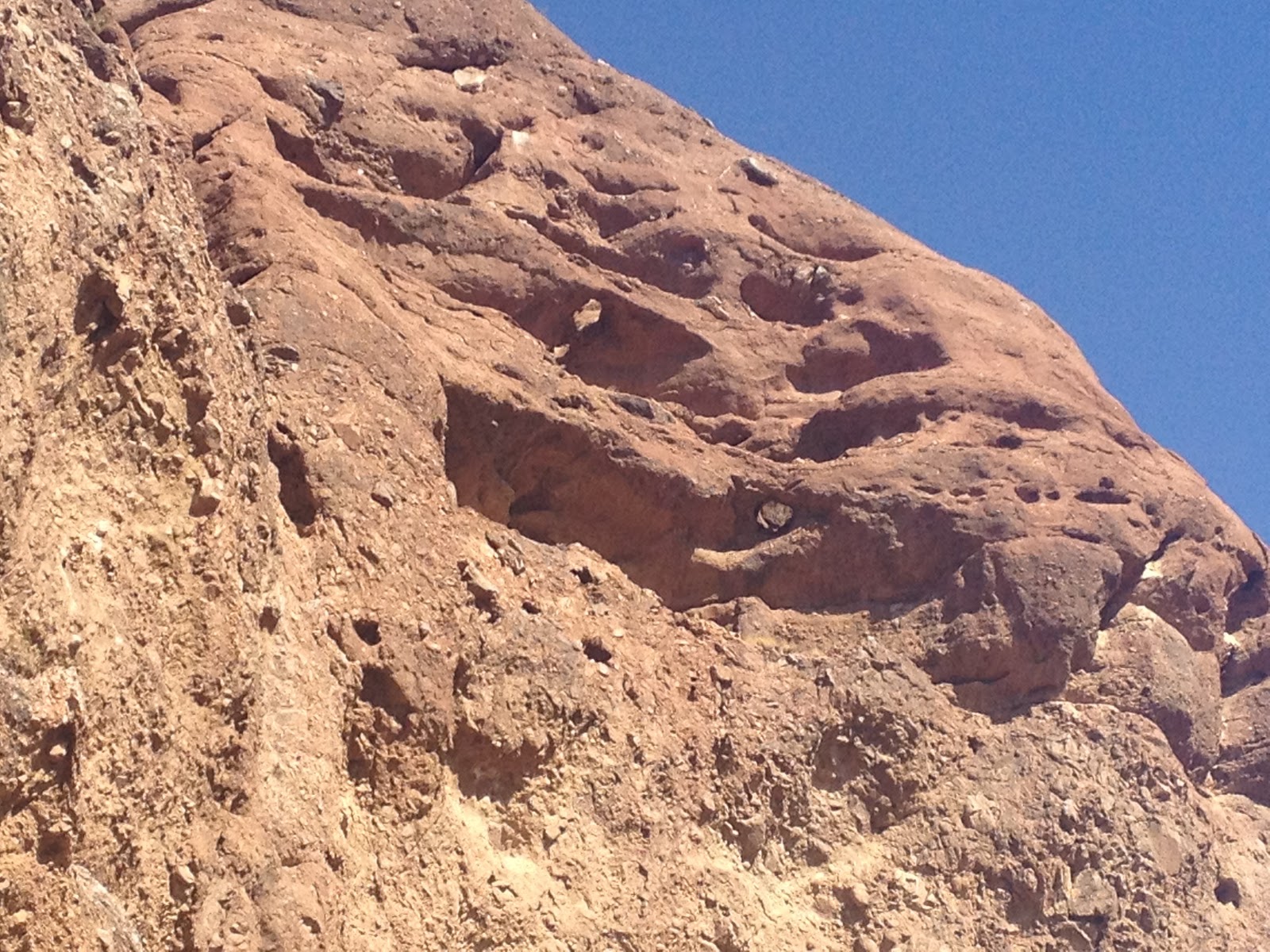
An amazing, tiny rock-hollow
on the Camel's Foot approach
caught my eye. When I saw the
picture, I thought the holes
looked like eye sockets. The
second "face" of the day.


Getting near Camel's Foot...


...and...

there. It's an impressive formation -- eye-candy. And two climbs on the south side, a 5.1, Camel's Foot, and a 5.8, Otherwise. I've never done either one because they're short. Might be an enjoyable way to pass an hour or so.


A sublime profile of Camelback's hump and... spines? Shot this from a down-sloping, gravelly outcrop as I tried to gauge whether it's possible to descend the steep gulch bordering the south-side head. It looks like a death trap. With two ropes, it would still be a double-rap, with the second one needing to be set up on the fly. No thanks. Besides, the bottom is someone's back yard.

That's the "Copenhaver Castle" in the distance there, with the turrets. It was up for auction a few months ago -- I'm not sure if it sold.


Next two shots: South cliff...


...and a wave of rock.


Finally, I quit screwing around and decided to locate some kind of connection from the Camel's Foot area to August Canyon. This is what I tried in 2008, but failed to find anything. The south-facing cliffs appear impassable without a Bosch drill and a bag of bolts, or maybe a rack of pitons and a hammer. That's not my typical style, of course.

I located a short gully, noticed a cairn piled on a rock shelf and the short face to climb, and thought maybe I'd discovered what I'd been looking for. How could I have missed this three years ago? I wondered. Possibly there was more brush then.

No matter. The eight-foot free solo, class four to 5.0 at the top, leads only to a dead end. The cliff that stopped me was gigantic, about two-fifty to the deck, affording a fantastic, bird's-eye view of Yellow Wall. I took a shot or two there, but the lighting wasn't right at all.

A minute after returning to the Bobby's Rock trail, I found myself cranking up to the base of Yellow Wall, wanting to see it from the ground-end. From my perch up high, I was dumbfounded at how steep and dangerous it looked, with that thought in juxtaposition with the memory of climbing it a few years ago with no rope.

During that free solo, I didn't top out on the stitches-like part -- it was simply too high and vertical. My back-off point was a good 50-60 feet. Now, I needed to look at it from the bottom again partly to judge how my next free solo on it might go. And I wanted to stretch my legs and lungs out on the ultra-steep approach.

I even had a mind to free-solo a ways up Yeller and try to recreate that delicious fear I remembered the first time I'd done it without a rope. After that experience I did climb Yellow Wall all the way with Scott, through the second pitch to the top of the Ridge Route plateau. But it's a good one for free-soloing, again, up to a point.

I knew there was an old beehive next to the base of the wall, complete with curtains of hardened beeswax, so I came closer only with caution, chest heaving from exertion. Damn. There they were.

I have seen the beehive sometimes active, and other times as empty as a skyscraper in a recession -- perhaps the critters go on vacation. On Saturday, the hive was thrumming with life. This is a true danger for people who might free-solo Yellow Wall, I believe. Unlike on Hart Route, which has all kinds of rappel anchor possibilities, the single-minded nature of the vertical stitches that make up the first 75 feet or so of the climb aren't that accepting of pro, and there are no bolts until the top. Down-climbing would be the only option. But it's not a bad option because it's easy.

I didn't feel like finding out how ornery the bees were that day and buggered out of there.


Now running short on time, I jogged over to the Headwall and cruised up the Walk Up, which I often consider a 5.0 but is labeled class four in all the books and Marty's guide. I climbed it in my hiking boots, so I guess it really is a class four. Down-climbed in my rock shoes, though.

Before I started the down-climb, I overheard a kid crying at the top of Rappel Gully. The boy's dad and dad's friend had gotten him up there, and he was scared out of his mind. They were trying to lower him on belay, but the boy -- about Annabelle's age -- didn't want to take that first step over the edge. I know that feeling -- heck, everyone knows that feeling. But the poor boy just cried and cried.

He came walking over just before I lowered myself to the ground on the down-climb, meaning he got over it. Good for him.

Then it was to time to go.

Sunday, November 27, 2011

More Thoughts on Camelback Naked Man


The plan today is to explore the cliffs on the south side of the hump, and some other stuff along the way, too. We'll see how much I accomplish. I have plenty of time today, but not as much oomph in my bones as I'd like. Went on a run yesterday and a long bike ride the day before. My right knee has been bothering me in the last few weeks. Of course, it's amazing that the ACL reconstruction from 1993 has lasted so long, with the all the abuse it's had. I can't help but wonder if it's going to blow out someday. I don't think it will be today, though.

I'd like to start with a climb up the Camel's Foot formation, though I've also a hankering to do my regular jaunt up the headwall routes and see if anyone's climbing the Monk or Gargoyle wall. I've also been itching to go back up the 5.1 route up to August Canyon - the green Petzl is in my pack. But I've done all those things, so the goal must be to hit some new sites today, like the south-side cliffs.

If some gas remains in the tank after the scrambling expedition, I might go up the summit, mostly to check out the base of the cliffs on the northeast side. There are a couple of bolted routes on them I'd like to see, in the hopes of climbing them someday. I've never seen anyone rock-climbing at the summit.

Hiked Echo Canyon several times since the Naked Man incident and haven't seen any other naked people. The police report still hasn't been released. A couple of weeks ago I interviewed Nick, the naked man's friend. The naked man's name was Brian. My lengthy Jackalope post on their mental misadventures can be found here. 

Nick had been hiking with Brian in the beginning. Nick says he tried to stop Brian after the older man stripped down, and Brian threatened to bash his head in with a rock. He told Nick, according to Nick, that he wouldn't do it because Nick was his friend. What would have stopped him from doing the same to a stranger? Nothing, in my opinion. I feel bad for Brian, who apparently left a couple of zany comments on the above-linked Jackalope post. But dealing with young, muscle-packed mentally ill people actually is dangerous -- it wasn't just paranoia on my part. As for the other part, the question still going around in my head of whether I should have attempted a prompt rescue like the one that eventually occurred on the summit, I lose no sleep on it. The biggest problem, as I see it, is that I had no certainty that he intended to kill himself. He'd passed up so many big cliffs already. It wasn't till later that he shouted his intention to do himself harm. But even if I'd have heard him yell something suicidal, there was no question I wasn't going to deal with him myself. Gathering a "posse" of sorts would have been the only option. It appears to me that Ewelina managed to do this only over time -- by hanging with Brian, showing to others that she cared about the situation, and nagging others to take action. Even then, the action only occurred at the top of the mountain, with Brian screaming that he was going jump, with no more options available.

And now, back to my irregularly scheduled adventure...