Showing posts with label phoenix. Show all posts

Sunday, September 1, 2013

Sunday, February 24, 2013

Camelback Mountain's Praying Monk Christmas Garbage & Other Camelback Trash


Merry Trashmas

Someone put up another Christmas Tree on the Praying Monk this year. This time it didn't work out so well.

I'm no longer mentioning names, but they wrote about it online:

"Somebody cut the lines it was rigged with, tossed the tree off the Monk, and took the gear that I anchored it with. The tree was broken into little bits, and was very difficult to carry down. "

Coincidentally, I noticed Christmas garbage strewn all over the Praying Monk plateau during two separate scrambling sessions in January. The people who put the tree up in the first place are responsible for the trash, even if "somebody" else cut the tree down.

The tree was gone during my climbahikes, but broken and intact ornaments could be seen scattered around the Monk's base. (I didn't pick them up, having no pockets or a bag to put them in, but I'll get them eventually if no one else does.)

Several gear tags were lying around. Hundreds of tiny, green pine tree needles were littering the chute leading from the plateau to Rappel Gully. They appear to be plastic and not biodegradable -- if so, they'll be up there for quite a while, mixed with the gravel. Annoying.

For years, I've also been bugged by the goofballs who decorate the top of Camelback Mountain with holiday decorations and a Christmas Tree each holiday season. I've noticed holiday litter at the summit in past years, too.

If you feel compelled to spread Christmas cheer to every mountaintop, literally, ask yourself if Jesus would want you to celebrate his birthday by trashing one of the few natural areas in the city.


Climbing Litter

Now, when I see an empty Gatorade bottle or crumpled snot-rag or other trash along Echo Canyon or Cholla trails, it's expected because of the sheer number of people on Camelback Mountain. The mountain is usually quite clean, but it only takes one litterbug out of every 10,000 hikers to make a mess. Very few people, relatively, scamper up the Headwall to the Monk plateau. So when I see garbage up there, it's more disappointing because it means that a much smaller proportion of the climbing population than hiker population is littering. Yet climbers, in my humble opinion, should be much better stewards of the land than average hikers. They visit more pristine, sensitive areas, and they should know those areas are less likely to ever be cleaned up by anyone, being more difficult to access and to move and up and down the slopes and cliffs with trash bags.

Most climbers believe strongly in self-reliance, and this ethic extends to the idea that you pack out all trash, barring some good reason not to. This applies to old webbing and other climbing-specific trash. Yes, climbers may leave webbing tied around boulders or trees after using it as a rappel anchor. That's not littering -- it's survival, and not the same thing as leaving sliced, sun-decayed webbing lying at the base of a popular climb.


More annoyances

Next, an example of Camelback graffiti. Fortunately, this sort of thing doesn't appear on the rocks as frequently as it could. Phoenix doesn't have an excessive graffiti problem in general. If I had to guess, I'd say "SL" stands for S*%^ Licker:


The Ultimate Garbage Sin

Finally, I must bring up the trashy act that makes me more furious than any other: Leaving dog poop on the side of the trail in a tied-up plastic bag. I mentioned this in a previous post but it's worth talking about again because so many people do it. I come across these poop bags on the trail once every two or three times up the mountain, and sometimes see two on the same day, in different types of bags, meaning more than one of these boors had been there. I've never caught anyone doing it, but would certainly say something if I did.

The poop-bag method is even more annoying to me than the idea of dogs pooping freely on the ground. While it's possible that some of the poop-heads who do this plan on picking up the bag on their way down from the mountain, most clearly don't. They leave it there, believing falsely that if they have housekeepers, groundskeepers and janitors at their beck and call, so does Camelback Mountain.

Last time at the mountain, a couple of weeks before the Echo Canyon closure, I talked to a ranger about this strange and obnoxious behavior.

"Hey, thanks so much for the service you guys provide -- picking up all those little bags of dog poop that people leave," I said with a smirk.

She got my drift right away and she snarled, "Oh, there's no service! They think there's a service, but there isn't. I don't pick them up!"

"I know! What is wrong with those people?"

"Actually, I do pick up the bags, sometimes," she confessed. "But only when I'm positive that no one is around, so no one sees me do it. Otherwise, they'll think there really is a service."

Listen up, poop-baggers: Do NOT leave your animal's crap on the trail, even for a minute. If you have a plastic bag, that's wonderful -- take it with you, whether you're hiking down or are still on your way up. There is no valid excuse for doing otherwise.

Saturday, September 15, 2012

Camelback Mountain: Suicide Direct -- Serious, But (Probably) Not Suicidal


A few months after I experienced the ridiculous "hanging rappel" misadventure, I led Suicide Direct (left).

Doing stuff you previously thought was impossible or too scary is one reason I have always loved rock climbing. My lead of this 5.8 Phoenix testpiece remains one of my most treasured times in my 23 years of on-and-off climbing.

The achievement was ironic, considering how badly I'd flailed on the route on toprope. Worse, I'd cracked a heelbone after falling on a boulder problem at Camelback Mountain the very weekend after Mike and I had climbed it. About three weeks later, my foot in a walking cast, I used crutches to hike up the trail to the base of Suicide Direct and photographed another friend, Kent, who had chosen this 5.8 as his first lead. I managed to snap a killer picture of him flying through the air. He'd slipped on relatively easy terrain above the bulging-overhang crux. He took a 20-25 lead fall that day. Very impressive. Then he slithered back up the overhang like it was nothing to finish the route.

Suicide Direct was first climbed in the late 40s or early 50s -- or maybe the 60s. I don't have firsthand info on the history of the route, but one looks at the bolts in it during my late-80s climb revealed that it was a classic. Greg Opland's Phoenix Rock II suggests it was climbed within five years of 1947 by the Kachinas, that hardcore group of Boy Scouts who pioneered many Valley routes not too long after WWII ended. Rock Climbing Arizona by Stewart M. Green, on the other hand, says the route's first ascent was completed in the 1960s by Lance and Dane Daugherty. Waugh's original Phoenix Rock says the Daugherty boys climbed it in '49. I'd go with that. Either way, as a 2008 report on the route on rockclimbing.com states, "Those old boys sure could climb hard in tennis shoes!" (Although if it was in the 1960s, it was possible they were wearing EBs.) (CORRECTION: The info from Waugh and Green's books is not correct. The Daughertys did not climb it in '49. They were too young then. According to Opland, "Suicide Direct FA was Ralph Patement and Bob Owens in 1949. 
Suicide Direct FFA was Lance and Dane Daugherty, date unknown.")


Waugh's scripture states that Suicide, the fun, three-pitch, 5.5 route left of Direct, suffered some infamous falls some years ago. I don't know the details on those. But I did find one old news story about a death on Suicide Direct in January of 1987. Andre Dauvergne fell after climbing the route with a partner, fellow ASU student Doug Loveday. According to the newspaper article I found, which quoted a volunteer rescuer, the climbers "had no climbing equipment and were wearing only tennis shoes ... to attempt an assault that is considered difficult even for experienced mountaineers." As Waugh's book says, climbers must "surmount the difficult overhang."

The overhang is not terribly difficult if you're a solid 5.10 leader, but even then it'll likely cause you to reflect on life and other important things. The spooky reputation of Camelback rock calls for that sort of perspective. If you're in over your head by leading a runout, exposed 5.8, the route's name doesn't seem far-fetched.


My obsessive hiking at Camelback frequently takes me past Suicide and Suicide Direct; I've never seen anyone climbing the latter, (because it's no ladder, hee-hee). Twice, I've seen people on Suicide. Once it was a pair of competent-looking climbers. The other time, which was a few years ago, it was a pair of yahoos using a 50-foot static line as a lead rope. I have no idea if they made it past the first pitch, which they had split into two pitches.
(Suicide Direct from Echo Canyon pkng lot.)


I know S.D. must get a few ascents a year, but it sure isn't a commonly climbed route. Which is all the better, if you want to do something special. It's for experts and foolhardy souls only, obvi-frickin-ously. Extremely satisfying when you nail it, for sure, and it puts you in an interesting spot on the western side of August Canyon. I don't know if the bees are still there. It's been quite a while since I've climbed it. Only did one other time after my lead. That was with Kent, who wanted me to belay him on a clean lead of the route about a year after his fall there. Although he finished the lead the day he fell, and flashed it when I belayed him his second time, that fall bugged him for years. Sometime around 99 or 00, he decided to put all his Suicide Direct fears behind him and complete a solo ascent of the route. At night. He's improved his climbing skills considerably since then. Last month, he free-soloed the Matterhorn.

I digress.

While I don't recall hearing about the '87 incident, I do remember one high-profile rescue at Suicide Direct from 10 years later. This was the case of a teenage resident of a now-closed juvenile boot camp on a group outing to Camelback. He snuck away from his group and freed the climb up to the bolted overhang. At the rest-stop just below the overhang, he realized he could neither go nor back down without killing himself. So he took off his T-shirt, pulled it through a bolt hangar, and tied a knot in it for a handy hold. Then he waited for the expensive technical rescue. I still think that was a fairly smart move on his part, to use the shirt like that. Going up the 5.8 without experience or rock shoes wasn't too swift. But I do appreciate the boldness. He probably didn't know the name of the route or its Yosemite Decimal System rating, but he knew it was a great line up a sweet cliff.

Suicide Direct isn't highlighted on the ClimbPhx Web site's Camel-page, so I assume the author hasn't climbed it. I thought I saw an in-depth route report, but it got lost in cyberspace and I've been unable to locate the site again. The above-mentioned rockclimbing.com report refers to the "stiff overhang," while a commenter notes the long runout. Those are actually just two of the challenges.

The first challenge climbers must confront is the 90-foot, "class-four" first pitch. Perhaps because this route gets so few ascents, or maybe it's just a geological quirk, this pitch does contain a fair amount of Camelback choss. It's easy to become lost in this asteroid field, so depending on how you do it, the first pitch might be an honest 5.0-5.2. And you'll be wearing a pack with your gear. So be wary of that class-four designation. When I climbed this with Kent, a rattlesnake was coiled in the shade at the top of the first pitch. I scrambled past it before seeing it, realizing it could have bitten me in the face. Kent used it as a handhold for a brief second, until his brain understood the skin on his fingertips had touched something alive. He pulled his hand back. "What was that?" "A rattlesnake," I answered. The snake shook its head and went back to sleep. The sun hadn't yet hit the crag, and it must enjoy sleeping in almost as much as I do.

(Photo of Suicide, 5.5, ripped from www.rockclimbing.com.)

You'll forget the excitement of the first pitch once you begin the second. Although it starts off fairly easy, you're instantly launched into the stratosphere. Lots of exposure, real soon -- thanks to that steep first pitch. I was sure happy when I reached that first bolt, but I had to leave it behind all too quickly. I recall only two bolts between the ground and the bolted overhang; another one may have been installed in recent years.

I'm cranking the overhang in the picture. I'd been doing a decent amount of climbing back then, so I found it rather fun, though strenuous. Funny, but on lead I remember that the handhold on the top-side of the overhang, which had some stiff grass growing in it, felt incredibly positive. When I later seconded it with Kent, it felt more angled and tricky. Could have just been conditioning. But both times, it required strength and nailing the footholds to get on top of it. After that, it's a tricky cat-walk left and up. I was well aware of Kent's fall when I led it and was extra cautious. Tired and a bit freaked out, the climax of my lead was yet to come.

The last move of Suicide Direct, unless it's been retro-bolted, is a sketchy pull in a gravelly slot with almost nothing for footholds. Scared the bejesus out of me. I placed a .5 Camelot in a flaring pocket a couple of feet under the move, knowing it wouldn't hold if I slipped. It would be as if the rock spit that cam out as I screamed past it, taking a lead fall of -- I don't know -- forty feet? Maybe more? Bouncing all the way. Of course, I didn't have a helmet, as the picture shows. So this climb might have been the death of me. Instead of flying off, though, I gritted my teeth, clenched everything else, and made that last pull, where I found -- and grabbed -- the chains attached to two or three bolts. This was one of the many experiences that make visiting Camelback an almost religious experience for me.

So, if you go, (and I hope you do, 'cause I'd love to see someone leading it...):

* Take two ropes, or;

* Brave the maze of August Canyon and find Pedrick's Chimney on its east side;

*Watch your step on that first pitch;

* Keep your head after the overhang.

* Watch out for poisonous reptiles and take a spare battery if you do it at night!

(Suicide Direct route at Camelback Mountain. Yellow dots indicate path, not bolts. There aren't many bolts.)

UPDATE: Just wanted to bring attention to and repeat some of the historical context here. As I mentioned in another blog post, Bob Owens of the Kachinas contacted me to report his climb of "Suicide Cliff" in 1947. Then there's the comment below about Lance and Dane Daugherty, legends of Phoenix climbing:

Climbing brothers said...
Just to clarify some information.
Lance and Dane Daugherty were my older 1/2 brothers. We moved out to Phoenix Az in the Fall of 1963. They began climbing in 1965.
Lance was born in 1947 and Dane in 1949.
Lance was killed in 1968 on his motorcycle coming back from a climb in Carefree. Dane quit climbing altogether in 1969.
Ironically, Dane was also killed on a motorcycle in 1978.
If the first climb of Suicide was in 1949 it could not have been my brothers.
Hope this clears up some confusion.
Sincerely,
Von Wagner

Saturday, December 24, 2011

Holiday Greetings From the Summit of Camelback

Our Christmas Eve hike. What a beautiful day. Perfect weather. Another summit for the kid.

Saturday, March 26, 2011

Parking Problems


Camelback's in the news again, but this time not just for disaster, (though a 63-year-old hiker did die there last week.) The Arizona Republic says today that the parking situation is getting much worse.

Last July it became apparent that the mountain was getting more crowded in the summer. Things have changed since the shot I took of the parking lot in August three years ago -- now it's rare to see it this empty unless it's over 110.

I chatted with some rangers a couple of weeks ago who were directing traffic around the parking lot and back out -- no one is allowed to wait for a parking spot, they say. That began a month or two ago, although I waited in a typical line about three weeks ago; the rangers said that's cause they're not there all of the time. This time, they had signs out and didn't let anyone stop while all the spots were full. I asked if they had a limit on how many times you could go back in to check, and they said there wasn't any, but they made it more difficult by putting vehicles back onto McDonald before you could go back up Echo Canyon Drive.

I had biked up, an option the rangers appreciated. Parked the truck near the shopping center at 44th and Camelback Road.

The Arizona Republic article suggests that people could hike elsewhere. One commenter on the article states that people could simply walk around their neighborhoods, to which a smart-ass replied that he's too frightened to walk around his neighborhood because he doesn't own a gun.

Fact is, Camelback is unique. There is nothing like it. Piestewa comes close, and the parking lot is huge. But the trail is narrow and it doesn't have anywhere near the beauty of Camelback. It's like Wickenberg compared to Sedona. The trail on Camelback, often made up nothing but boulders, is way better than Piestewa. Beyond Piestewa and Camelback, no other standard mountain trail in the Phoenix area is as steep and long. Siphon Draw comes close, so does the hike to Tom's Thumb in the McD's, and Brown's Trail on Four Peaks. But who's got time for that?

Anyways, I hiked Camelback today. Tons of people. An absolute zoo.

I took three months off of running and hiking, from December to February, but have begun to get back on the mountain. Plantar fasiciitis. I think it's getting better.

I've been enjoying the spring on Camelback and have seen a few chuckwallas, including a baby. The chucks are clearly thriving despite the hordes of hikers. I shot this picture of a good-sized chuckwalla last week.

Monday, July 5, 2010

Heat Hike


At noon on July 5, you can always get a good parking spot at Camelback Mountain. It was 98, according to my iPhone.

Ninety-eight isn't so hot for a summer hiker around here. It was like a warm, spring day, (I'm talking about a normal spring, which it wasn't this year). I've certainly hiked Camelback in far worse conditions, in terms of temp, humidity and lack of wind.

Yet the sun was strong -- the temp later topped out at 105. To be sure, it was a hot hike. The incredible June we've just had lulled me into the delusion that the summer might not include a hellacious heat wave. I knew all along it would, of course, and when the normal weather finally arrived I figured there was no use fighting it. I needed a mid-day hike to set the tone for the next few weeks.

A few short years ago, almost no one would be on the mountain at this time, but the recession is keeping a lot of people in town. More Phoenix residents than ever in the last couple of years have discovered that Camelback -- and Piestewa, South Mountain and other mountain parks -- are wonderful diversions if you can't afford San Diego, Flagstaff or elsewhere. That's meant more people in nice weather and "bad."

I sweated my butt off and was grateful for the breeze that whipped up every few minutes. My pace is always slower in the heat -- so is everyone else's. Today, maybe half the folks seemed to be suffering. I didn't do too badly, but I took two water breaks.

For some reason, I often get passed at least once when it's warm, though usually not at all during un-hot days. Why is this?

Well, as I've mentioned before, it seems like the heat brings out the more hardcore people. These are folks who, like me, enjoy the challenge of the intense Phoenix heat. Perhaps it's the higher ratio of hardcore hikers that explains why I get passed more often. Or maybe it's that I almost never stop on the way to the summit, but on hot days I'm willing to take a break or two and not push myself. (That makes sense to me, because when the air temperature is higher than your body temperature and you're working out in direct sunlight, ignoring what your body tells you can be dangerous. Heat exhaustion can come on suddenly. When I know the weather will be extreme, I take at least one water bottle packed with ice-water, with lots of ice -- enough to have a couple of pieces of ice still floating in the water when I reach the summit. I also wear a hat. Noticed a few people today without one. I don't know how they do it).

The final possibility is that I hike more during the cooler seasons and, therefore, I'm in better shape.

Whatever it is, it's just one of those things I think about as I'm hiking. I don't mean to imply I feel I'm in a race, though I'll admit to a sense of competition among other hikers. If passed, I don't put on speed and try to retake the lead. I suppose on occasion I've increased speed, slightly, when it's clear the person who passed me is a poseur who isn't able to hold the pace. Then, when the poseur stops because he's overestimated his abilities and gets pooped, I'll have a solid pass. The mental competition helps me move up the slope and measure my climbing shape against others. (There is a prize for great performances, though -- I get to hike even tougher mountains!) Most of the time, if you started after me and you pass me, you win. I never attempt to race anyone. That would be lame. And since my cruising speed is a fairly high RPM for me, I'm unlikely to redline for very long.

Going down, I never worry about these things and can be passed by some of the folks I passed on the way up. I've gotten hurt falling while running down Camelback as if I was on a ski run, and I've also seen a guy break his arm doing it. I'll come back to those stories some other time.

Back to the hike:


At the summit, I took refuge under a palo verde I've used before for just such heat breaks and sipped the icy Gatorade I had brought. A bee began buzzing around my sweat-soaked shirt, so I poured a bit of ice and water on the ground to divert its attention. A minute later, a cute little fence lizard appeared out of nowhere and acted like it had been given a gift from heaven. I lingered in the semi-shade of the palo for a bit, watching it lick the ice and sit among the cubes like he was in a Palm Springs spa.

Sunday, June 20, 2010

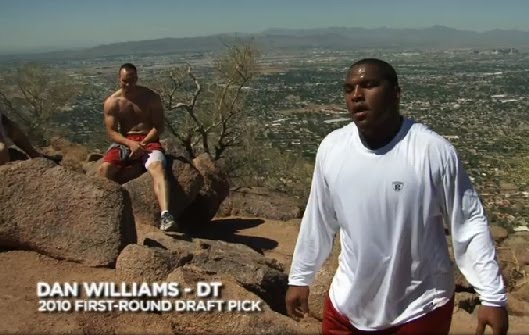
Arizona Cardinals Rookies Hike Camelback to Get Acclimated

Sports bloggers were passing a link around yesterday about Arizona Cardinals rookies hiking Camelback. It's been warm lately so it's not surprising to see some of these out-of-state guys appear sort of weak as they arrived at the summit. Judging by the pace of the group shown in the video, they probably got passed by quite a few regulars. If these burly rookies keep hitting the trail, though, it won't be long before they'll be bounding up and down like ibexes.


Here's the link to the video on www.azcardinals.com, (which is where I ripped this still shot).

Wednesday, May 26, 2010

Hart Route Freesolo Pt. 2 -- The Ascent


This was to be a grand day of adventure. The weather was outstanding -- high 60s rising to low 70s. (This was in mid-April, if you'll recall from Pt. 1). I had all morning and then some -- more than enough time. And I had a new rope and harness, something I'd been planning on buying for the last few years. In the back of my head, thoughts lurked of turning back. No matter what, I promised myself, I would climb with caution and reversibly -- I would back down all the way or rappel down if need be. At no time did I want to find myself on super-sketchy terrain. Yet I was also 100 percent committed to the attempt.


I took my small backpack, cleared out of all work stuff and loaded with icewater, an apple and a banana, the A630, some slings and a couple of small cams. At the base of Hart Route, I attached the climbing gear to my new BD harness and tied into the new rope. The rope would be in a coil at the base as I climbed, which is much easier than hauling the whole thing up at once. Doing that presents a small risk of a rope-stuck situation, but the first pitch is fairly vertical and has no rope-eating cracks.

The beginning went well, and soon I was at that nasty little crux before the ledge. As before, on the recon trip, I didn't like the looks of that last couple of meters, which require sort of pulling into vegetation, feet in a stemming-type position that heightens the exposure and potential for falling all the way to the deck. The right was more of a series of face moves. I decided the rock quality was decent enough to attempt it. A minute later I was finished with the first pitch, feeling like I'd discovered the easy topout I'd hoped would be there the week before. My beautiful, new, green 9.8 mil rope (Petzl Nomad) pulled up easily behind me. As I made my butterfly coil, my lack of companionship seemed acute -- nobody was at the other end of the rope.


Despite the bitchin' weather, Echo Canyon wasn't as crowded as I would have expected. It seemed quieter than usual -- or maybe my mind was just making it seem like that way. No other climbers were out on Gargoyle Wall, which Hart Route is part of, and no one was on the Monk. I had everything above the Headwall to myself. Which was just fine, for this trip, anyway.

The first pitch felt like solid 5.2 to me, especially compared to the 5.0 that I usually freesolo to get the top of the Headwall. That's the route just north of the class 4 section which is also freesoloable. The 5.0 is the one with the palo verde about 3/4 of the way up. It has a slightly sketchy top-out, but there are plenty of footholds, unlike the top of p1 of Hart Route. That makes a huge difference when you're unroped.

After topping out on p1 during the recon, a glance at the beginning of p2 caused more doubts to enter my mind. Those doubts were still with me as I prepared to go higher on the freesolo. If you zoom into the picture from Pt. 1, you'll see the bloke I pictured leading the start of p2. The section just under him is tougher than it looks, and I found the spot where's he's at in the picture a bit exciting, too. Plenty of handholds but it keep you off balance in places. Halfway up is a traverse to a left-facing fracture -- all good. Some rests requires an awkward foot stuck in the crack, but the rests were mainly to get my bearings and prepare the next few feet of slow, static freesoloing -- not the desperate rests needed during an intense lead. Still, adrenaline leaked into my veins as if from an IV drip.

From the top of pitch 2, you need to go up and right to access the start of p3. As I began to do this, I heard what I hoped I wouldn't hear: Buzzing. The hive was nearby, for sure. I tried to walk on the sloping ledge as quietly as possible, holding the heavy, coiled rope in one hand. Then I could see the hive -- it was about 40 feet away, up and left, in the same spot where it had been some years ago, when I climbed Hart Route with Scott. The hive thrummed with activity; in fact, the bees seemed a bit agitated and not just simply flying back and forth on pollen runs. Every few seconds, a small, black streak would zip by me, coming or going to the hive.

The bees hadn't noticed me -- yet. My apprehension was higher than it had been since I started the climb 45 minutes earlier. The rope was coiled neatly -- but could I set up an emergency rappel if the bees began stinging me? One reason Abbe and his partner, Jeff Passage, couldn't get the rappel going was that the rope was somewhat tangled. But if I was under attack, would my rope be tangled, too, thanks to Murphy's Law? Sure it would. I became convinced that if a swarm attack began, it would be a miracle if I could get the rope anchored and thrown down without tangles as stingers were plunging into my eyes and face. As on George Route, my guts fluttered as I imagined a full-on killer-bee attack, how I'd be stuck on the crag and praying for death to come sooner rather than later.

My fear level shifted into high gear. Fear is a requirement on a climb like this -- but managed fear, a useful tool to keep my senses as sharp as possible. Now I was re-thinking the whole endeavor. I stepped back to the false safety of the p2 ledge, where I couldn't see the bees. I started visualizing the two rappels it would take to descend the pitches I had just climbed, planning to bail. Dammit, I thought, who's the dominant species here!

I was on a mission. After a few minutes of pondering, I decided that I would risk the bees to complete what I had started. I was very much looking forward to the p3 face and successful summit. As quiet as a gecko, I tip-toed up and right, keeping my eye on the hive and trying to gauge the bees' mood. They didn't seem to notice. Without hesitation, I began pulling up the start of p3, which is a face but has plenty of fractures and cracks to hold on to.

Having led and seconded Hart Route a few times, I remembered the 3rd pitch quite well -- it's all sweet and fun, compared to most face routes. It's a relatively low-angle friction pitch, with lots of Camelback pinchers and finger holds and very little dicey rock (as long as you're on-route). The first 25 feet went very quickly; my tinge of panic made it feel like my climbing shoes had rocket thrusters attached. But as I got higher, I grew less concerned that I might piss off the bees. If they respond only to threats, they would have known when I was halfway up the pitch that I had no way of messing with them, even if I wanted to. After a while I forgot about them and concentrated on the somewhat nutty task at hand.

The first half of p3 is really easy, definitely 5.0 or less. I thought the whole thing might be a 5.0. But to my chagrin, the very last couple of moves of Hart Route are the crux of the whole climb. The third pitch is rated 5.2, but I didn't know that at the time. I thought the first pitch had the 5.2 and the last pitch was 5.0. That's what I get for not properly researching the beta.


(Above, P3 with crux marked. Below, the Monk.)

One last bolt before the crux tempted me enough to throw a sling on it. I thought maybe I could hold onto the sling if I fell as I made the last couple of moves. But my sling was much too short. I could not hold on to it and make the moves to gain more height. Plus, I knew that falling on static webbing -- compared to a dynamic climbing rope -- could easily generate enough force to rip the bolt out. Embarrassed with myself for wasting time, I took the sling off and steeled myself to do the last moves. They're easy, but it's Camelback face -- the poor rock quality adds significantly more risk.

I reached as high as I could and found something to pinch. I caressed the rock as I settled into the strongest handhold I could muster, looking for positive edges and the right directional pull. Once I found them, all I needed to do with get my feet up. This was a long way up and p3 had turned spooky, getting steeper and harder. I brought a left foot up higher and tried to move my right foot. Suddenly, my right leg decided to stop working that well. I tried to place my right foot in an adequate, though marginal hold - and felt a spasm in my thigh. Whoa, I thought, realizing that a fall here would probably mean death. Get it together. Calm down. Fear can make your worst nightmare come true -- or it can be channeled into action. I chose the latter.

I calmed my mind but could not completely convince my right leg that everyone was going to be fine. Still, everything worked nicely and a minute later I was done. Success!

I was ecstatic I had decided to ignore the bees. I had just done something I'd thought about doing since I was 23. Now, 20 years later, I have the experience and confidence to pull it off, so I did. It feels good.


I lingered a very long time in August Canyon, checking out its mysteries. I'd like to spend much more time there and maybe even spend the night. Then I rapped down Pedrick's and -- with much relief -- took off my climbing shoes and put my hiking shoes back on. My legs and feet felt strained from the few tense stances on the way up. Yet I still had plenty of energy, so I decided to summit Camelback. Hauling the backpack (with the rope inside) was more weight than I usually carry up the Echo Canyon trail; after that, I was finally tired.

So what's next for freesoloing at C-back, if anything? Well, there's always the Monk, if I want to scare the bejesus out of myself. It's got at least one kind of blank section for the feet that requires a friction smear -- the problem is, friction smears and freesololing don't go along - not in my book, anyway. One slip could mean curtains. But I would consider pushing up the first half of the Monk without a belay, then backing down at the smear foothold. Then there's... let's see -- how about Hanging Gardens in the McDowells? Probably not -- that's a solid 5.5 and has some very sketchy granite face moves that would be be terrifying. The good thing about doing Hart Route is that I now don't feel compelled to freesolo anything for the time being!

All in all, this was a day to remember. I would consider freesoloing Hart Route again before leading it. It's too easy on rope!


Saturday, September 20, 2008

George Route -- Half of It, Anyway

Karabin's guide calls this an adventure route -- he's right about that. In Phoenix Rock, the route shows as linking up with the v-notch above the rescued dudes perch, the west-facing notch from which I emerged on the last August Canyon trip. I only got halfway. It's easier than the Neck route -- goes up straightforward terrain to the little green bush near the bottom of this picture, just left of center, then heads right in sort of a ramp-shelf system. I explored that frozen wave-looking thing, bit of a drop on the other side. Kept pushing right till the climbing got way intense for having no protection. Actually, I stopped right before it looked like it was going to get way intense -- around a corner on easy, but thin ground. If it was five feet up, anyone would try it. It's 300-400 feet off the deck right there. One slip and it's the express route the whole way down, barely a bounce before the big plunge. Extreme exposure. There are enough bolts on this route to minimize that danger -- I figured I'd come back sometime with a rope and maybe a partner and try it. But first I wanted to go as far as I could, so I pushed onward, already starting to feel the beginnings of that exposure. That's when the sentinel buzzed up to me, the lone sentry ordered to spy on this ridiculous wingless mammal clinging to the rock -- and to deter said mammal from going any further. The bee darted all around me, but not like the horse flies that zoom at 300 mph in figure 8s around my head sometimes at Camelback -- the bee flew purposely slow, as if to better use its eyes. Its buzz was like a red alert in my head -- I'd seen this behavior before. Bees are really smart and don't want to mess with people, any more than they want people messing with them. When a hive is nearby and menace lurks, advance guard bees will steer people away from them. And that's just what I felt this bee was doing. Which meant, of course there was a hive nearby. Except I doubted all the non-scientific gobbledegook I just spoke of -- I'm no bee scientist, and I don't really know how bees act. How could I know whether there was a hive or not? So I decided to keep heading around the ever-steeper mound of the corner of red rock, trying to peer at the terrain beyond, seeing what I might be up against if I made it around the corner without slipping, deciding there were a few very hairball parts on the other side of the corner, then heard and saw more bees. I stopped, focusing on the air just over the bulge of rock. Yes, there were bees, but were they just working a flower patch on the cliffside for some nectar? No. The little bee bodies I saw zipping to and fro just ahead were clearly converging on a central point around the corner on the northwest-facing cliff. It was a hive, all right. I aborted the whole plan right there. It seemed foolhardy, to say the least, to risk disturbing that hive while on sketchy, steep Camelback rock above a 300-foot-plus death fall.

The next two shots were from the bottom -- the exit of George route is marked "top" on each. In the first picture, note the horizontal crack-line at the left -- that's where the beehive is. The corner I'm talking about, and my stopping point, is the ground immediately left of the long horizontal crack. If it weren't for the beehive, it's possible to suck it up and traverse the corner, drop down onto a large ledge where those bushes and palos are growing just right of the crack, then scramble upward to the top. Definitely more trippy than pumpy. A fun adventure, which is exactly what I'm looking for.


Sunday, August 3, 2008

Camel's Head

This looks like the skull of some long-dead, big-eyed bird or crocodile, doesn't it? It was one of the pleasures from my day on the Camel's head, besides the joy of just being out for an afternoon on the mountain. With a few hours to kill today, I opted to try to find the spot where those yahoos got stuck. Now, I know as well as anyone how tricky the head bluffs can be to traverse. But I figure I ought to be able to climb to anywhere they did and return to my car safely, and without too much problem. As mentioned, the exact location of the dugout they'd found was hard to pinpoint from the media coverage. I never found it, but I did see a few possible candidates. I decided my true goal would be to thoroughly explore the westernmost high bluff on the head, with the hopes of finding a back door to the Ridge Route/Yellow Wall plateau. A wonderfully long rappel point can be found there, but as far as I know the minimum climbing rating to the plateau is at least 5.1 (the top part of Yellow Wall) and not safe to free solo. I suspect there's a safer class 3 or 4 scramble that gets you there, but I didn't see it today. What I did see was the western bluff and the area around the Camel's Foot. Though I began at about 1 p.m., the climate was kinder today, only about 100 degrees, with the occasional blessed cloud and a friendly breeze.
Took Bobby's Rock trail to north side of bluff, scrambled up class 4 terrain to the trail system on top of the bluff. I'd been there before and knew to look for these markers:


At the top I also found this "gem" mounted on a rock:


Isn't that sweet?


Here's the full context for the arch. A spectacular Camelback formation not easily visible to the masses.

A few years ago, my friend and I were on the Ridge Route plateau looking at the arch from the other side. It dawned on us that a dog was standing in it -- we decided it must have been a coyote. No sane pet would ever try the climbing route up to the eye. I'm still not sure if 4th class will get you there (and to the set of bluffs directly east) or if I'll need to break out the ropes. I need to pick up a copy of Marty Karabin's guide. A guy I met last year at the Pyramid boulder told me he'd climbed about 100 routes at Camelback. Not all of those are documented, undoubtedly, but if I run into him again I'll ask him about the route possibilities near the Foot. I saw a few slabby gullies that might lead to the top of this formation and beyond. As it was on Sunday, I decided I'd have to rappel about 90 feet to the base of a cliff, then scramble up what looks like a loose system of trails on the south face, behind some houses. I might have done it except for my landing spot was too close to the undefined back yard area of a multi-million-dollar home. The space could be private property -- gotta be respectful of that. But when I tried to find another break to the east, I met only sheer cliffs, a very steep and loose and gully, and slanted gravel zones directly above more sheer cliffs. I had a very enjoyable break in the shadow of an overhanging boulder, chomping on Ritz crackers and drinking chilled Tang. Spent about two hours scoping out the bluff but saw no signs of the rescue.

Saturday, August 2, 2008

Summer isn't usually rescue season

This is a scene from an impressive rescue effort on Camelback July 30, ripped from Channel 3's Web site. You can read all it about on their site at azfamily.com. Two young dudes, Sean Sullivan and Anthony Edwards, thought they could handle a romp across the headwall. They were wrong. They ended up stuck in a small canyon somewhere -- it's always hard to tell from the news coverage exactly where these things occur. TV news people never have a clue when it comes to mountain rescue stories, most of them having come from stations in other states. One of them said he was vomiting and thought he'd gotten heat stroke. In the raw footage interview of Edwards never makes it quite clear what their flight plan, if any, was. A helicopter plucked one guy out before dark and the other guy sometime that night, or maybe the next morning. That's one thing I love about Camelback -- with the right set of circumstances, people have true life-threatening mountain adventures, right here in the heart of a big city. If you're not careful, you can even lose your life. I don't think it's too dramatic to say every outing to Camelback contains potential risk. What a wonderful thing, too. Camelback is a special place that challenges all parts of your being, physical and otherwise, no matter who you are. The fittest folks can find mind-blowing adventure here as well as the most unprepared, out-of-shape folks who stop after the first staircase and just gaze at the geology.

Thursday, July 31, 2008

Slouching toward the summit at 111 degrees


Started at 6:40 or so and was surprised to see so many people in Echo Canyon considering how warm it was. Perhaps the breeze had brought them - it was fairly nice, at first. Extreme heat brings out the hard-folk, and today was no exception, though there were a lot of them. Parking lot was nearly full. The heat was intense. I burned through the trail with my Ipod on shuffle. Suppose I looked weird with my bandanna tied around my head -- nobody seems to do that. But I like it because it keeps the sweat out of my eyes. Few people wear hiking boots as sturdy as mine, either. I had my Danner Mountain Lites on, my typical Camelback shoe. Slowed down a whole lot about 3/4 of the way up, going into my plodding, low-energy climb mode. Had to stop and take a water break; I only do that on the hottest days, and this was one of them. Took a few pictures with the A630. Gorgeous red sunset.


On the way down this dude tells me to watch out for a rattlesnake he saw "just around the bend." I asked him to clarify that and he sounded like he didn't know what he was talking about. Told him I thought I'd like to see a snake tonight. "Well, watch out," he said with rising drama in his voice. "They KILL!" I couldn't help but laugh and I wanted to say something and what came out was, "They only kill you if you mess with them." Not sure if he was just screwing around or what, but I didn't hear or see anything. I was kind of disappointed, since I had my camera on me. I've seen a handful of snakes at Camelback, and I know to watch out for them. Pretty much as long as you don't surprise them you'll be okay. It's a good idea to avoid stepping right in front of small, overhanging rocks where snakes could be hiding, not that I always follow that rule. Most of the snakes I've seen anywhere in the Sonoran desert give you a good warning rattle when you get within 10 feet or so, just like they're supposed to. But they don't always follow that rule. It's just prudent to always keep your eyes wide open, especially when hiking in the dusk, like I was tonight on the way down. Saw no wildlife at all except for these big horseflies buzzing around like angry bees. Though it was truly hot, though not scorching because the sun was at such a low angle, I started feeling like I always do when I hike Camelback: Awesome. I haven't climbed it in a couple of months and despite some joint issues, in particular a troublesome wobbly right knee (the site of my nasty ACL replacement surgery in '93), things went well. Felt a little guilty about the time factor - everything I do these days seems to mean a sacrifice of something else I should be doing. But it was worth it, as usual.