Showing posts with label heat. Show all posts

Thursday, September 17, 2015

My Camelback Mountain Coverage Wins Award


It seems my love for the pink rockpile is being shared by more people than ever. And sadly, the mountain has been in the news because people have died there. It's what I call the dark side of the place.

For my January 2014 article about the beauty and danger of Camelback, I wrote:

 If you're not careful, Camelback will hurt -- or kill -- you.
Which is one of its most interesting aspects. It has been preserved as a place where you can test your limits. The summit trails are tough, no matter what your fitness level, especially in extreme summer heat. Climbers can seek higher cliffs, while the plain adventurous can scout "secret" trails to sublime, maze-like hideaways of rock.
The dark side of all this risky fun is that deaths occur at Camelback. The city couldn't provide an official tally of how many, but news reports register six between 2008 and 2012: three from falling, two from heart attacks, and a suspected suicide. No deaths were recorded in 2013, but rescues are common.

Six fatalities between '08 and '12. Yet since that article was published a year and a half ago, five people met their ends on Camelback in four separate accidents. I don't want this website to focus too exclusively on the rescues and/or death at Camelback, so I'd like to wrap all that coverage up here in one story.

In June, Seattle resident Eric Fernandes disappeared for three days on Camelback. The search-and-rescue operation turned out to be less robust than many hoped for. I was astonished at news coverage of how the rescue had been called off on the first day due to heat. I knew that plenty of people would be hiking that day. The heat would keep the crowds off, but the regulars would be going up and down during the park's open hours, as usual. So why weren't the rescuers combing the mountainside, looking for Eric?

I decided to explore this issue thoroughly when I got back, and the result was the following cover story:


Eric's body was found by a hiker three days after he disappeared. For some reason, he'd ended up far below the Echo Canyon Trail in a spot I hadn't explored before. Using the GPS coordinates from a police report, I found the exact spot where he'd been found. A stuffed animal was placed there -- I thought it had been from a family member, but I later learned none of the family had climbed down there. It must have been brought by one of the firefighters who participated in the body recovery and brief investigation to find out what might have happened. He'd been seen near the top by a witness who thought he looked tired. But no one knows for sure why he veered off the trail and climbed into sort of a box canyon, with steep terrain to one side and cliffs on the other.

I reported in a follow-up story that the coroner's report showed Eric had died of heat-related illness.

I talked to Eric's father. This kind of tragedy is unthinkable for a parent. I hope fewer people go through this kind of thing in part because of the info in this blog.

Gary Johnstone, a technical-rescue team member and fifteen-year veteran of the Phoenix Fire Department, died along with fifteen-year-old Trevor Crouse after they fell while rappelling on the Sugar Cube, a forty- or fifty-foot high formation just off the Echo Canyon Trail, not too far up from trailhead. I often see people practicing out there. In December, I published a story based on the police report. It contained a number of details I found worth including. I was interested in the sling Gary had used to tie to the big eyebolt in the rock at the top of the Sugar Cube, and how it went missing.
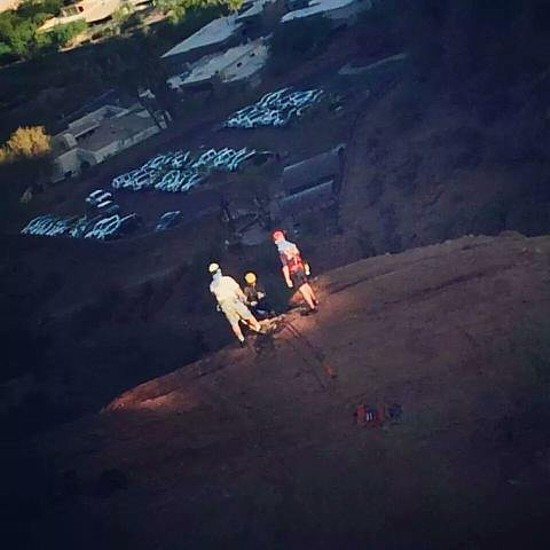
Picture of the ill-fated rappelling session just before the accident. According to the police report, a hiker snapped this just because he found the rappellers interesting, then later turned in the picture as evidence. I obtained it and the police report on the incident through a public records request to the Phoenix Police Department.

According to the officer who wrote the report:

"Evidence shows that a component of the failed anchor system was a piece of orange webbing strap," ... "It is unknown whether the failure was in the strap itself, or in a knot tied in the strap. The orange strap has not been located as of the writing of this report, in spite of exhaustive efforts..."

As I speculated in a follow-up:

So what happened? One possibility is that, despite his extensive experience, Johnstone didn't tie the orange webbing correctly to the eye bolt, or to himself. His son told Branch that Johnstone tugged on the orange sling after fastening it to the steel anchor, so perhaps the bad knot -- if that's what it was -- was where the sling attached to his harness.

Dougald MacDonald, executive editor for the American Alpine Club, agreed with that assessment but had some detail to add. We talked in May and he credited me in his short write-up of the incident for the 2015 edition of the Alpine Club's Accidents in North American Mountaineering, which was just released. In his piece, he postulates that Gary probably had an overhand bend knot in his anchor sling instead of the more-common water knot.

Before the year was out, another apparent heat-related death occurred, that of a 22-year-old Brazilian college student Emanuel Rodrigo Biana Costa Bezerra, who had just started an engineering program at Arizona State University.

I found this picture in a Brazilian online newspaper. It was apparently taken shortly before the student's death. Emanuel is the one with the red shirt over his shoulders.
In July, British visitor Ravinder Takhar died while hiking Echo Canyon Trail with her family. That incident drew worldwide attention. But Camelback had been gaining in press attention even before then. As I wrote in a August 10th article:

Enthusiastic visitors swamped the new parking lot, which still was relatively small at 135 spaces. The traffic situation now is as bad as, or worse than, before the upgrade. That's partially because visitation to Echo Canyon appears to have increased this year, officials say.
No wonder: Camelback received heightened attention and rave reviews when the Valley hosted Super Bowl XLIX on February 1.
The Wall Street Journal published a well-written article on January 31 about Phoenix's "Vertical Central Park."Time listed Camelback Mountain as number-two on a list of the top-seven must-do activities for Super Bowl fans to consider while in town. Pop superstar Katie Perry, who put on the event's halftime show, mentioned the mountain in an interview with the Arizona Republic: "I have hiked Camelback Mountain. You are talking to a Super Bowl performer who has hiked your mountain. So I know about you guys a bit.

My two cover articles on Camelback in 2014, the overview/history piece and the Eric Fernandes piece, received a second place award for Statewide Environmental Reporting in the Arizona Press Club annual award's. Here's what the kind judge had to say about them:


“Stern first sounds a clarion and prescient warning about the risks of hiking a popular trail outside Phoenix. Then when disaster strikes, he pivots and attacks the issue from the other side, exposing flaws in the response community’s readiness and rescue efforts. A fine effort filled with narrative, writerly flourishes.” 

I appreciate the award very much. But award or not, my goal is always first to tell newsworthy stories about people, and to give the public information they can use.

Wednesday, June 12, 2013

Camelback Mountain's Echo Canyon Trail is Open for Hiking! (Well, Three-Quarters of It, and You First Have to Climb Cholla Trail to the Summit)

If you want to have Echo Canyon Trail all to yourself, there's no better time than now.

The trail isn't closed like you may have heard. As usual, the news media steered you wrong. Most of Echo Canyon is open. The catch is that you have to hike to the summit via Cholla Trail to access Echo Canyon.

It's worth it. Echo Canyon is never this depopulated without heavy rain or intense heat. A couple of weeks ago on a Saturday morning, I saw just five people on the trail at 7 a.m. when it was only 73 degrees. Last weekend, on June 8, I saw one woman on the trail during my entire down-and-up hike. I doubt many more came after us, not with the temperature rising so quickly.

Besides the solitude to be found amid the gorgeous, craggy vistas, the lack of people adds to the adventure factor. Echo Canyon always provides a potential for danger. For the solo hiker, an empty Echo Canyon becomes something akin to trails in more remote areas, where beautiful landscapes mask the potential for big trouble. Though you're never from nearby houses or the summit, as the crow flies, with all the mini-canyons and cliffs, plus my overactive imagination, I definitely got a "in-space-no-one-can-hear-you-scream" feeling. No head-to-rock contact, compound fractures or heat-related seizures allowed, not when it might be many minutes, if not hours, before help arrives.

The experienced Camelback hiker will notice that the trail has subtle clues of abandonment: extra gravel in some spots, weeds poking up where before they would have been trampled. So cool. And the workout is phenomenal, of course, with its two Camelback summits. A very solid, tough, scenic hike.

Lack of preparation is one reason the west side of the mountain isn't seeing many visitors despite a sign at the top telling people the upper three-quarters is open. The first time I hiked Cholla since Echo closed, I contemplated going down the other side but ruled it out because I didn't have the time or water. That's clearly the case for many Cholla hikers who might otherwise descend Echo Canyon and re-ascend the mountain.

Going up both sides of Camelback is one of my favorite ways to hike the mountain. Typically, I start from the Echo Canyon side, but I've have started from Cholla as well. It's a long hike, though. Cholla's 2.8 miles round-trip, and Echo is 2.4 -- so, 5.2 miles with 2,400 feet of vertical. I take anywhere from two-and-a-half to three hours to complete what I call the "Full Tour." (Less time with the currently shortened Echo Canyon trail.) I bring two one-liter Nalgene bottles packed with ice and water when it's warm or hot. An inexperienced, out-of-shape hiker might take twice as long.

The turnaround point is an ugly fence at the top of the steep handrail section. I was shocked at the sight of it. How dare they fence me out! Just till the fall, I kept telling myself.

How did everyone come to believe that all of Echo Canyon trail was closed? That's what the news media reported. I inadvertently spread some of the misinformation. But don't blame me and my ilk too harshly.  City officials told us the whole trail would be closed. It also says on the city's website that the "Trailhead and Summit Trail are closed through fall."

I'd been avoiding Camelback since the Echo Canyon closure, hitting the McDowells and South Mountain more often in its place. I love Cholla, but when it's crowded, it's too narrow for my liking. Worse than Piestewa Peak. But now with most of Echo open again, I've added C-back back into the mix, which is a great thing. Having missed it for a while and done trails nearly as steep, such as the east-side Tom's Thumb trail, which has a lot of switchbacks, I still believe Echo Canyon beats everything in the Valley in an effort-per-meter contest, not to mention the fact that it's the prettiest little red mountain outside of Sedona.


Cholla Trail in the morning.

Echo Canyon Trail, about 7 a.m., at 73 degrees on a Saturday -- and no one's here.


End of the line -- for now.

Smart water, dumb people.


I picked up about 20 empty water bottles in my last two Cholla hikes. Part of the reason trash accumulates on Cholla rather than Echo Canyon is the chossy down-slopes right off the trail. Easy for the occasional idiot to chuck a bottle, but tough for someone to clean up. When I have time, I enjoy the opportunity to down-climb those slopes, looking for solid rock to step on and being careful to avoid loose boulders and what look like cryptobiotic soil crusts.
  

Sunday, September 30, 2012

Camelback Mountain Rescues Steady in 2012; Included One for Tim Hightower, Former Arizona Cardinals Player

Tim Hightower's March 2012 Camelback rescue.

At least nine people have been rescued in six incidents so far this year at Camelback Mountain. Most were treated for heat exhaustion and dehydration.

The two primary hiking trails of Camelback, Echo Canyon and Cholla Trails, are both just over a mile long. That little number, "1," has sure fooled a lot of people. The rocky trails rise more than 1,000 feet in that mile-plus walk, and both are not only steep, they've got places where the use of hands is mandatory. The effects of a heat illness can set in within minutes of a scorching summer hike up Camelback Mountain under full sunlight. Even in the morning and evening, or in spring or fall, when the sun's rays are less intense, susceptible people with too little water can die in as little as two to four hours on any mountain trail in Phoenix. I'd estimate at least one hiker per year has died from the heat in the last few years, though the average went up a little with the deaths of three aging gold-seekers from Utah who died in the Supes a couple of summers ago.

Besides the deaths and heat-related rescues on Camelback, no doubt many more hikers have suffered a miserable outing because they brought too too little water. On a very hot day, 110-plus, I (generally) don't hike between 10 a.m. and 5 p.m. Outside of those hours is fine, even if it's 111 or slightly higher, though if the air's too thick with humidity -- not uncommon in cumulonimbus-heavy monsoon season -- even 105 can be oppressive enough to make me wish I was at the gym. If you're not very acclimated to the heat, go with the temperature you're comfortable in.

In the heat at Camelback, the pale red landscape becomes like magma. The cicadas providing a sizzling soundtrack. Mini-canyons are brick ovens. The heat zaps strength from your legs and fries your brain. If sunlight has lit up a rock formation for very long, forget about climbing. The stone feels like an electric stove-top on high. Except for those cicadas, it's lonely. Very few people are out here with you. No need to worry about rattlesnakes on super-hot days -- they're in their cool burrows, not being Crockpotted by the air-temperature.

I take about a liter of water for every hour I expect to be at Camelback in temperatures over 95-100. I pack a Nalgene bottle with ice, then fill the spaces with water. Doing this ensures I'll still have at least some ice, and therefore really cold water, by the time I get to the top. On the hottest days, I'll take an additional small water bottle or even another ice-packed Nalgene. I move slower in extreme heat, adding to the total time out there. It's also good to dump icewater over my head or body at times. Getting lost or going too slow on a hot day can turn into a nightmare if you don't have a similar quantity of water on you. One rescue two years ago involved a couple of women who were on one of the main trails for five hours before authorities were called. After writing about that one for Valley Fever, I also published "Ten Tips for Avoiding Heat Stroke."

Here's what the National Park Service's Grand Canyon site has to say:

During the summer months, your fluid/electrolyte loss can exceed two quarts per hour if you hike uphill in direct sunlight during the hottest part of the day.

If you've never done Echo Canyon or Cholla Trail before and you're not with anyone who has, it will probably take about 45 minutes or more to get to the top. That means you should take at least one liter. Taking another liter or even two might be wise, because you'll want that much water if you spend three hours up there.


Heat-related illnesses are probably the most common reason for mountain rescues on Camelback. But as I've documented previously, a surprising variety of problems can happen up there.

Besides not bringing enough water on a hot day, I see a lot of hikers on the trail near sunset without flashlights. They end up having to pick their way down the boulders in the near-dark. A scary experience for some. Fortunately, I've found that it never gets completely dark at Camelback. On a Grand Canyon trail below the rim on a moonless night, the darkness envelopes you like a liquid if you shut off flashlight. It's like the darkness inside a cave except for the canopy of stars. Camelback trails, by contrast, are always bathed in a faint, eerie glow of reflected city lights. I've intentionally hiked Echo Canyon at night without a headlamp, but I know the trail quite well. Most visitors caught after dark without a light are in a for a struggle and an adventure. Sometimes they go off the main trails, making things worse. In March, that's what happened to former Arizona Cardinals player Tim Hightower.
Hightower and friend in the media spotlight before rescue.

Press accounts say Hightower and a female friend were hiking the mountain when they got off trail in the dark and phoned for a rescue. Channel 10 News showed the burly player with his head hung low, hopping into an SUV without talking to a camera crew. The announcer notes with glee that he seems embarrassed.

I find the incident ironic not just because a burly he-man pro football player needed the rescue, but because in the latter two years of Hightower's time with the Cards, John Lott, the team's strength and conditioning coach, was having players march up and down Echo Canyon trail to supplement their exercise routines. In other words, you'd think Hightower would have known what he was doing on Camelback. This rescue, though, brings up other issues -- overzealous rescue and the overreliance on cell phones to save our butts. These people were nowhere near death's door. I'm quite sure that Hightower and his friend would have figured out a way down and out of the 400-plus-acre park, which is surrounded by city lights. Either they would have done it that night and ended up scratched and bruised, or would have suffered a miserable night on the hill and walked out in the morning. But odds are they would have been fine, and unless their cell phone battery was low, there was no life-or-death reason to call in the cavalry. Not then, anyway.

Another way to look at it: The city of Phoenix has the helicopter and all of those firefighters sitting around, probably with nothing better to do, so why not use that phone? Perhaps Hightower would have sucked it up and rescued himself if he'd been alone, but he had the woman to think of. Then again, maybe I'm being sexist -- maybe she's the bigger outdoorsperson and he insisted on calling in the rescue. Either way, one or both made the decision to call, and they likely knew the TV crew would show up. They always do.

Here's the roundup, as best I could find on the Internet:

* In January, ABC-15 broadcast a story about how 10 people had been rescued from Camelback Mountain in a two-week period.

*  The Tim Hightower Camelback Debacle came in March.


* June: A woman in flip-flips and little water is overcome by the heat at Camelback.

* July: Two men suffer heat problems on Echo Canyon Trail. One is cramping up so bad, firefighters decide to airlift him out.

* August: Steve Amren of San Antonio got lost while hiking Echo Canyon. Somehow, he became "stuck in a ravine" and also became seriously dehydrated. Here's his quote from that story: "I just got up on the wrong path, and I got into an area where I couldn't get out because I was too tired."

* September: Two teens start hiking Camelback at about 1 p.m. Three hours later, they're off the main trail, lost and suffering from severe dehydration. This one shows clearly just how fast these symptoms can appear in some people.

Having too little water is a big factor in these kinds of stories, but it's also true that some people are more susceptible to heat-related illnesses than others, for different reasons.

Yet to have a great adventure, certainly one of my goals, it's necessary to push your physical limits. As long as this is done with forethought to what sort of experience you're about to have, a trip to Camelback is safe and fun. Except when it's not. Which is the point of this adventure blog.

It may be somewhat macabre to keep returning to the subject of rescues, injuries and other serious human calamities at Camelback. But the thrills and spills help make up the mystique of this place. The potential danger is a reason to respect the mountain. As a vehicle for excitement, the risk is also a reason to go there. So I'll pushing myself right up to -- but, with luck, never surpassing -- the point that results in the arrival of the Phoenix Fire Department and local news media.

Sunday, December 11, 2011

Claud the Water Guy


This picture was found on a blog post written by photographer/"footballer" Jason Johnson.

Jason, a U of A grad who's from Seattle, runs into "Claud the Water Guy" and hikes to the summit with him. Claud juices up Johnson's short and entertaining description of the hike. Especially nice is his use of dialogue. He mentions how Claud tries to hand out water to "everyone he meets" has Claud saying, "It's a dangerous hill ... These city-slickers forget how hot it is. People die here... in the summer it will get to one-sixteen and they don't even bring water!"

Johnson surmises that all regular Camelback hikers have met Claud -- I certainly have, though I've never chatted with him for as long as Johnson did and didn't know his name was Claud. He hikes Echo Canyon a lot, that's for sure; he's in the top 10 of regulars I've noticed, probably because of his outfit. He's asked me several times if I needed water.

I suppose every mountain needs a self-appointed savior of foolish and unprepared hikers. Claud takes his job of Trail Police seriously.

About a year ago, I departed from Echo Canyon Trail to explore the base of some 40-50 foot cliffs above the saddle between hump and head. The gully turned bushy and I began scampering on a sidewall, having fun, when I heard a concerned voice far behind me shouting, "HEY! HEY! THAT'S NOT THE TRAIL!"

I tried to ignore him for a moment, hoping to climb out of his sight, but he kept it up: "TURN BACK! YOU'RE GOING THE WRONG WAY!"

I looked up at Claud, who was several hundred feet back and up at curve in the trail, wearing the same hat and having the same general appearance as in this picture, but appearing less than an inch high to me from that distance. "IT'S O-KAY!" I yelled back. "I'M NOT LOST!"

Then I turned around and resumed traversing. He yelled one more time before giving up. I found a great spot to free solo in the class-four range for about 20-30 feet before coming to a section that I didn't want to do without protection. The downclimb was just tricky enough to put a smile on my face.

I passed Claud on the way down.

"Nice rock-climbing there," he said graciously.

Sunday, August 7, 2011

Monday, July 4, 2011

An Early Start, and More Dogs


Starting the trail at 6 a.m. felt like cheating.

The temperature was supposed to be 117 on Saturday, though I don't think it ever made it quite that high. For some reason, the lows hadn't caught up to the extreme heat the Phoenix area suffered last week. The days had all been in the 111-114 range, but the mornings were still nice. It was probably about 85 when I began. Beautiful. But not the intense challenge from the week before.

Still, it was probably going up a degree or two every few minutes. I'd parked at my usual spot, 44th and Camelback, and biked in. Gotten up at 5:05. Not typical for me. After the slow-moving death march from last week, though, I needed a break from the ultra-heat.

Funny, but my theory about getting passed during the particularly hellish days still holds up. Last week, when I started at 11 a.m. and the parking lot was less than one-third full, I got passed by three guys and a gal. There were very few people on the trail and I passed maybe five. On Saturday, just before 6, the lot was overflowing and the trail thrumming. I passed 30 or 40 people who'd started at roughly the same time before first saddle, plus quite a few more on the way up. All told, I was passed by only three dudes. My theory, of course, is that the extreme heat brings out a much great proportion of the hard-men and women who are stronger climbers than I am.

Since I wrote that last story on dogs I was more attuned to canines on this hike. There were four dogs being treated to the early-morning hike, which honestly was nothing like "cool" but was refreshingly nice by comparison. The first one was a Yorkshire Terrier. It's owner, a Hispanic girl about 18 or so, was encouraging it to climb the steepest portion, the first handrail section.

"Is he going to make it?" I asked with obvious skepticism. The dog was already panting heavily.

"We're gonna try!" the girl replied.

Near the top was a thirty or forty-something, in-shape woman with what looked like a small Collie mix. I passed them, but they were making good time.

"How's he doing?" I asked the woman.

"He's fine. He's a professional," she said. And it looked like she was right.

Another small, well-muscled mutt and his owner passed me going down. Near the top, there was a big, mostly black, overweight dog -- looked like a Rottie -- panting heavily and on its way down. A couple with the dog looked concerned for its health, but it had made it pretty far and there was no turning back. I was a little worried about that one.

Then, about halfway down, I ran into the woman with the Yorkshire Terrier again. This time, the poor thing looked like it was about to have a stroke. A middle-aged guy, who was possibly with them, told the dog's owner, "He's done." The girl seemed to understand and I assume she turned around at that point.


Top picture: Late sunrise with haze/brown cloud from summit. Above: Looking the other way at downtown Phoenix. Below: Took this one about a week ago. I love this angle of the mountain, looking south near Tatum and Lincoln.

Friday, July 1, 2011

Dog Tired


Most dogs I've seen on Echo Canyon Trail seem to do quite well. The little ones amaze me, the way their tiny legs move so quickly up the stairstep-like rocks. Camelback must be like Mount Everest to those guys. If it's true that dogs take after their owners, evidence of that old saying can often be found on steep trails like Echo.

Other dogs, including some I've seen on Camelback, are mismatched with their owners. They're the couch potatoes -- or just old -- and their owners more resemble human chihuahuas. I use that breed as an example because chihuahuas have a lot of energy, but they're not all that smart.

One day last year, I saw this sad-looking black dog looking extremely peaked at the top of the mountain. After I arrived at the summit I spent a few minutes watching as the dog's owner tried to get moving down. The dog was simply done hiking. Or so it thought. Of course, it was just halfway. It had no intention of walking any further. The guy at the end of the leash coaxed his animal repeatedly, getting it up and moving a few feet at one point. But it just plopped back down like a sack of rice. The man pulled on the leash, gently, for a few more minutes. Then he picked up the dog, straining as he lifted it by the chest and butt. He draped it over his neck and began hiking down the gravelly summit area, moving slowly because the dog was obviously pretty heavy. At that point I began heading down myself and didn't see them again.

A couple of years ago in late June I noticed a similar situation and blogged about it in Valley Fever. I mentioned that the mutt weighed about 85 pounds, causing a reader to say he/she didn't think that was too much for a Golden Retriever. I'm not sure what it weighed, but it looked fat to me. The same reader also took me to task for the crappy picture, which I'll reproduce here because no one can stop me.


The worst, though, is something I haven't taken a picture of but might someday: Ultra-hiker parents taking their non-ambulatory infants to the summit and back in a baby backpack. This drives me crazy and I never did that with my kids. I realize that it's too easy to be critical of other people's parenting skills and I'm not perfect, but I think taking a baby up Echo Canyon trail puts the child at too much risk. The incline means a misstep and trip puts you on the ground with much more impact than on level ground. Even though those backpacks have shoulder straps, the child's head could strike a rock, causing a concussion or breaking its neck. And speaking of neck, infants have heads that are too large for their bodies -- they aren't designed for constant bouncing on serious hiking trails, and I can't help but think their necks are straining too much. Looks like it, anyways. True, I've never heard of a kid dying or getting hurt in this manner in all the years I've been observant of Camelback news, but I can't help but think this behavior isn't wise. I felt the same way once upon seeing a woman rollerblading on a beach boardwalk with her infant in a front-loading baby bjorn.

Friday, June 24, 2011

Summer's Here


Summertime -- and the living is easy.

Unless you're from Chicago, you've never before experienced real Sonoran heat and you're crazy enough to follow a desert rat like me up Camelback.

Our friend and co-worker Greg exclaimed, "This is harder than I thought it was going to be!" about halfway up. (I mean the Echo Canyon side, of course. All hikes to the summit referenced in this blog will be from Echo unless noted.)

Funny, because he's half my age and in better shape, overall. During one of our many, mandatory stops for rest and water on the way up, I told him I still had no doubt he could kick my ass at one-on-one b-ball.

I had found the going remarkably easy and, much to his chagrin, couldn't help continuously commenting how cool it felt.

We'd started at 2 p.m. on June 4. The temp about 105. But this was a classic dry-heat day. My guess is 2-3 percent humidity. Best of all, it was breezy. With wind chill, I was feeling like it was about 80-85. Gorgeous. And I've been hiking a lot lately, so the whole way up I felt like a coiled spring. Normally, on a beautiful day like that, I wouldn't have stopped once. That day I probably would have topped out in just over a half-hour. Still not prime form, but a good summit time for me. Instead, we pushed it near the 70-minute mark. And poor, Greg -- he just flopped to the rocks when we arrived on top.

He did well for his first time, actually. He's leaving for Minnesota in another week.

I'll be here, though -- my home for the past 34 years. The Stern family crossed the border from New Mexico, on our way out from Queens, on July 4, 1977. Nearly two weeks passed as my parents searched the Valley for a decent apartment and a possible home site, and in the interim my sister and I experienced Phoenix heat like I've never experienced it before. We lived in our family's tent-trailer in the Pony Acres Trailer Park near Apache and McClintock, (which, by God, is still there -- though catering to a slightly less middle-class clientele now), without the slightest trace of air-conditioning at night. Back then, the heat-island effect wasn't as pronounced and the nights were slightly cooler. But only slightly. We spent our days sitting in the trailer park's not-quite-cool pool and felt truly comfortable only when going inside the park's clubhouse or in stores or the model homes my parents kept touring.

That was my first summer.

And here it is now, my 34th.

The mercury is expected to rise to 113 later this week, NPR told us this morning at about 8:30 a.m., when it was 92 degrees out. No more cool hikes up Camelback until September.

That's just fine with me.

Saturday, July 24, 2010

Camelback Hikers Brave the Summer Heat, but Not Always Successfully


Camelback's been in the news and mentioned in blogs quite a bit in the last few days, so I thought I'd catch up.

First off, several notable mountain rescues occurred due to the heat. This enabled me to mix business and pleasure by publishing a blog post in Valley Fever about the incidents, and a follow-up making fun of a local TV reporter. (Sorry, Kevin!) The news coverage of the rescues also spurred message threads like this one. I'm hoping the 13-year-old kid whose parents took him up the mountain without enough water is okay.

Seeing these incidents and the community's response to them, as heart-breaking as it may be to see anyone hurt, gives me confidence that liberty still rules the day. For all this talk about the feminization, wimpification, or whatever you want to call it, of modern society, the freedom to roam on our local mountains -- up its steep cliffs and in all conditions -- trumps notions of perceived, relative safety. It's 105 degrees and you're 73, from much-cooler Wisconsin, and aren't packing enough water? Nobody's going to stop you at the trailhead and tell you not to do it.

The firefighter interviewed in the Channel 10 report on the rescues, Captain Tony Mure, (they spelled his name wrong in their caption), says "I don't care what kind of shape you're in -- the human body cannot tolerate this kind of heat and this kind of exertion." That's simply not true and plenty of people who work outside prove him wrong every day. (Tony's a good guy -- the authorities often take a scolding tone with the public when it comes to these things, to try and warn people away).

I've hiked Camelback dozens of times in temperatures of 110 degrees or higher and only once did I feel like I'd made a mistake -- (4 p.m. hike, 117 degrees). The trick is to sweat a lot, which results in a "wind chill" (ha!) factor of much less than the air temp. This is difficult to achieve when the sun is directly above, so most of my 110-plus hikes have NOT taken place between, say, 10 and 3. Most often, those hikes were in the evening -- after 6.

Hiking in the sun, (even outside the hours of 10-3) requires extra precautions, like packing 2 bottles of icewater instead of one and wetting my shirt before heading up. Sunscreen is mandatory, naturally. Some people wear long-sleeved shirts. Once, while hiking at about 4pm on a 110-degree day, I ran into a guy coming down in full camo gear, long pants and long-sleeved shirt, with undershirt, calf-high boots and a backpack stuffed with unknown gear. This guy has the audacity to stop me and say, "Excuse me, can I ask you a question? Are you wearing sunscreen?" I told him I was, and asked him why he was dressed up like that. He said he was training for officer candidate school.

Meanwhile, plenty of people besides me made it to the top this summer without nearly dying. My next featured post is from a blog called "Daily Nuggets." The picture is of the blogger's "cousin Rob" making it to the top; my screen capture includes their text as well.


I also like this one from "DaSmith Foursome" blog. They met for their Father's Day hike at 4:15 a.m. (that's their picture below). Whoa! That's early. You go, girls. They all made it to the top.

I failed to summit the first time I hiked Camelback, I must admit. I was 18 and unfamiliar with mountains back then, though I was in better shape than I am now. The defeat was 100 percent mental.

I'd been by myself, huffing and puffing up the steep trail for a while, thinking I was getting somewhere. After I cleared the headwall area, the summit still looked very far, far away. I went a little further, and it still looked far away. I realized the only thing holding me back from cool comfort was a decision. And I made the wrong decision -- I decided to turn back. It had been warm, but not that bad. I'm pretty sure I'd brought a water bottle, but I forget what my water situation was that day. Probably not good. Still, I have no doubt now that I could have made it.


Anyway, my search this morning for mountain rescue photos led to a cool January report by Channel 3 I hadn't seen about rescues. The anchor keeps referring to dramatic scenes of firemen climbing the Headwall and of a helicopter as similar to a Hollywood stunt. I hadn't heard about the accident, in which a climber on the Monk fell 25-30 while rappelling, fracturing both legs. Holy ouch, Batman! I took this screen-grab of the shot of a helicopter next to the Monk.

One last note today: As the oppressive heat of July wears on, much as I love it, the green hills of the "other" Camelback Mountain featured in many Internet sites this summer makes me wish for a vacation there. I found a "SummitPost" posting from 2006 recently in which somebody crowed about the "great-tasting blueberries and rasberries" they picked, as well as the "amazing views." That sounds pretty good.

Monday, July 5, 2010

Heat Hike


At noon on July 5, you can always get a good parking spot at Camelback Mountain. It was 98, according to my iPhone.

Ninety-eight isn't so hot for a summer hiker around here. It was like a warm, spring day, (I'm talking about a normal spring, which it wasn't this year). I've certainly hiked Camelback in far worse conditions, in terms of temp, humidity and lack of wind.

Yet the sun was strong -- the temp later topped out at 105. To be sure, it was a hot hike. The incredible June we've just had lulled me into the delusion that the summer might not include a hellacious heat wave. I knew all along it would, of course, and when the normal weather finally arrived I figured there was no use fighting it. I needed a mid-day hike to set the tone for the next few weeks.

A few short years ago, almost no one would be on the mountain at this time, but the recession is keeping a lot of people in town. More Phoenix residents than ever in the last couple of years have discovered that Camelback -- and Piestewa, South Mountain and other mountain parks -- are wonderful diversions if you can't afford San Diego, Flagstaff or elsewhere. That's meant more people in nice weather and "bad."

I sweated my butt off and was grateful for the breeze that whipped up every few minutes. My pace is always slower in the heat -- so is everyone else's. Today, maybe half the folks seemed to be suffering. I didn't do too badly, but I took two water breaks.

For some reason, I often get passed at least once when it's warm, though usually not at all during un-hot days. Why is this?

Well, as I've mentioned before, it seems like the heat brings out the more hardcore people. These are folks who, like me, enjoy the challenge of the intense Phoenix heat. Perhaps it's the higher ratio of hardcore hikers that explains why I get passed more often. Or maybe it's that I almost never stop on the way to the summit, but on hot days I'm willing to take a break or two and not push myself. (That makes sense to me, because when the air temperature is higher than your body temperature and you're working out in direct sunlight, ignoring what your body tells you can be dangerous. Heat exhaustion can come on suddenly. When I know the weather will be extreme, I take at least one water bottle packed with ice-water, with lots of ice -- enough to have a couple of pieces of ice still floating in the water when I reach the summit. I also wear a hat. Noticed a few people today without one. I don't know how they do it).

The final possibility is that I hike more during the cooler seasons and, therefore, I'm in better shape.

Whatever it is, it's just one of those things I think about as I'm hiking. I don't mean to imply I feel I'm in a race, though I'll admit to a sense of competition among other hikers. If passed, I don't put on speed and try to retake the lead. I suppose on occasion I've increased speed, slightly, when it's clear the person who passed me is a poseur who isn't able to hold the pace. Then, when the poseur stops because he's overestimated his abilities and gets pooped, I'll have a solid pass. The mental competition helps me move up the slope and measure my climbing shape against others. (There is a prize for great performances, though -- I get to hike even tougher mountains!) Most of the time, if you started after me and you pass me, you win. I never attempt to race anyone. That would be lame. And since my cruising speed is a fairly high RPM for me, I'm unlikely to redline for very long.

Going down, I never worry about these things and can be passed by some of the folks I passed on the way up. I've gotten hurt falling while running down Camelback as if I was on a ski run, and I've also seen a guy break his arm doing it. I'll come back to those stories some other time.

Back to the hike:


At the summit, I took refuge under a palo verde I've used before for just such heat breaks and sipped the icy Gatorade I had brought. A bee began buzzing around my sweat-soaked shirt, so I poured a bit of ice and water on the ground to divert its attention. A minute later, a cute little fence lizard appeared out of nowhere and acted like it had been given a gift from heaven. I lingered in the semi-shade of the palo for a bit, watching it lick the ice and sit among the cubes like he was in a Palm Springs spa.

Sunday, June 20, 2010

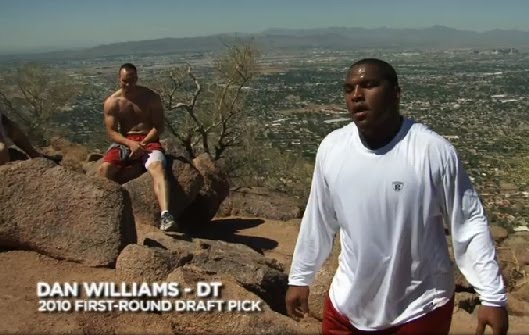
Arizona Cardinals Rookies Hike Camelback to Get Acclimated

Sports bloggers were passing a link around yesterday about Arizona Cardinals rookies hiking Camelback. It's been warm lately so it's not surprising to see some of these out-of-state guys appear sort of weak as they arrived at the summit. Judging by the pace of the group shown in the video, they probably got passed by quite a few regulars. If these burly rookies keep hitting the trail, though, it won't be long before they'll be bounding up and down like ibexes.


Here's the link to the video on www.azcardinals.com, (which is where I ripped this still shot).

Thursday, July 31, 2008

Slouching toward the summit at 111 degrees


Started at 6:40 or so and was surprised to see so many people in Echo Canyon considering how warm it was. Perhaps the breeze had brought them - it was fairly nice, at first. Extreme heat brings out the hard-folk, and today was no exception, though there were a lot of them. Parking lot was nearly full. The heat was intense. I burned through the trail with my Ipod on shuffle. Suppose I looked weird with my bandanna tied around my head -- nobody seems to do that. But I like it because it keeps the sweat out of my eyes. Few people wear hiking boots as sturdy as mine, either. I had my Danner Mountain Lites on, my typical Camelback shoe. Slowed down a whole lot about 3/4 of the way up, going into my plodding, low-energy climb mode. Had to stop and take a water break; I only do that on the hottest days, and this was one of them. Took a few pictures with the A630. Gorgeous red sunset.


On the way down this dude tells me to watch out for a rattlesnake he saw "just around the bend." I asked him to clarify that and he sounded like he didn't know what he was talking about. Told him I thought I'd like to see a snake tonight. "Well, watch out," he said with rising drama in his voice. "They KILL!" I couldn't help but laugh and I wanted to say something and what came out was, "They only kill you if you mess with them." Not sure if he was just screwing around or what, but I didn't hear or see anything. I was kind of disappointed, since I had my camera on me. I've seen a handful of snakes at Camelback, and I know to watch out for them. Pretty much as long as you don't surprise them you'll be okay. It's a good idea to avoid stepping right in front of small, overhanging rocks where snakes could be hiding, not that I always follow that rule. Most of the snakes I've seen anywhere in the Sonoran desert give you a good warning rattle when you get within 10 feet or so, just like they're supposed to. But they don't always follow that rule. It's just prudent to always keep your eyes wide open, especially when hiking in the dusk, like I was tonight on the way down. Saw no wildlife at all except for these big horseflies buzzing around like angry bees. Though it was truly hot, though not scorching because the sun was at such a low angle, I started feeling like I always do when I hike Camelback: Awesome. I haven't climbed it in a couple of months and despite some joint issues, in particular a troublesome wobbly right knee (the site of my nasty ACL replacement surgery in '93), things went well. Felt a little guilty about the time factor - everything I do these days seems to mean a sacrifice of something else I should be doing. But it was worth it, as usual.