
It seems my love for the pink rockpile is being shared by more people than ever. And sadly, the mountain has been in the news because people have died there. It's what I call the dark side of the place.
For my January 2014 article about the beauty and danger of Camelback, I wrote:
If you're not careful, Camelback will hurt -- or kill -- you.
Which is one of its most interesting aspects. It has been preserved as a place where you can test your limits. The summit trails are tough, no matter what your fitness level, especially in extreme summer heat. Climbers can seek higher cliffs, while the plain adventurous can scout "secret" trails to sublime, maze-like hideaways of rock.
The dark side of all this risky fun is that deaths occur at Camelback. The city couldn't provide an official tally of how many, but news reports register six between 2008 and 2012: three from falling, two from heart attacks, and a suspected suicide. No deaths were recorded in 2013, but rescues are common.
Six fatalities between '08 and '12. Yet since that article was published a year and a half ago, five people met their ends on Camelback in four separate accidents. I don't want this website to focus too exclusively on the rescues and/or death at Camelback, so I'd like to wrap all that coverage up here in one story.
In June, Seattle resident Eric Fernandes disappeared for three days on Camelback. The search-and-rescue operation turned out to be less robust than many hoped for. I was astonished at news coverage of how the rescue had been called off on the first day due to heat. I knew that plenty of people would be hiking that day. The heat would keep the crowds off, but the regulars would be going up and down during the park's open hours, as usual. So why weren't the rescuers combing the mountainside, looking for Eric?
I decided to explore this issue thoroughly when I got back, and the result was the following cover story:

Eric's body was found by a hiker three days after he disappeared. For some reason, he'd ended up far below the Echo Canyon Trail in a spot I hadn't explored before. Using the GPS coordinates from a police report, I found the exact spot where he'd been found. A stuffed animal was placed there -- I thought it had been from a family member, but I later learned none of the family had climbed down there. It must have been brought by one of the firefighters who participated in the body recovery and brief investigation to find out what might have happened. He'd been seen near the top by a witness who thought he looked tired. But no one knows for sure why he veered off the trail and climbed into sort of a box canyon, with steep terrain to one side and cliffs on the other.
I reported in a follow-up story that the coroner's report showed Eric had died of heat-related illness.
I talked to Eric's father. This kind of tragedy is unthinkable for a parent. I hope fewer people go through this kind of thing in part because of the info in this blog.
Gary Johnstone, a technical-rescue team member and fifteen-year veteran of the Phoenix Fire Department, died along with fifteen-year-old Trevor Crouse after they fell while rappelling on the Sugar Cube, a forty- or fifty-foot high formation just off the Echo Canyon Trail, not too far up from trailhead. I often see people practicing out there. In December, I published a story based on the police report. It contained a number of details I found worth including. I was interested in the sling Gary had used to tie to the big eyebolt in the rock at the top of the Sugar Cube, and how it went missing.
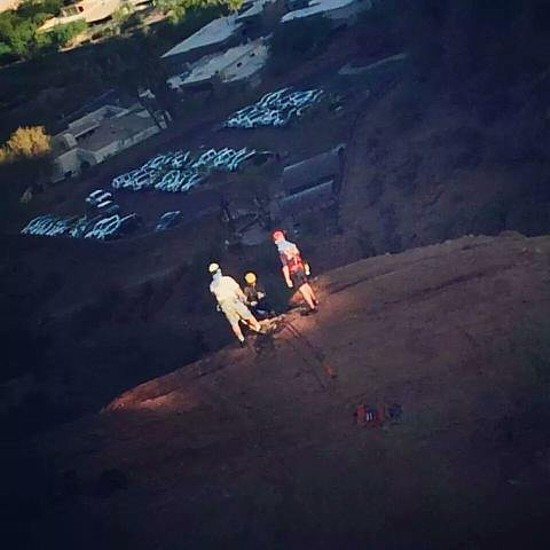 |
| Picture of the ill-fated rappelling session just before the accident. According to the police report, a hiker snapped this just because he found the rappellers interesting, then later turned in the picture as evidence. I obtained it and the police report on the incident through a public records request to the Phoenix Police Department. |
According to the officer who wrote the report:
"Evidence shows that a component of the failed anchor system was a piece of orange webbing strap," ... "It is unknown whether the failure was in the strap itself, or in a knot tied in the strap. The orange strap has not been located as of the writing of this report, in spite of exhaustive efforts..."
As I speculated in a follow-up:
So what happened? One possibility is that, despite his extensive experience, Johnstone didn't tie the orange webbing correctly to the eye bolt, or to himself. His son told Branch that Johnstone tugged on the orange sling after fastening it to the steel anchor, so perhaps the bad knot -- if that's what it was -- was where the sling attached to his harness.
Dougald MacDonald, executive editor for the American Alpine Club, agreed with that assessment but had some detail to add. We talked in May and he credited me in his short write-up of the incident for the 2015 edition of the Alpine Club's Accidents in North American Mountaineering, which was just released. In his piece, he postulates that Gary probably had an overhand bend knot in his anchor sling instead of the more-common water knot.
Before the year was out, another apparent heat-related death occurred, that of a 22-year-old Brazilian college student Emanuel Rodrigo Biana Costa Bezerra, who had just started an engineering program at Arizona State University.
 |
| I found this picture in a Brazilian online newspaper. It was apparently taken shortly before the student's death. Emanuel is the one with the red shirt over his shoulders. |
Enthusiastic visitors swamped the new parking lot, which still was relatively small at 135 spaces. The traffic situation now is as bad as, or worse than, before the upgrade. That's partially because visitation to Echo Canyon appears to have increased this year, officials say.
No wonder: Camelback received heightened attention and rave reviews when the Valley hosted Super Bowl XLIX on February 1.
The Wall Street Journal published a well-written article on January 31 about Phoenix's "Vertical Central Park."Time listed Camelback Mountain as number-two on a list of the top-seven must-do activities for Super Bowl fans to consider while in town. Pop superstar Katie Perry, who put on the event's halftime show, mentioned the mountain in an interview with the Arizona Republic: "I have hiked Camelback Mountain. You are talking to a Super Bowl performer who has hiked your mountain. So I know about you guys a bit.
My two cover articles on Camelback in 2014, the overview/history piece and the Eric Fernandes piece, received a second place award for Statewide Environmental Reporting in the Arizona Press Club annual award's. Here's what the kind judge had to say about them:
“Stern first sounds a clarion and prescient warning about the risks of hiking a popular trail outside Phoenix. Then when disaster strikes, he pivots and attacks the issue from the other side, exposing flaws in the response community’s readiness and rescue efforts. A fine effort filled with narrative, writerly flourishes.”
I appreciate the award very much. But award or not, my goal is always first to tell newsworthy stories about people, and to give the public information they can use.


