Showing posts with label camelback phoenix. Show all posts

Thursday, September 17, 2015

My Camelback Mountain Coverage Wins Award


It seems my love for the pink rockpile is being shared by more people than ever. And sadly, the mountain has been in the news because people have died there. It's what I call the dark side of the place.

For my January 2014 article about the beauty and danger of Camelback, I wrote:

 If you're not careful, Camelback will hurt -- or kill -- you.
Which is one of its most interesting aspects. It has been preserved as a place where you can test your limits. The summit trails are tough, no matter what your fitness level, especially in extreme summer heat. Climbers can seek higher cliffs, while the plain adventurous can scout "secret" trails to sublime, maze-like hideaways of rock.
The dark side of all this risky fun is that deaths occur at Camelback. The city couldn't provide an official tally of how many, but news reports register six between 2008 and 2012: three from falling, two from heart attacks, and a suspected suicide. No deaths were recorded in 2013, but rescues are common.

Six fatalities between '08 and '12. Yet since that article was published a year and a half ago, five people met their ends on Camelback in four separate accidents. I don't want this website to focus too exclusively on the rescues and/or death at Camelback, so I'd like to wrap all that coverage up here in one story.

In June, Seattle resident Eric Fernandes disappeared for three days on Camelback. The search-and-rescue operation turned out to be less robust than many hoped for. I was astonished at news coverage of how the rescue had been called off on the first day due to heat. I knew that plenty of people would be hiking that day. The heat would keep the crowds off, but the regulars would be going up and down during the park's open hours, as usual. So why weren't the rescuers combing the mountainside, looking for Eric?

I decided to explore this issue thoroughly when I got back, and the result was the following cover story:


Eric's body was found by a hiker three days after he disappeared. For some reason, he'd ended up far below the Echo Canyon Trail in a spot I hadn't explored before. Using the GPS coordinates from a police report, I found the exact spot where he'd been found. A stuffed animal was placed there -- I thought it had been from a family member, but I later learned none of the family had climbed down there. It must have been brought by one of the firefighters who participated in the body recovery and brief investigation to find out what might have happened. He'd been seen near the top by a witness who thought he looked tired. But no one knows for sure why he veered off the trail and climbed into sort of a box canyon, with steep terrain to one side and cliffs on the other.

I reported in a follow-up story that the coroner's report showed Eric had died of heat-related illness.

I talked to Eric's father. This kind of tragedy is unthinkable for a parent. I hope fewer people go through this kind of thing in part because of the info in this blog.

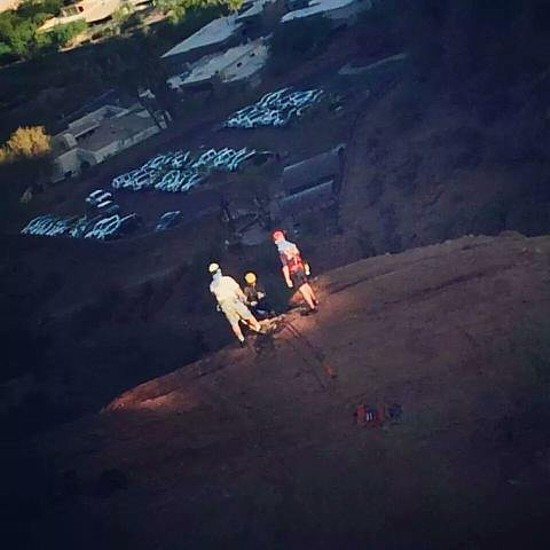
Gary Johnstone, a technical-rescue team member and fifteen-year veteran of the Phoenix Fire Department, died along with fifteen-year-old Trevor Crouse after they fell while rappelling on the Sugar Cube, a forty- or fifty-foot high formation just off the Echo Canyon Trail, not too far up from trailhead. I often see people practicing out there. In December, I published a story based on the police report. It contained a number of details I found worth including. I was interested in the sling Gary had used to tie to the big eyebolt in the rock at the top of the Sugar Cube, and how it went missing.

Picture of the ill-fated rappelling session just before the accident. According to the police report, a hiker snapped this just because he found the rappellers interesting, then later turned in the picture as evidence. I obtained it and the police report on the incident through a public records request to the Phoenix Police Department.

According to the officer who wrote the report:

"Evidence shows that a component of the failed anchor system was a piece of orange webbing strap," ... "It is unknown whether the failure was in the strap itself, or in a knot tied in the strap. The orange strap has not been located as of the writing of this report, in spite of exhaustive efforts..."

As I speculated in a follow-up:

So what happened? One possibility is that, despite his extensive experience, Johnstone didn't tie the orange webbing correctly to the eye bolt, or to himself. His son told Branch that Johnstone tugged on the orange sling after fastening it to the steel anchor, so perhaps the bad knot -- if that's what it was -- was where the sling attached to his harness.

Dougald MacDonald, executive editor for the American Alpine Club, agreed with that assessment but had some detail to add. We talked in May and he credited me in his short write-up of the incident for the 2015 edition of the Alpine Club's Accidents in North American Mountaineering, which was just released. In his piece, he postulates that Gary probably had an overhand bend knot in his anchor sling instead of the more-common water knot.

Before the year was out, another apparent heat-related death occurred, that of a 22-year-old Brazilian college student Emanuel Rodrigo Biana Costa Bezerra, who had just started an engineering program at Arizona State University.

I found this picture in a Brazilian online newspaper. It was apparently taken shortly before the student's death. Emanuel is the one with the red shirt over his shoulders.
In July, British visitor Ravinder Takhar died while hiking Echo Canyon Trail with her family. That incident drew worldwide attention. But Camelback had been gaining in press attention even before then. As I wrote in a August 10th article:

Enthusiastic visitors swamped the new parking lot, which still was relatively small at 135 spaces. The traffic situation now is as bad as, or worse than, before the upgrade. That's partially because visitation to Echo Canyon appears to have increased this year, officials say.
No wonder: Camelback received heightened attention and rave reviews when the Valley hosted Super Bowl XLIX on February 1.
The Wall Street Journal published a well-written article on January 31 about Phoenix's "Vertical Central Park."Time listed Camelback Mountain as number-two on a list of the top-seven must-do activities for Super Bowl fans to consider while in town. Pop superstar Katie Perry, who put on the event's halftime show, mentioned the mountain in an interview with the Arizona Republic: "I have hiked Camelback Mountain. You are talking to a Super Bowl performer who has hiked your mountain. So I know about you guys a bit.

My two cover articles on Camelback in 2014, the overview/history piece and the Eric Fernandes piece, received a second place award for Statewide Environmental Reporting in the Arizona Press Club annual award's. Here's what the kind judge had to say about them:


“Stern first sounds a clarion and prescient warning about the risks of hiking a popular trail outside Phoenix. Then when disaster strikes, he pivots and attacks the issue from the other side, exposing flaws in the response community’s readiness and rescue efforts. A fine effort filled with narrative, writerly flourishes.” 

I appreciate the award very much. But award or not, my goal is always first to tell newsworthy stories about people, and to give the public information they can use.

Sunday, February 24, 2013

Camelback Mountain's Praying Monk Christmas Garbage & Other Camelback Trash


Merry Trashmas

Someone put up another Christmas Tree on the Praying Monk this year. This time it didn't work out so well.

I'm no longer mentioning names, but they wrote about it online:

"Somebody cut the lines it was rigged with, tossed the tree off the Monk, and took the gear that I anchored it with. The tree was broken into little bits, and was very difficult to carry down. "

Coincidentally, I noticed Christmas garbage strewn all over the Praying Monk plateau during two separate scrambling sessions in January. The people who put the tree up in the first place are responsible for the trash, even if "somebody" else cut the tree down.

The tree was gone during my climbahikes, but broken and intact ornaments could be seen scattered around the Monk's base. (I didn't pick them up, having no pockets or a bag to put them in, but I'll get them eventually if no one else does.)

Several gear tags were lying around. Hundreds of tiny, green pine tree needles were littering the chute leading from the plateau to Rappel Gully. They appear to be plastic and not biodegradable -- if so, they'll be up there for quite a while, mixed with the gravel. Annoying.

For years, I've also been bugged by the goofballs who decorate the top of Camelback Mountain with holiday decorations and a Christmas Tree each holiday season. I've noticed holiday litter at the summit in past years, too.

If you feel compelled to spread Christmas cheer to every mountaintop, literally, ask yourself if Jesus would want you to celebrate his birthday by trashing one of the few natural areas in the city.


Climbing Litter

Now, when I see an empty Gatorade bottle or crumpled snot-rag or other trash along Echo Canyon or Cholla trails, it's expected because of the sheer number of people on Camelback Mountain. The mountain is usually quite clean, but it only takes one litterbug out of every 10,000 hikers to make a mess. Very few people, relatively, scamper up the Headwall to the Monk plateau. So when I see garbage up there, it's more disappointing because it means that a much smaller proportion of the climbing population than hiker population is littering. Yet climbers, in my humble opinion, should be much better stewards of the land than average hikers. They visit more pristine, sensitive areas, and they should know those areas are less likely to ever be cleaned up by anyone, being more difficult to access and to move and up and down the slopes and cliffs with trash bags.

Most climbers believe strongly in self-reliance, and this ethic extends to the idea that you pack out all trash, barring some good reason not to. This applies to old webbing and other climbing-specific trash. Yes, climbers may leave webbing tied around boulders or trees after using it as a rappel anchor. That's not littering -- it's survival, and not the same thing as leaving sliced, sun-decayed webbing lying at the base of a popular climb.


More annoyances

Next, an example of Camelback graffiti. Fortunately, this sort of thing doesn't appear on the rocks as frequently as it could. Phoenix doesn't have an excessive graffiti problem in general. If I had to guess, I'd say "SL" stands for S*%^ Licker:


The Ultimate Garbage Sin

Finally, I must bring up the trashy act that makes me more furious than any other: Leaving dog poop on the side of the trail in a tied-up plastic bag. I mentioned this in a previous post but it's worth talking about again because so many people do it. I come across these poop bags on the trail once every two or three times up the mountain, and sometimes see two on the same day, in different types of bags, meaning more than one of these boors had been there. I've never caught anyone doing it, but would certainly say something if I did.

The poop-bag method is even more annoying to me than the idea of dogs pooping freely on the ground. While it's possible that some of the poop-heads who do this plan on picking up the bag on their way down from the mountain, most clearly don't. They leave it there, believing falsely that if they have housekeepers, groundskeepers and janitors at their beck and call, so does Camelback Mountain.

Last time at the mountain, a couple of weeks before the Echo Canyon closure, I talked to a ranger about this strange and obnoxious behavior.

"Hey, thanks so much for the service you guys provide -- picking up all those little bags of dog poop that people leave," I said with a smirk.

She got my drift right away and she snarled, "Oh, there's no service! They think there's a service, but there isn't. I don't pick them up!"

"I know! What is wrong with those people?"

"Actually, I do pick up the bags, sometimes," she confessed. "But only when I'm positive that no one is around, so no one sees me do it. Otherwise, they'll think there really is a service."

Listen up, poop-baggers: Do NOT leave your animal's crap on the trail, even for a minute. If you have a plastic bag, that's wonderful -- take it with you, whether you're hiking down or are still on your way up. There is no valid excuse for doing otherwise.

Sunday, October 21, 2012

Copenhaver Castle: Going Medieval on Camelback Mountain

The castle protected Hohokam royalty from attack by conquistadors until the infamous Siege of 1312...

Saturday, September 15, 2012

Camelback Mountain: Suicide Direct -- Serious, But (Probably) Not Suicidal


A few months after I experienced the ridiculous "hanging rappel" misadventure, I led Suicide Direct (left).

Doing stuff you previously thought was impossible or too scary is one reason I have always loved rock climbing. My lead of this 5.8 Phoenix testpiece remains one of my most treasured times in my 23 years of on-and-off climbing.

The achievement was ironic, considering how badly I'd flailed on the route on toprope. Worse, I'd cracked a heelbone after falling on a boulder problem at Camelback Mountain the very weekend after Mike and I had climbed it. About three weeks later, my foot in a walking cast, I used crutches to hike up the trail to the base of Suicide Direct and photographed another friend, Kent, who had chosen this 5.8 as his first lead. I managed to snap a killer picture of him flying through the air. He'd slipped on relatively easy terrain above the bulging-overhang crux. He took a 20-25 lead fall that day. Very impressive. Then he slithered back up the overhang like it was nothing to finish the route.

Suicide Direct was first climbed in the late 40s or early 50s -- or maybe the 60s. I don't have firsthand info on the history of the route, but one looks at the bolts in it during my late-80s climb revealed that it was a classic. Greg Opland's Phoenix Rock II suggests it was climbed within five years of 1947 by the Kachinas, that hardcore group of Boy Scouts who pioneered many Valley routes not too long after WWII ended. Rock Climbing Arizona by Stewart M. Green, on the other hand, says the route's first ascent was completed in the 1960s by Lance and Dane Daugherty. Waugh's original Phoenix Rock says the Daugherty boys climbed it in '49. I'd go with that. Either way, as a 2008 report on the route on rockclimbing.com states, "Those old boys sure could climb hard in tennis shoes!" (Although if it was in the 1960s, it was possible they were wearing EBs.) (CORRECTION: The info from Waugh and Green's books is not correct. The Daughertys did not climb it in '49. They were too young then. According to Opland, "Suicide Direct FA was Ralph Patement and Bob Owens in 1949. 
Suicide Direct FFA was Lance and Dane Daugherty, date unknown.")


Waugh's scripture states that Suicide, the fun, three-pitch, 5.5 route left of Direct, suffered some infamous falls some years ago. I don't know the details on those. But I did find one old news story about a death on Suicide Direct in January of 1987. Andre Dauvergne fell after climbing the route with a partner, fellow ASU student Doug Loveday. According to the newspaper article I found, which quoted a volunteer rescuer, the climbers "had no climbing equipment and were wearing only tennis shoes ... to attempt an assault that is considered difficult even for experienced mountaineers." As Waugh's book says, climbers must "surmount the difficult overhang."

The overhang is not terribly difficult if you're a solid 5.10 leader, but even then it'll likely cause you to reflect on life and other important things. The spooky reputation of Camelback rock calls for that sort of perspective. If you're in over your head by leading a runout, exposed 5.8, the route's name doesn't seem far-fetched.


My obsessive hiking at Camelback frequently takes me past Suicide and Suicide Direct; I've never seen anyone climbing the latter, (because it's no ladder, hee-hee). Twice, I've seen people on Suicide. Once it was a pair of competent-looking climbers. The other time, which was a few years ago, it was a pair of yahoos using a 50-foot static line as a lead rope. I have no idea if they made it past the first pitch, which they had split into two pitches.
(Suicide Direct from Echo Canyon pkng lot.)


I know S.D. must get a few ascents a year, but it sure isn't a commonly climbed route. Which is all the better, if you want to do something special. It's for experts and foolhardy souls only, obvi-frickin-ously. Extremely satisfying when you nail it, for sure, and it puts you in an interesting spot on the western side of August Canyon. I don't know if the bees are still there. It's been quite a while since I've climbed it. Only did one other time after my lead. That was with Kent, who wanted me to belay him on a clean lead of the route about a year after his fall there. Although he finished the lead the day he fell, and flashed it when I belayed him his second time, that fall bugged him for years. Sometime around 99 or 00, he decided to put all his Suicide Direct fears behind him and complete a solo ascent of the route. At night. He's improved his climbing skills considerably since then. Last month, he free-soloed the Matterhorn.

I digress.

While I don't recall hearing about the '87 incident, I do remember one high-profile rescue at Suicide Direct from 10 years later. This was the case of a teenage resident of a now-closed juvenile boot camp on a group outing to Camelback. He snuck away from his group and freed the climb up to the bolted overhang. At the rest-stop just below the overhang, he realized he could neither go nor back down without killing himself. So he took off his T-shirt, pulled it through a bolt hangar, and tied a knot in it for a handy hold. Then he waited for the expensive technical rescue. I still think that was a fairly smart move on his part, to use the shirt like that. Going up the 5.8 without experience or rock shoes wasn't too swift. But I do appreciate the boldness. He probably didn't know the name of the route or its Yosemite Decimal System rating, but he knew it was a great line up a sweet cliff.

Suicide Direct isn't highlighted on the ClimbPhx Web site's Camel-page, so I assume the author hasn't climbed it. I thought I saw an in-depth route report, but it got lost in cyberspace and I've been unable to locate the site again. The above-mentioned rockclimbing.com report refers to the "stiff overhang," while a commenter notes the long runout. Those are actually just two of the challenges.

The first challenge climbers must confront is the 90-foot, "class-four" first pitch. Perhaps because this route gets so few ascents, or maybe it's just a geological quirk, this pitch does contain a fair amount of Camelback choss. It's easy to become lost in this asteroid field, so depending on how you do it, the first pitch might be an honest 5.0-5.2. And you'll be wearing a pack with your gear. So be wary of that class-four designation. When I climbed this with Kent, a rattlesnake was coiled in the shade at the top of the first pitch. I scrambled past it before seeing it, realizing it could have bitten me in the face. Kent used it as a handhold for a brief second, until his brain understood the skin on his fingertips had touched something alive. He pulled his hand back. "What was that?" "A rattlesnake," I answered. The snake shook its head and went back to sleep. The sun hadn't yet hit the crag, and it must enjoy sleeping in almost as much as I do.

(Photo of Suicide, 5.5, ripped from www.rockclimbing.com.)

You'll forget the excitement of the first pitch once you begin the second. Although it starts off fairly easy, you're instantly launched into the stratosphere. Lots of exposure, real soon -- thanks to that steep first pitch. I was sure happy when I reached that first bolt, but I had to leave it behind all too quickly. I recall only two bolts between the ground and the bolted overhang; another one may have been installed in recent years.

I'm cranking the overhang in the picture. I'd been doing a decent amount of climbing back then, so I found it rather fun, though strenuous. Funny, but on lead I remember that the handhold on the top-side of the overhang, which had some stiff grass growing in it, felt incredibly positive. When I later seconded it with Kent, it felt more angled and tricky. Could have just been conditioning. But both times, it required strength and nailing the footholds to get on top of it. After that, it's a tricky cat-walk left and up. I was well aware of Kent's fall when I led it and was extra cautious. Tired and a bit freaked out, the climax of my lead was yet to come.

The last move of Suicide Direct, unless it's been retro-bolted, is a sketchy pull in a gravelly slot with almost nothing for footholds. Scared the bejesus out of me. I placed a .5 Camelot in a flaring pocket a couple of feet under the move, knowing it wouldn't hold if I slipped. It would be as if the rock spit that cam out as I screamed past it, taking a lead fall of -- I don't know -- forty feet? Maybe more? Bouncing all the way. Of course, I didn't have a helmet, as the picture shows. So this climb might have been the death of me. Instead of flying off, though, I gritted my teeth, clenched everything else, and made that last pull, where I found -- and grabbed -- the chains attached to two or three bolts. This was one of the many experiences that make visiting Camelback an almost religious experience for me.

So, if you go, (and I hope you do, 'cause I'd love to see someone leading it...):

* Take two ropes, or;

* Brave the maze of August Canyon and find Pedrick's Chimney on its east side;

*Watch your step on that first pitch;

* Keep your head after the overhang.

* Watch out for poisonous reptiles and take a spare battery if you do it at night!

(Suicide Direct route at Camelback Mountain. Yellow dots indicate path, not bolts. There aren't many bolts.)

UPDATE: Just wanted to bring attention to and repeat some of the historical context here. As I mentioned in another blog post, Bob Owens of the Kachinas contacted me to report his climb of "Suicide Cliff" in 1947. Then there's the comment below about Lance and Dane Daugherty, legends of Phoenix climbing:

Climbing brothers said...
Just to clarify some information.
Lance and Dane Daugherty were my older 1/2 brothers. We moved out to Phoenix Az in the Fall of 1963. They began climbing in 1965.
Lance was born in 1947 and Dane in 1949.
Lance was killed in 1968 on his motorcycle coming back from a climb in Carefree. Dane quit climbing altogether in 1969.
Ironically, Dane was also killed on a motorcycle in 1978.
If the first climb of Suicide was in 1949 it could not have been my brothers.
Hope this clears up some confusion.
Sincerely,
Von Wagner

Sunday, May 27, 2012

Camelback Mountain Chuckwalla - the Sonoran Desert's Iguana

Hey, big fella. Enjoying the view?

This one's wife was joining him for an afternoon basking session.

Monday, May 7, 2012

Camelback Phoenix: The Blog About Camelback Mountain Hiking, Climbing and Exploring


This is the 50th post for this blog. I don't really consider it a blog. The older posts -- most of them, anyway -- shouldn't be considered "old news." The site is a collection of stories, information, news, photos, links and other tidbits about my favorite mountain. It's a place for the outside world to better know Camelback Mountain, and the adventures I and other people have had there. On Camelback Phoenix, you can find info about hiking, rock climbing, the wildlife, the visitors and their trip reports, parking and anything else Camelback Mountain that I can think of. Some of this info you'll find in the provided links. For instance, sites are listed in my blogroll that give you precise directions to Echo Canyon and Cholla Trail, including the city of Phoenix Parks and Recreation site. The blogroll is automatically prioritized by Google Blogger depending on how often those other sites are updates. Summitpost is an example of a great site that pulls in trip reports and climbing info from uncountable cyber-commenters.


This site is mainly about spreading the Camelback love.

Another interest is to get a larger variety of info out there about Camelback Mountain as possible. No single site or book exists that compiles everything on it. Even Gary Driggs' famous coffee-table book, Camelback, (which I intend to jabber on about in some future post), doesn't offer as many details as I'd like to see, especially as a climber. Camelback's history deserves to be preserved, and I'd like to help do that.


As I continue to post here, feel free to comment and share links or other information. Years ago, I met a guy at Headwall named Ken who told me there are at least 70 climbing routes at Camelback -- far more than you'll find in any guidebook. There is much left for me to learn within these rugged 400-plus acres.

Okay, now it's time to update some of the Camelback stories, pictures and videos I've seen on the Internet...


Clichtenberger

I want to bring attention to a few posts done on Mountain Project by a "clichtenberger," as well as the Camelback pages on MP's site in general.

I assume that's stands for C. Lichtenberger, but I'm not sure. Whatever his or her name is, I'm jealous of the quality time this climber spent with friends on various Camelback routes at the end of last year. "Clichtenberger" has new postings on routes that I've been wanting to climb, like (Aerial Combat and Chimera, both 5.9), as well as some I've done, like Hard Times and Beehive. (I wished for photos of the latter two, though, for nostalgia's sake.)

When I clicked on the photo above that Clichtenberger took of his buddy "Lauren" on the 3rd pitch of Hart Route (4th pitch, the way they climbed it), I had a visceral response and flashback to my 2010 freesolo of the route. Maybe that freesolo wasn't such a good idea.


Tons of videos

At this www.climbingweather.com link, you'll find a collection of more than 100 videos about Camelback Mountain. A couple of examples:


This one's kind of cute and courteously short. Skateboarding, nice splicing and a great Beatles song.

Another video has a weird sky serpent and a song by Godsmack:


Suicide

Want more info on a phenomenal, three-pitch adventure climb with the scary name of Suicide? (C'mon, it's only 5.5!) Click here.


Where was that rescue?


Last November, I read about a couple of kids who got lost while scrambling around. I'm fascinated by the tale of how they climbed down something they could not get back up. Usually, it's the other way around. Of course, the TV stations never nail down for the viewer the precise site. Check back for a future post that will have the GPS coordinates. I'm also trying to find the coordinates for the spot where a guy in his mid-50s was freesoloing and attacked by bees. He was stung 120 times. I think that's information you or I may need to know someday. Phoenix Fire is supposed to get back to me on that one.


Climbing routes

Next to Suicide Direct is a 5.10 I'd like to try someday called Black Direct.

Some routes at Camelback Mountain, however, are best done just once. Misgivings is one of those. This isn't one that I've led, and I vowed never to do so after watching one of my friends fall on a sketchy piece near the top. Had he not put that piece in, or had the piece popped out, he very well might have decked.


A place to have real adventures

In searching for other posts out there about Camelback, the ones I enjoy the most capture the thrill and seriousness of the park -- like this one, entitled "This is crazy."

This one by adventureparents.com also captures the spirit I look for, though I think the type of pushy hikers he describes is more often found on Piestewa Peak.


Photos, paintings and other Camelback Mountain art

You paint it, I'll showcase it. (The above painting is by Michael J. Liebhaber.)


See you on the trail.


Tuesday, April 17, 2012

The Hanging Rappel: A Misadventure


November 5, 1989

I woke up at about 10 a.m. and tried to get Mike out of bed for an hour and a half. He still didn't have a job and arising in the morning was a very bizarre experience for him. We had borrowed some of Dusty's gear the night before, including "Phoenix Rock," a book which described Camelback Mountain, the day's destination, in exquisite detail.

We figured out what to climb after we parked the car in the small lot. I looked up at a humongous and seemingly blank face to the south. Mike, book in hand, pointed to the face.

"See that little 'v' in the rock up towards the top, with that dark line running down it? That's it, a 5.8 called 'Suicide Direct.'"

I gasped. "You're going to lead that? You're nuts."


"No nuts involved," Mike explained. "Just five bolts up to the 5.8 part. The first pitch is a class 4. We'll just free that."

I took another look, my curiosity aroused. It just looked so damned impossible. "Let's go," I said, opening the car door.

One of us forgot the backpack, so we had to wear all of the gear during the hike to the first pitch. The protective equipment dangled from our harnesses, bouncing and clinking. Parts of the hike were steep, but it wasn't very long. Soon enough, the large rock formation towered directly over us as we scrambled up the first, ladder-like part of the class 4.

Fifty feet up, that class 4 somehow turned into a 5.1 or 5.2 With gear weighing me and my harness down, the dangerous moves became a matter of life and something else. I'd step up to a one-inch ledge with my left leg while grasping a decent hold, then find a spot -- fast -- for the right leg to go, preferably higher. I didn't want to think about the less-than-perfect sturdiness of the rock. All we could hope was that if a foothold gave out, our handholds would be good enough, and vice versa.

The climb ended in a big ledge which was the belay stance for the 5.8. Three solid-looking black bolts protruded from the cliff face four feet above the ledge, and there was a blue sling connected to them, already set up for action. Mike and I sorted gear and prepared to climb.

The face on which Mike embarked was not straight up, but close. Now that we were here, the face didn't look blank at all -- there were plenty of decent holds. It looked more possible than it did on the approach, although eighty feet up was a lump of an outcrop -- "surmount the difficult overhang," the book said of it. I was glad Mike had decided to lead. The distance between the bolts on the climb was hideous, and there were no pockets or cracks for hexes or cams. I'd led 5.4s, but leading such a poorly protected 5.8 was unthinkable for me. Mike had led a poorly protected, difficult 5.6 at Granite Mountain (3rd pitch of Classic), so that and his other recent successes made him cocky enough to try this. Up he went.


Fifteen minutes later, my neck was starting to ache badly as he reached the overhang. There had been two long runouts for Mike to worry about, I estimated them at twenty feet each. That meant very careful and methodical climbing. You move slowly in a situation like that, conserving balance and energy. You check holds vigorously and be wary if one should crumble beneath your feet... as it did for Mike right before reaching the overhang. Leading a 20-foot runout means no falls, period. Never mind if your foothold just disintegrated. A 40-foot fall could break limbs, or a head.

Mike paused for ten minutes at the overhang, muscles tense, standing on one-inch ledges. Luckily, a bolt beneath the outcropping meant he would only fall six or eight feet if his skill failed him, but the fall would be a bad one since he would swing under the rock when the rope pulled tight.

Patiently, he felt around for options, not happy with what the rock required him to do. A deep, six-inch pocket was about face height. It would have been an excellent hold except that it kept you off balance, and the bomber hold up above had to be grasped at an angle. So Mike tried his famous opposition hold on the pocket, both hands inside, pulling closer to the face, where he could then attain a precarious, temporary balance point to launch his left hand slowly up to grab the good hold. It must have been a great, awful few seconds to go for that hold, feeling his balance diminishing as the one hand remaining in the pocket tried to pull him off left, causing his feet to smear off their tiny ledges and maybe sending him screaming over the outcropping to swing violently into the cliff wall.

It looked very smooth and professional from my vantage point. It had taken a while, but that seemed natural and necessary. A brief respite, and the rest of the climb took him only a few minutes.

"Major power moves, Ray!" he called to me, sounding relieved and proud. "It's just two or three power moves. You're going to love it!"

I wasn't destined to make those power move, as it turned out, although when it came to my turn to ascend the face, I did so with total readiness and confidence. Anything Mike could lead, I thought, I could sure as hell toprope. What happened next I can only make excuses about.

Maybe it was the 45-mile bike ride the day before, preceded by a few weeks of almost zero exercise. Come to think of it, I was heavily loaded down with the rest of the gear, including three full water bottles. Then again, maybe I just plain pussed out.

The route was challenging up to the overhang, but not 5.8 material. The overhang, on the other hand, seemed a lot like a 5.12 when I reached it.

Eight feet from my previous belay stance, a hundred-forty or so from the ground, I stood nervously balanced on one good foothold, a one-inch ledge, right hand in the aforementioned pocket, left hand further left on a two-finger balance hold, straining to keep my face away from the bulging overhang. I tried everything I could -- hugging the inverted face while stretching sloth-like for hand holds, tenuous laybacking, even an somewhat conservative lunge move. I looked to my left and right. The book, which I had dropped halfway up the first pitch and with which I could not have looked at then, anyway, told of 5.6 escape traverse to the right.

Far away in a world of relative peace and security, across a landscape of pale-green desert plants and orange rock, motorists cruised by on the busy roads bordering the mountain park. The scratchy hum of their vehicles wafted up on the breeze to my ears. Paradise Valley went on with life, its inhabitants totally oblivious to my problem. It was a constant reminder that the whole world was not -- as I was -- frazzled, frightened, frustrated and on the verge of exhaustion.


The last lunge move had decided it. "Forget it, Mike!" I shouted, unable to see him in his belay stance. "I can't surmount this difficult overhang!"

"Are you sure? Try putting both hands in that pocket."

"I can't! I keep pitching off to the right!" I noticed that trying to yell and stick to the face weren't mutually compatible actions. I had to do something soon or I would come off the face again.

"I thought that reach might be high for you. What are you going to do now?"

"Get ready. I'm going to weight the rope and try to get over to the left. The book said it was easier over there."

Never again will I climb a route without memorizing everything the book has to say about it.

"Left?" Mike questioned. "I thought it was to the right."

"No, it was left. There's nothing to the right."

Then came the awful task of weighting the rope. That wasn't a problem - just a matter of crouching down and hopping off my tiny ledge and putting all of my trust and life into a small bit of woven plastic. It was pretending I had no fear of dangling from the rope on a steep face. Then, while hanging uncomfortably, knowing this was killing Mike's guts as his harness bit down, I had to pedal my feet left and right, building up momentum to propel me far enough to grab something. As I swung, the rope chafed above me on rough, uneven rock. I made a desperate grab too soon and only pitched forward in my harness, losing precious inertia.

"Hurry up! What are you doing down there?" Mike sounded strained.

"Almost there!" I didn't sound too casual, either. I swung to the left, grabbed with one hand and stopped the motion with a foot. My arm shook with tension. The rope was pulling me sideways now that it angled so sharply to the right. "Slack!" I grunted.

"What?"


"Slack, slack! About two-three inches!" The rope relaxed and so did I. The next handhold I grabbed crumbled, leaving me like I was before. I slipped half a foot and felt the strong tug of rope threatening to yank me off. "More slack!"

"Are you on something?"

"Yeah, but I need more slack!"

This time Mike let out a good foot or more, enough to start climbing again, but too much should I pop off the rock. The horizontal swing combined with a couple of feet of vertical falling might be all I needed to break something.

I was on explored terrain, and as I now know, anything unexplored at Camelback is unclean. I carefully went up, using cautious stemming on untrustworthy footholds. What creaked or moved when I tugged with my hand would certainly come out under my foot's weight. Eventually I was five feet below Mike and far left of him. I reached with my right hand to a large black rock, bigger than my head, and pulled myself up with it. It started to pull out. I moved rapidly, using pressure from my left hand to stand on a good foothold I'd found. The boulder tipped out of the cranny it had been living for the last 10,000 years, plopped onto my foot and crashed into the belay ledge 80 feet below with the roar of an atomic bomb. People all over Camelback Park strained their necks looking up at me, perhaps thinking another climber had fallen.

I shouted an expletive, then kept going with only one thing in mind: Get off this shitty rock.

Finally I saw Mike. Relief washed through me. I took one more step and that that rock disappeared under my foot, though when I had inspected it, there was no indication a boulder that size would not support me. Even bigger than the last, it crashed violently on the ledge, splintering off into thousands of pebbles. Again, people looked to see who was making all that racket.

Just me folks, cleaning a route. Just making it safer for the next guy, if there ever is a next guy.

Had someone been on the ledge below, there would have no escaping the 25-pound projectiles raining down like vicious, inanimate predators.

But no one was down there, and I was done with my climb. I soon found out that our problems had just gotten worse.

Standing close to the edge as I usually do, I noted the height. "I hope you remember where that walk-down was."

"I guess I have to now that the book is down there, don't I?"

"Yeah, well, it's got to be around here somewhere." As we coiled the rope and organized the gear, I looked at the short gully leading to the top. We were not on the summit. We were in a maze-like valley. It was then that I started to get nervous. "Are you absolutely sure that walk-down is reachable from here?"


"Oh, it's up here somewhere." He took a long, pensive drag on his Camel. "I don't know if it's on the left or right, though. We may be up here a while."

"You have any idea what time it is?"

"Nope. Didn't bring a watch."

"Oh." We were on the shady side of the mountain, and I had to look out towards Paradise Valley to get an idea how bright the sun was. The city was still shining like a TV in the dark to my slightly dilated eyes. It seemed very distant and unreal. My gaze fell again to the ledge far below. "We sure can't rappel down from here."

"No, we sure can't. Not with a single rope. But we'll find the climb down. I'm just hoping it won't be too much of a bitch with all this gear."

We decided to go right. Twenty- to forty-foot-tall hills rose up smoothly all around us. Most were unclimbable. The path we had chosen was overgrown with particularly hungry, dark-green sticker-bushes. We had to hug the wall to avoid bad scratches, but at least we seemed to be descending. As we came around a corner, the bright-green cityscape showed through a gap in the hills.

"That must be the downclimb," Mike said.

"I don't think so. It looks a lot like a drop-off," I replied. The closer we got, the steeper it seemed. I was within a couple of feet from the edge and still couldn't see where this supposed path continued. Too bad we didn't have the book. It would have explained about the easy walk-down one ridge over from where we stood.

Not realizing this, we turned around, retraced our path and explored the way to the left. The hills separated enough to make one large, natural corridor which was good at first but soon closed up. I looked at the vegetation-choked passageway and noted, "That's all sticker-bush."

"Yeah, it is," Mike said. "You going in there?"

"I guess so. If I climb up a little here, I shouldn't get it so bad."

I picked my way up carefully, trying to hold the spring-like branches back as others clawed my hand. Then I noticed the humming. It got louder as I went further right. The sound changed to a low, muted buzzing.


Bees, I thought.

I tried to see what I was about to encroach on. There they were, dozens of the little guys flying in and out of their comfy hole in the rock. Many were just milling around outside their hive, waiting maliciously for some dumb climber to piss them off. Retreat seemed like a good idea.

It dawned on me that I had no idea what we would do next. We had a vague feeling that somewhere there was a downclimb, but now we were facing an additional problem. The end of the afternoon was almost here.

The breeze that had been perfect an hour ago was now tinted with coolness, and the preserved bit of desert terrain and hills which made up Camelback Park were dull with shadows, the reddish rock looking rather orange.

That was when Mike cooked up an idea so maniacal, repulsive and horrifying, we both knew at once it had to be acted upon. We uncoiled the rope. Mike would be the first one down, we decided.

We put the rope through an expendable, anchored sling. Folded up, the rope ends went down 80 feet, nowhere near the rock-pummeled ledge that was the start of Suicide Direct's second pitch. The overhang Mike had led over was 25 feet below us. Just beneath it were three bolts, enough to make us feel somewhat safe. The general idea was to rappel down to there, run a sling through the bolt hangers, clip in, pull the rope down, (being certain one end is tied to something so we're not left stranded), and then rappel down from our hanging rappel stance.

Mike clipped his figure-8 to the locking carabiner on his harness and slowly rappelled down the cliff face, not worrying if it was going to be difficult. I also felt very confident, perhaps overly so. Nevertheless, it was like I had seen us do this before. I had no doubt we could do it.

Mike was under the overhang, out of sight. I looked around the area one last time, and it was more beautiful than it had been when I was still thinking I'd be stuck up here forever. The sounds were of the wind, the same cars in the distance, the faint clipping of carabiners. Being the last one to rappel is always a good experience. It gives a fantastic, welcome feeling of total isolation.

"Mr. Stern, come on down!" Mike called. "And don't forget to test the rope!"

I wasn't about to forget that. If I got down there and the rope wouldn't pull through, one of us would have to climb back up to free it. I grabbed both strands and worked them back and forth easily. The runner was long enough and there were no rope-eating cracks to worry about. I clipped in and rappelled out to space.


It was a straightforward descent, though the overhang demanded some tricky footwork. There was Mike, standing on one-inch ledges and secured to a good-looking sling system. I had stopped to his right, my chest even with his head.

"All right, you having fun yet?" he asked me.

"Sort of. Where do I get to stand?"

"There's a small foothold near your left foot."

I found it, holding the rope tightly with one hand and clawing a slight ridge with the other. On one foot, with the rope tight from rappelling, balancing was awkward. I was using hordes of energy to stay on the rock; my hands were draining of strength.

"Why don't you clip in?" Mike suggested.

"It's all I can do to stay on this rock! This is no good," I shot back.

"Just clip in and hang. You won't go anywhere."

"No, I want to stand on something. At least then I'll have some control."

"Well, okay. There's a good ledge on my left. Can you get over to it?"

I sure as hell did. I remembered it from the climb up. It was a decent little ledge, wider than the one Mike was standing on. I secured myself to the sling system.

Mike then tied one end of the rope off and I leaned out and tugged it. Nothing happened -- the rope didn't budge. With a second pull, it gave a smidgen and then stopped, this time for good.

For the first time, the stress began to get to Mike. "Why the hell is it stuck? You were supposed to check that!"

"I did, and it worked perfectly! Everything looked fine. What more could I do?"

Mike contemplated this. "Okay, give me the rope. Maybe I can it get it from a different angle."

I handed it over, now more scared than I had been all day. The wind felt even colder exposed like this on a naked rock face. I couldn't stand the prospect of standing there for another half-hour while Mike climbed back up. I'd have almost rather gone myself.

Mike pulled, succeeding only in stretching the rope.


"I don't believe this shit," I said. My ankles were stiffening up. A second didn't go by that I wasn't aware we were twenty stories off the ground.

The rope was moving. Whichever way Mike had pulled it had worked. Seconds later, it whipped through the air like a giant snake and I could breathe again. Everything would end safely, this time.


(Pictures of postcards ripped from the Internets...)

Monday, December 26, 2011

Adventure Travelers Install Christmas Tree on the Praying Monk


On the way down from our hike yesterday, I noticed a second Christmas tree at Camelback. This one was on top of the Monk.

Googling around, I found that a couple of TV stations typed out blurbs on the tree a few days ago, and then I found the Adventure Traveling blog post about the teens who'd hauled it up there and decorated it.

Though I have mixed feelings about this kind of thing, I enjoyed the story of the climb and installation. I've been planning lately to write about the Monk and a few weeks ago had come across the teens' blog, which had several fun tales about their first exploits on Camelback's most-classic route.

High-school students Thomas Rankine and Andrew Keating, both 17, are doing the blog.


The beautiful and ambitious dream of cycling to Patagonia, "climbing some mountains along the way," sparked their online effort. (At right, picture and caption ripped from their site.) Besides the challenge of avoiding the banditos, to make that South American trip a reality they'll have to show more organizational skills and less gear-mongering than in their Grand Canyon toproping adventure! (As a master of over-gearing, I'm qualified to say that. Once, as a friend and I looked at some TR routes in Red Rocks, a local sportclimber looked at our packs and remarked, "Are you guys preparing to climb Mount Everest?)

I sure appreciate this sort of teen spirit. Such a trip would be best done with outside support to either meet them or mail supplies as they go. But Goran Kropp, in his astonishing bike ride to Everest (which he nearly summitted) in 1996 proves that no dream is too big for a committed adventurer (or an adventurer who probably needs to be committed!) Thomas and Andrew have some great times ahead.

Whatever they do, I look forward to their future stories. I expect one of them to be how they took the tree and its decorations down.

Below, the late, legendary bike-and-climber, Goran Kropp (Internet shot)


Sunday, December 11, 2011

Claud the Water Guy


This picture was found on a blog post written by photographer/"footballer" Jason Johnson.

Jason, a U of A grad who's from Seattle, runs into "Claud the Water Guy" and hikes to the summit with him. Claud juices up Johnson's short and entertaining description of the hike. Especially nice is his use of dialogue. He mentions how Claud tries to hand out water to "everyone he meets" has Claud saying, "It's a dangerous hill ... These city-slickers forget how hot it is. People die here... in the summer it will get to one-sixteen and they don't even bring water!"

Johnson surmises that all regular Camelback hikers have met Claud -- I certainly have, though I've never chatted with him for as long as Johnson did and didn't know his name was Claud. He hikes Echo Canyon a lot, that's for sure; he's in the top 10 of regulars I've noticed, probably because of his outfit. He's asked me several times if I needed water.

I suppose every mountain needs a self-appointed savior of foolish and unprepared hikers. Claud takes his job of Trail Police seriously.

About a year ago, I departed from Echo Canyon Trail to explore the base of some 40-50 foot cliffs above the saddle between hump and head. The gully turned bushy and I began scampering on a sidewall, having fun, when I heard a concerned voice far behind me shouting, "HEY! HEY! THAT'S NOT THE TRAIL!"

I tried to ignore him for a moment, hoping to climb out of his sight, but he kept it up: "TURN BACK! YOU'RE GOING THE WRONG WAY!"

I looked up at Claud, who was several hundred feet back and up at curve in the trail, wearing the same hat and having the same general appearance as in this picture, but appearing less than an inch high to me from that distance. "IT'S O-KAY!" I yelled back. "I'M NOT LOST!"

Then I turned around and resumed traversing. He yelled one more time before giving up. I found a great spot to free solo in the class-four range for about 20-30 feet before coming to a section that I didn't want to do without protection. The downclimb was just tricky enough to put a smile on my face.

I passed Claud on the way down.

"Nice rock-climbing there," he said graciously.

Saturday, December 3, 2011

Camelback on the Web


At least three other sites focus exclusively on Camelback Mountain. They don't contain climbing info, but they're very enthusiastic about the hiking.

ClimbCamelback appears to be run by two guys -- Bobby Klingler and Jason Glashan -- who want people to hire them as a guide. I'm not sure why anyone would do that, but okay. They charge $110 to take one person up, with a sliding scale up to $200 for groups of 4-6. I'm not sure if this activity needs to be regulated by the city of Phoenix or not. I could see the city wanting to get involved if a company regularly ran large groups up there.

Klingler registered the site in August of 2007, earlier than I registered CamelbackPhoenix, (Feb of '08). I'm not sure, to be honest, if his site was up before mine -- it may have been. He's done more with his site and installed some bells and whistles -- map and weather links, for example. A big focus is the list of "times of the fastest hikers." I hope he does more with it. His photograph quality has room for improvement.


HikingCamelback.com is like Klingler's site, but contains a blog. It's not like my blog, which is a collection of stories along with some blog-like material. HikeCamelback's blog posts are quick hits, a couple of which have more personality than others. Those two are about "Lewi" (pictured above, in the pink helmet, from a shot ripped for the site) and friends. Lewi is someone the blogger went up with who kept a "blistering" 23-minute pace. Not bad at all. My best time is 26 minutes, by the way -- that was in the late '90s. Lewi intends to do it in 16 minutes and also beat Camelback Jack's amazing record of 25 ascents in 24 hours. For some reason, these guys are dressed like male strippers near the end of their act. I first came upon this site while doing a search for Web stories about Brian Z., a.k.a. Naked Man. Their short, November 7 post on Brian Z didn't contain much detail, but it did draw scathing criticism of Ewelina, the woman who saved Brian's life and posted the YouTube videos of him. The more recent post before that, a generic list of park regulations, was published October 1. That tells me these guys are on my sort of glacial time scale. Their site has a few qualities to respect, like the professional layout.

Recently I discovered "Trails to Camelback." This one seems to be the most similar to mine in spirit, but it only has three posts. Paige Gruner, who launched it, is a journalism student who just finished an internship at Channel 5. I love Paige's vision for this blog and hope she keeps adding to it:

"She wants to share her passion for hiking the beautiful mountain, the history behind Camelback, and her knowledge of the trails leading to the scenic view of Phoenix."

As far as climbing info, I recently found ClimbPhx. Internet sites about climbing in general (see my blogroll) tend to feature more outing reports, but I like the personal style of this one.

It's still in an early phase and lists more routes than it describes. For example, the author writes about routes like Spiderwalk (5.6) at the Supes as if they've climbed it, but don't give any sort of tale to go along with it. Could be they are working on it. When I and Webber climbed that one a few years ago, we found it quite the mini-epic. Especially the junkoid summit. I got off-route on the 2nd or 3rd pitch and had to lower off a twig about 25 feet. Amazingly, it didn't snap, I got back on track and we finished the climb.

I've been familiar with the Mountain Project site for years, and it often has the sort of stories I like to read -- such as the route description and all four comments on the Spiderwalk page. MP doesn't have a ton on Camelback, though. I prefer the kind of personalized story found on this site, LA Mountaineers, about a couple of Headwall climbs.

ClimbPhx, which appears to be the brainchild of a climber named Shiloh Dorsett, has a few outing reports from Camelback. I'm hoping to read more of his trips to the mountain. At left is a picture from the site's page on the Headwall.

Yelp, TripAdvisor and similar sites also contain reviews of Camelback, usually for the hiking, which sometimes contain some color. Major differences in opinion are to be expected, naturally.

I hesitate to disagree with any of them. Camelback is treacherous, and safe. It's difficult, and moderate. The climbing is rotten, and fantastic. The park is easily accessible, the parking situation is awful. The people are nice, and sometimes rude. It's a rockpile for residents of a soulless town who have nothing better to do, and it's a near-sacred mini-Mecca of outdoor recreation smack dab in the middle of paradise.