Saturday, July 24, 2010

Camelback Hikers Brave the Summer Heat, but Not Always Successfully


Camelback's been in the news and mentioned in blogs quite a bit in the last few days, so I thought I'd catch up.

First off, several notable mountain rescues occurred due to the heat. This enabled me to mix business and pleasure by publishing a blog post in Valley Fever about the incidents, and a follow-up making fun of a local TV reporter. (Sorry, Kevin!) The news coverage of the rescues also spurred message threads like this one. I'm hoping the 13-year-old kid whose parents took him up the mountain without enough water is okay.

Seeing these incidents and the community's response to them, as heart-breaking as it may be to see anyone hurt, gives me confidence that liberty still rules the day. For all this talk about the feminization, wimpification, or whatever you want to call it, of modern society, the freedom to roam on our local mountains -- up its steep cliffs and in all conditions -- trumps notions of perceived, relative safety. It's 105 degrees and you're 73, from much-cooler Wisconsin, and aren't packing enough water? Nobody's going to stop you at the trailhead and tell you not to do it.

The firefighter interviewed in the Channel 10 report on the rescues, Captain Tony Mure, (they spelled his name wrong in their caption), says "I don't care what kind of shape you're in -- the human body cannot tolerate this kind of heat and this kind of exertion." That's simply not true and plenty of people who work outside prove him wrong every day. (Tony's a good guy -- the authorities often take a scolding tone with the public when it comes to these things, to try and warn people away).

I've hiked Camelback dozens of times in temperatures of 110 degrees or higher and only once did I feel like I'd made a mistake -- (4 p.m. hike, 117 degrees). The trick is to sweat a lot, which results in a "wind chill" (ha!) factor of much less than the air temp. This is difficult to achieve when the sun is directly above, so most of my 110-plus hikes have NOT taken place between, say, 10 and 3. Most often, those hikes were in the evening -- after 6.

Hiking in the sun, (even outside the hours of 10-3) requires extra precautions, like packing 2 bottles of icewater instead of one and wetting my shirt before heading up. Sunscreen is mandatory, naturally. Some people wear long-sleeved shirts. Once, while hiking at about 4pm on a 110-degree day, I ran into a guy coming down in full camo gear, long pants and long-sleeved shirt, with undershirt, calf-high boots and a backpack stuffed with unknown gear. This guy has the audacity to stop me and say, "Excuse me, can I ask you a question? Are you wearing sunscreen?" I told him I was, and asked him why he was dressed up like that. He said he was training for officer candidate school.

Meanwhile, plenty of people besides me made it to the top this summer without nearly dying. My next featured post is from a blog called "Daily Nuggets." The picture is of the blogger's "cousin Rob" making it to the top; my screen capture includes their text as well.


I also like this one from "DaSmith Foursome" blog. They met for their Father's Day hike at 4:15 a.m. (that's their picture below). Whoa! That's early. You go, girls. They all made it to the top.

I failed to summit the first time I hiked Camelback, I must admit. I was 18 and unfamiliar with mountains back then, though I was in better shape than I am now. The defeat was 100 percent mental.

I'd been by myself, huffing and puffing up the steep trail for a while, thinking I was getting somewhere. After I cleared the headwall area, the summit still looked very far, far away. I went a little further, and it still looked far away. I realized the only thing holding me back from cool comfort was a decision. And I made the wrong decision -- I decided to turn back. It had been warm, but not that bad. I'm pretty sure I'd brought a water bottle, but I forget what my water situation was that day. Probably not good. Still, I have no doubt now that I could have made it.


Anyway, my search this morning for mountain rescue photos led to a cool January report by Channel 3 I hadn't seen about rescues. The anchor keeps referring to dramatic scenes of firemen climbing the Headwall and of a helicopter as similar to a Hollywood stunt. I hadn't heard about the accident, in which a climber on the Monk fell 25-30 while rappelling, fracturing both legs. Holy ouch, Batman! I took this screen-grab of the shot of a helicopter next to the Monk.

One last note today: As the oppressive heat of July wears on, much as I love it, the green hills of the "other" Camelback Mountain featured in many Internet sites this summer makes me wish for a vacation there. I found a "SummitPost" posting from 2006 recently in which somebody crowed about the "great-tasting blueberries and rasberries" they picked, as well as the "amazing views." That sounds pretty good.

Friday, July 16, 2010

Jersey Girl Gets Sweaty


The pickings have been slim lately for good Camelback-related blog posts, at least for the type I enjoy.

I'm sick to death of the typical "all about hiking at Camelback Mountain" posts, which sometimes try to describe every step of Echo Canyon or Cholla in mind-numbing, technical detail.

"The Spicy Lens," is an example of my favorite type of post -- newbies exploring the pleasure and pain of Camelback terrain. (I also love posts about kids making it to the top for the first time). Spicy Lens hiked Echo Canyon trail in February, but published this post in late June.

People like Ms. Spicy Lens write about their experience because they need to -- because they had an adventure. And, of course, adventure is what I seek, either direct or vicarious.

She writes:

This was no easy hike, there are no fences or guard rails. If you lose your footing, it could easily become your last hike.

Local uber-hikers can scoff at such a warning, but she's right. I remember a story about a guy who fell off a cliff a few years ago at Camelback after sneaking up there at night to do the wild thing with his girl. As I recall, the story was that when they were done, he got up to stretch or something and stepped off into oblivion.

Spicy also worries about snakes:

I have trouble chewing gum and walking at the same time. Let alone knowing where to place my foot and how to look for snakes at the same time.


I've seen a half-dozen rattlesnakes at Camelback over the years, yet have never heard of someone being bitten there. It's a remote possibility. Out-of-towners fret about rattlesnakes, scorpions or even tarantulas on Camelback. The biggest dangers, though, are heat stroke, falling and killer bees.

The Spicy Lens blog typically focuses on photography. She's pretty good with close-ups of food and plants.

Monday, July 5, 2010

Heat Hike


At noon on July 5, you can always get a good parking spot at Camelback Mountain. It was 98, according to my iPhone.

Ninety-eight isn't so hot for a summer hiker around here. It was like a warm, spring day, (I'm talking about a normal spring, which it wasn't this year). I've certainly hiked Camelback in far worse conditions, in terms of temp, humidity and lack of wind.

Yet the sun was strong -- the temp later topped out at 105. To be sure, it was a hot hike. The incredible June we've just had lulled me into the delusion that the summer might not include a hellacious heat wave. I knew all along it would, of course, and when the normal weather finally arrived I figured there was no use fighting it. I needed a mid-day hike to set the tone for the next few weeks.

A few short years ago, almost no one would be on the mountain at this time, but the recession is keeping a lot of people in town. More Phoenix residents than ever in the last couple of years have discovered that Camelback -- and Piestewa, South Mountain and other mountain parks -- are wonderful diversions if you can't afford San Diego, Flagstaff or elsewhere. That's meant more people in nice weather and "bad."

I sweated my butt off and was grateful for the breeze that whipped up every few minutes. My pace is always slower in the heat -- so is everyone else's. Today, maybe half the folks seemed to be suffering. I didn't do too badly, but I took two water breaks.

For some reason, I often get passed at least once when it's warm, though usually not at all during un-hot days. Why is this?

Well, as I've mentioned before, it seems like the heat brings out the more hardcore people. These are folks who, like me, enjoy the challenge of the intense Phoenix heat. Perhaps it's the higher ratio of hardcore hikers that explains why I get passed more often. Or maybe it's that I almost never stop on the way to the summit, but on hot days I'm willing to take a break or two and not push myself. (That makes sense to me, because when the air temperature is higher than your body temperature and you're working out in direct sunlight, ignoring what your body tells you can be dangerous. Heat exhaustion can come on suddenly. When I know the weather will be extreme, I take at least one water bottle packed with ice-water, with lots of ice -- enough to have a couple of pieces of ice still floating in the water when I reach the summit. I also wear a hat. Noticed a few people today without one. I don't know how they do it).

The final possibility is that I hike more during the cooler seasons and, therefore, I'm in better shape.

Whatever it is, it's just one of those things I think about as I'm hiking. I don't mean to imply I feel I'm in a race, though I'll admit to a sense of competition among other hikers. If passed, I don't put on speed and try to retake the lead. I suppose on occasion I've increased speed, slightly, when it's clear the person who passed me is a poseur who isn't able to hold the pace. Then, when the poseur stops because he's overestimated his abilities and gets pooped, I'll have a solid pass. The mental competition helps me move up the slope and measure my climbing shape against others. (There is a prize for great performances, though -- I get to hike even tougher mountains!) Most of the time, if you started after me and you pass me, you win. I never attempt to race anyone. That would be lame. And since my cruising speed is a fairly high RPM for me, I'm unlikely to redline for very long.

Going down, I never worry about these things and can be passed by some of the folks I passed on the way up. I've gotten hurt falling while running down Camelback as if I was on a ski run, and I've also seen a guy break his arm doing it. I'll come back to those stories some other time.

Back to the hike:


At the summit, I took refuge under a palo verde I've used before for just such heat breaks and sipped the icy Gatorade I had brought. A bee began buzzing around my sweat-soaked shirt, so I poured a bit of ice and water on the ground to divert its attention. A minute later, a cute little fence lizard appeared out of nowhere and acted like it had been given a gift from heaven. I lingered in the semi-shade of the palo for a bit, watching it lick the ice and sit among the cubes like he was in a Palm Springs spa.

Sunday, June 20, 2010

Arizona Cardinals Rookies Hike Camelback to Get Acclimated

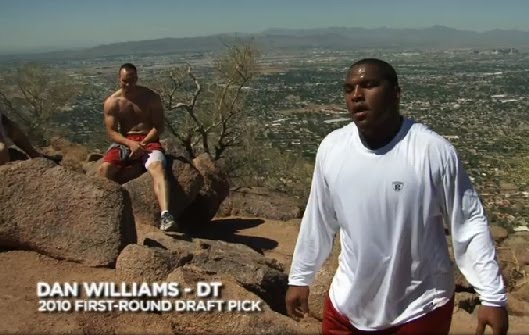
Sports bloggers were passing a link around yesterday about Arizona Cardinals rookies hiking Camelback. It's been warm lately so it's not surprising to see some of these out-of-state guys appear sort of weak as they arrived at the summit. Judging by the pace of the group shown in the video, they probably got passed by quite a few regulars. If these burly rookies keep hitting the trail, though, it won't be long before they'll be bounding up and down like ibexes.


Here's the link to the video on www.azcardinals.com, (which is where I ripped this still shot).

Tuesday, June 8, 2010

The "Other" Camelback Mountain

Sometimes it seems like half the info on the Web about Camelback Mountain is about the "other" Camelback Mountain, also known as "Big Pocono."


In my former life as a Queens boy, I knew that my parents had their honeymoon somewhere in the Poconos, but that's about all I knew of the place.

Thanks to my obsession with our local rockpile, I now know that part of the Poconos includes the Camelback Mountain Resort in Tannersville, Pennsylvania. It's a popular ski area that's filled with folks from New Jersey and New York City every winter. It looks like a great place to have fun in the snow.

By Western standards, the other Camelback is what I'd call a cute, little bump of a ski hill. The vertical drop is only 800 feet. Sunrise has an elevation gain of 1,800 feet, Snowbowl more than 2,000. (Phoenix Camelback = 1,200.)

Poconos Camelback rises to 2,113 feet, says Wikipedia (other sources put the max elevation at 2,050). That's much shorter than Phoenix Camelback, which tops out at 2,706.

Of course, our Camelback is a good deal south of Pennsylvania, and it's in the middle of a desert. Snow that falls on Phoenix Camelback melts quickly (it happens once every few years), so the Poconos provide much better skiing conditions.

In the summer, the Poconos don't bake at 115 degrees or more, either, meaning you can go splashing through mud puddles on a Segway or run a zip line through the trees.


Summer or winter, the other Camelback looks like my kind of place.


(Pictures from www.skicamelback.com)

Thursday, June 3, 2010

Bee Attack Panics Man, Causes Knee Blow-Out and Mountain Rescue


Hiker Tom Tenkler made the news yesterday after blowing his knee out while running away from some bees.

Several media outlets picked up on this one, and as usual, most ticked me off by failing to include decent info. At least the local Fox affiliate reported that the incident happened on Cholla Trail, which even the so-called paper of record did not.

Firefighters from Phoenix's TRT and Tempe FD took the guy down some sections on a Big Wheel, with rope assist, before flying him out via helicopter on the Cholla side.

I'd rather get stung 50 times and limp with a broken leg off the mountain rather than suffer the indignity of a mountain rescue and the obligatory TV news coverage. But that's just me. Besides, Tenkler may not have summoned rescuers himself. I tried to find his phone number, but neither online White Pages nor Yahoo People Search have a listing for a Tenkler in AZ. Fox was the only outlet that reported the guy's name -- maybe they got it wrong.

Tuesday, June 1, 2010

Camelback Chuckwalla

Late-spring hiking at Camelback this year has been different: Fewer parking spaces because of the great weather, less time to hike with the new closing hour of 7 p.m. (Jeez, they've gotta to change that!)

One thing is the same: The annual appearance of the friendly chuckwalla.

These handsome, large Sonoran-desert lizards come out when the ground heats up. Last month, On a recent day, I saw what looked like two baby chuckwallas. A couple of weeks later, I spotted this bad boy.


Don't try to catch one or you might hurt it. To escape predators, chuckwallas slip between cracks in the rock and puff up their bodies, wedging themselves in tight. This may work for coyotes (who may just get a drumstick instead of the whole thing) but determined humans would have no problem messing with them.

Seeing a chuckwalla at Camelback is a special treat for nerds like me and out-of-town visitors, some of whom probably wonder if they're Gila monsters. Chuckwallas are much bigger then common fence lizards, more colorful and all-around cooler-looking. They blend in beautifully with Camelback's orange-red hue.

Another neat thing about chuckwallas is their name. Though it sounds like something a hayseed from the Midwest might have thunk up, Wikipedia says it's derived from a Spanish bastardization of a couple of words for the lizard used by two Native American tribes.

The Hohokam, (the group of Native Americans who lived in the Phoenix area for about 1,000 years before leaving a few decades before Columbus' arrival) probably considered chuckwallas a delicious treat -- the Hohokam also ate cholla.

The Wiki article told me something I always suspected: that chuckwallas are basically desert iguanas. No wonder I like them so much: I used to have a pet iguana as a kid. Its name was Whiplash, because it liked to whip people with its tail so hard that it would leave a mark. It also bit me on the nose once. I sold it back to the pet shop I'd bought it from a year later, and found it had gone up in price like a rare coin. I was happy to have the extra money instead of the iguana. But I can't get those sweet little lizard faces out of my head. They're so cute!