Sunday, February 24, 2013

Camelback Mountain's Praying Monk Christmas Garbage & Other Camelback Trash


Merry Trashmas

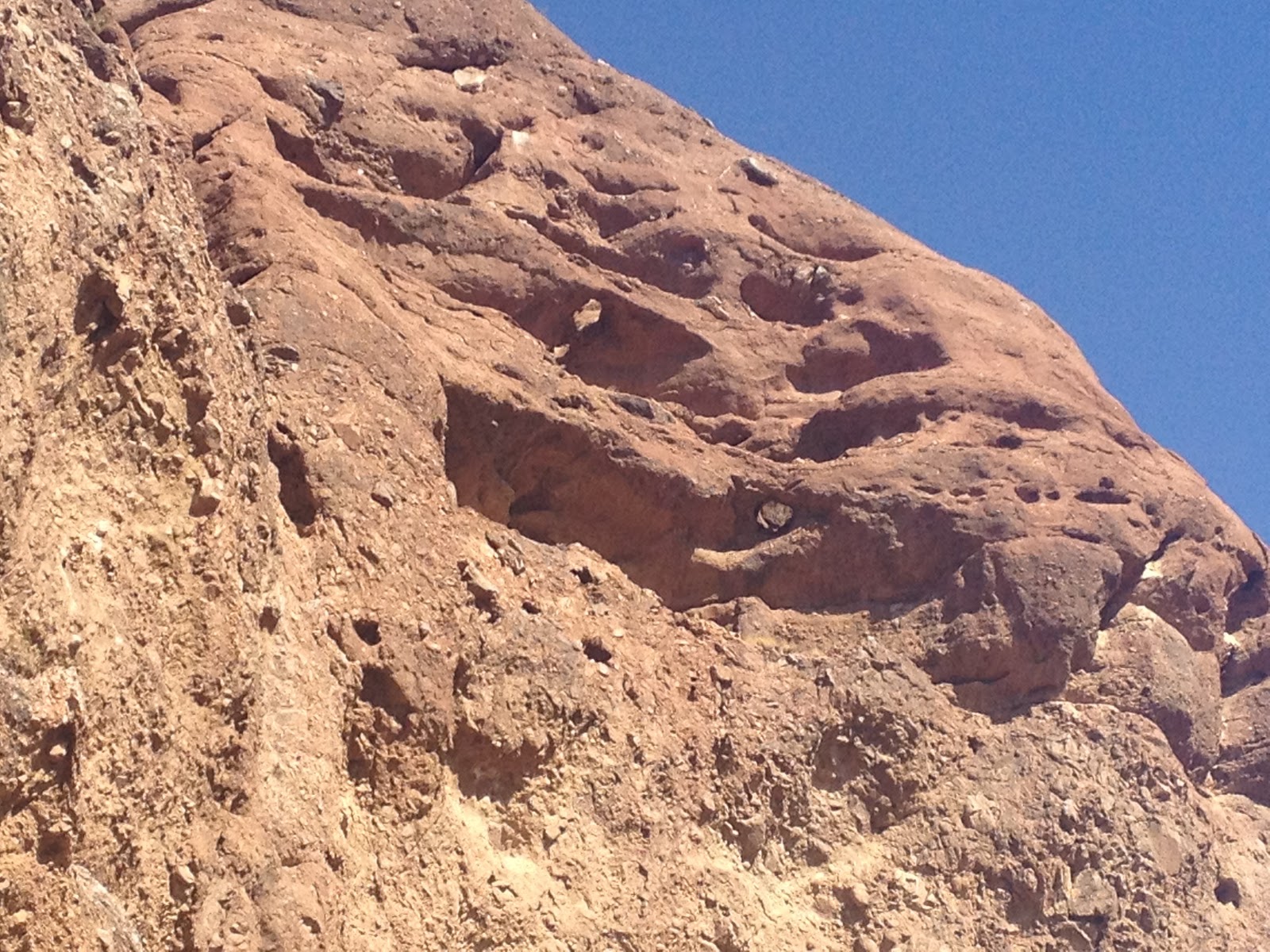
Someone put up another Christmas Tree on the Praying Monk this year. This time it didn't work out so well.

I'm no longer mentioning names, but they wrote about it online:

"Somebody cut the lines it was rigged with, tossed the tree off the Monk, and took the gear that I anchored it with. The tree was broken into little bits, and was very difficult to carry down. "

Coincidentally, I noticed Christmas garbage strewn all over the Praying Monk plateau during two separate scrambling sessions in January. The people who put the tree up in the first place are responsible for the trash, even if "somebody" else cut the tree down.

The tree was gone during my climbahikes, but broken and intact ornaments could be seen scattered around the Monk's base. (I didn't pick them up, having no pockets or a bag to put them in, but I'll get them eventually if no one else does.)

Several gear tags were lying around. Hundreds of tiny, green pine tree needles were littering the chute leading from the plateau to Rappel Gully. They appear to be plastic and not biodegradable -- if so, they'll be up there for quite a while, mixed with the gravel. Annoying.

For years, I've also been bugged by the goofballs who decorate the top of Camelback Mountain with holiday decorations and a Christmas Tree each holiday season. I've noticed holiday litter at the summit in past years, too.

If you feel compelled to spread Christmas cheer to every mountaintop, literally, ask yourself if Jesus would want you to celebrate his birthday by trashing one of the few natural areas in the city.


Climbing Litter

Now, when I see an empty Gatorade bottle or crumpled snot-rag or other trash along Echo Canyon or Cholla trails, it's expected because of the sheer number of people on Camelback Mountain. The mountain is usually quite clean, but it only takes one litterbug out of every 10,000 hikers to make a mess. Very few people, relatively, scamper up the Headwall to the Monk plateau. So when I see garbage up there, it's more disappointing because it means that a much smaller proportion of the climbing population than hiker population is littering. Yet climbers, in my humble opinion, should be much better stewards of the land than average hikers. They visit more pristine, sensitive areas, and they should know those areas are less likely to ever be cleaned up by anyone, being more difficult to access and to move and up and down the slopes and cliffs with trash bags.

Most climbers believe strongly in self-reliance, and this ethic extends to the idea that you pack out all trash, barring some good reason not to. This applies to old webbing and other climbing-specific trash. Yes, climbers may leave webbing tied around boulders or trees after using it as a rappel anchor. That's not littering -- it's survival, and not the same thing as leaving sliced, sun-decayed webbing lying at the base of a popular climb.


More annoyances

Next, an example of Camelback graffiti. Fortunately, this sort of thing doesn't appear on the rocks as frequently as it could. Phoenix doesn't have an excessive graffiti problem in general. If I had to guess, I'd say "SL" stands for S*%^ Licker:


The Ultimate Garbage Sin

Finally, I must bring up the trashy act that makes me more furious than any other: Leaving dog poop on the side of the trail in a tied-up plastic bag. I mentioned this in a previous post but it's worth talking about again because so many people do it. I come across these poop bags on the trail once every two or three times up the mountain, and sometimes see two on the same day, in different types of bags, meaning more than one of these boors had been there. I've never caught anyone doing it, but would certainly say something if I did.

The poop-bag method is even more annoying to me than the idea of dogs pooping freely on the ground. While it's possible that some of the poop-heads who do this plan on picking up the bag on their way down from the mountain, most clearly don't. They leave it there, believing falsely that if they have housekeepers, groundskeepers and janitors at their beck and call, so does Camelback Mountain.

Last time at the mountain, a couple of weeks before the Echo Canyon closure, I talked to a ranger about this strange and obnoxious behavior.

"Hey, thanks so much for the service you guys provide -- picking up all those little bags of dog poop that people leave," I said with a smirk.

She got my drift right away and she snarled, "Oh, there's no service! They think there's a service, but there isn't. I don't pick them up!"

"I know! What is wrong with those people?"

"Actually, I do pick up the bags, sometimes," she confessed. "But only when I'm positive that no one is around, so no one sees me do it. Otherwise, they'll think there really is a service."

Listen up, poop-baggers: Do NOT leave your animal's crap on the trail, even for a minute. If you have a plastic bag, that's wonderful -- take it with you, whether you're hiking down or are still on your way up. There is no valid excuse for doing otherwise.

Sunday, October 21, 2012

Copenhaver Castle: Going Medieval on Camelback Mountain

The castle protected Hohokam royalty from attack by conquistadors until the infamous Siege of 1312...

Sunday, September 30, 2012

Camelback Mountain Rescues Steady in 2012; Included One for Tim Hightower, Former Arizona Cardinals Player

Tim Hightower's March 2012 Camelback rescue.

At least nine people have been rescued in six incidents so far this year at Camelback Mountain. Most were treated for heat exhaustion and dehydration.

The two primary hiking trails of Camelback, Echo Canyon and Cholla Trails, are both just over a mile long. That little number, "1," has sure fooled a lot of people. The rocky trails rise more than 1,000 feet in that mile-plus walk, and both are not only steep, they've got places where the use of hands is mandatory. The effects of a heat illness can set in within minutes of a scorching summer hike up Camelback Mountain under full sunlight. Even in the morning and evening, or in spring or fall, when the sun's rays are less intense, susceptible people with too little water can die in as little as two to four hours on any mountain trail in Phoenix. I'd estimate at least one hiker per year has died from the heat in the last few years, though the average went up a little with the deaths of three aging gold-seekers from Utah who died in the Supes a couple of summers ago.

Besides the deaths and heat-related rescues on Camelback, no doubt many more hikers have suffered a miserable outing because they brought too too little water. On a very hot day, 110-plus, I (generally) don't hike between 10 a.m. and 5 p.m. Outside of those hours is fine, even if it's 111 or slightly higher, though if the air's too thick with humidity -- not uncommon in cumulonimbus-heavy monsoon season -- even 105 can be oppressive enough to make me wish I was at the gym. If you're not very acclimated to the heat, go with the temperature you're comfortable in.

In the heat at Camelback, the pale red landscape becomes like magma. The cicadas providing a sizzling soundtrack. Mini-canyons are brick ovens. The heat zaps strength from your legs and fries your brain. If sunlight has lit up a rock formation for very long, forget about climbing. The stone feels like an electric stove-top on high. Except for those cicadas, it's lonely. Very few people are out here with you. No need to worry about rattlesnakes on super-hot days -- they're in their cool burrows, not being Crockpotted by the air-temperature.

I take about a liter of water for every hour I expect to be at Camelback in temperatures over 95-100. I pack a Nalgene bottle with ice, then fill the spaces with water. Doing this ensures I'll still have at least some ice, and therefore really cold water, by the time I get to the top. On the hottest days, I'll take an additional small water bottle or even another ice-packed Nalgene. I move slower in extreme heat, adding to the total time out there. It's also good to dump icewater over my head or body at times. Getting lost or going too slow on a hot day can turn into a nightmare if you don't have a similar quantity of water on you. One rescue two years ago involved a couple of women who were on one of the main trails for five hours before authorities were called. After writing about that one for Valley Fever, I also published "Ten Tips for Avoiding Heat Stroke."

Here's what the National Park Service's Grand Canyon site has to say:

During the summer months, your fluid/electrolyte loss can exceed two quarts per hour if you hike uphill in direct sunlight during the hottest part of the day.

If you've never done Echo Canyon or Cholla Trail before and you're not with anyone who has, it will probably take about 45 minutes or more to get to the top. That means you should take at least one liter. Taking another liter or even two might be wise, because you'll want that much water if you spend three hours up there.


Heat-related illnesses are probably the most common reason for mountain rescues on Camelback. But as I've documented previously, a surprising variety of problems can happen up there.

Besides not bringing enough water on a hot day, I see a lot of hikers on the trail near sunset without flashlights. They end up having to pick their way down the boulders in the near-dark. A scary experience for some. Fortunately, I've found that it never gets completely dark at Camelback. On a Grand Canyon trail below the rim on a moonless night, the darkness envelopes you like a liquid if you shut off flashlight. It's like the darkness inside a cave except for the canopy of stars. Camelback trails, by contrast, are always bathed in a faint, eerie glow of reflected city lights. I've intentionally hiked Echo Canyon at night without a headlamp, but I know the trail quite well. Most visitors caught after dark without a light are in a for a struggle and an adventure. Sometimes they go off the main trails, making things worse. In March, that's what happened to former Arizona Cardinals player Tim Hightower.
Hightower and friend in the media spotlight before rescue.

Press accounts say Hightower and a female friend were hiking the mountain when they got off trail in the dark and phoned for a rescue. Channel 10 News showed the burly player with his head hung low, hopping into an SUV without talking to a camera crew. The announcer notes with glee that he seems embarrassed.

I find the incident ironic not just because a burly he-man pro football player needed the rescue, but because in the latter two years of Hightower's time with the Cards, John Lott, the team's strength and conditioning coach, was having players march up and down Echo Canyon trail to supplement their exercise routines. In other words, you'd think Hightower would have known what he was doing on Camelback. This rescue, though, brings up other issues -- overzealous rescue and the overreliance on cell phones to save our butts. These people were nowhere near death's door. I'm quite sure that Hightower and his friend would have figured out a way down and out of the 400-plus-acre park, which is surrounded by city lights. Either they would have done it that night and ended up scratched and bruised, or would have suffered a miserable night on the hill and walked out in the morning. But odds are they would have been fine, and unless their cell phone battery was low, there was no life-or-death reason to call in the cavalry. Not then, anyway.

Another way to look at it: The city of Phoenix has the helicopter and all of those firefighters sitting around, probably with nothing better to do, so why not use that phone? Perhaps Hightower would have sucked it up and rescued himself if he'd been alone, but he had the woman to think of. Then again, maybe I'm being sexist -- maybe she's the bigger outdoorsperson and he insisted on calling in the rescue. Either way, one or both made the decision to call, and they likely knew the TV crew would show up. They always do.

Here's the roundup, as best I could find on the Internet:

* In January, ABC-15 broadcast a story about how 10 people had been rescued from Camelback Mountain in a two-week period.

*  The Tim Hightower Camelback Debacle came in March.


* June: A woman in flip-flips and little water is overcome by the heat at Camelback.

* July: Two men suffer heat problems on Echo Canyon Trail. One is cramping up so bad, firefighters decide to airlift him out.

* August: Steve Amren of San Antonio got lost while hiking Echo Canyon. Somehow, he became "stuck in a ravine" and also became seriously dehydrated. Here's his quote from that story: "I just got up on the wrong path, and I got into an area where I couldn't get out because I was too tired."

* September: Two teens start hiking Camelback at about 1 p.m. Three hours later, they're off the main trail, lost and suffering from severe dehydration. This one shows clearly just how fast these symptoms can appear in some people.

Having too little water is a big factor in these kinds of stories, but it's also true that some people are more susceptible to heat-related illnesses than others, for different reasons.

Yet to have a great adventure, certainly one of my goals, it's necessary to push your physical limits. As long as this is done with forethought to what sort of experience you're about to have, a trip to Camelback is safe and fun. Except when it's not. Which is the point of this adventure blog.

It may be somewhat macabre to keep returning to the subject of rescues, injuries and other serious human calamities at Camelback. But the thrills and spills help make up the mystique of this place. The potential danger is a reason to respect the mountain. As a vehicle for excitement, the risk is also a reason to go there. So I'll pushing myself right up to -- but, with luck, never surpassing -- the point that results in the arrival of the Phoenix Fire Department and local news media.

Saturday, September 15, 2012

Camelback Mountain: Suicide Direct -- Serious, But (Probably) Not Suicidal


A few months after I experienced the ridiculous "hanging rappel" misadventure, I led Suicide Direct (left).

Doing stuff you previously thought was impossible or too scary is one reason I have always loved rock climbing. My lead of this 5.8 Phoenix testpiece remains one of my most treasured times in my 23 years of on-and-off climbing.

The achievement was ironic, considering how badly I'd flailed on the route on toprope. Worse, I'd cracked a heelbone after falling on a boulder problem at Camelback Mountain the very weekend after Mike and I had climbed it. About three weeks later, my foot in a walking cast, I used crutches to hike up the trail to the base of Suicide Direct and photographed another friend, Kent, who had chosen this 5.8 as his first lead. I managed to snap a killer picture of him flying through the air. He'd slipped on relatively easy terrain above the bulging-overhang crux. He took a 20-25 lead fall that day. Very impressive. Then he slithered back up the overhang like it was nothing to finish the route.

Suicide Direct was first climbed in the late 40s or early 50s -- or maybe the 60s. I don't have firsthand info on the history of the route, but one looks at the bolts in it during my late-80s climb revealed that it was a classic. Greg Opland's Phoenix Rock II suggests it was climbed within five years of 1947 by the Kachinas, that hardcore group of Boy Scouts who pioneered many Valley routes not too long after WWII ended. Rock Climbing Arizona by Stewart M. Green, on the other hand, says the route's first ascent was completed in the 1960s by Lance and Dane Daugherty. Waugh's original Phoenix Rock says the Daugherty boys climbed it in '49. I'd go with that. Either way, as a 2008 report on the route on rockclimbing.com states, "Those old boys sure could climb hard in tennis shoes!" (Although if it was in the 1960s, it was possible they were wearing EBs.) (CORRECTION: The info from Waugh and Green's books is not correct. The Daughertys did not climb it in '49. They were too young then. According to Opland, "Suicide Direct FA was Ralph Patement and Bob Owens in 1949. 
Suicide Direct FFA was Lance and Dane Daugherty, date unknown.")


Waugh's scripture states that Suicide, the fun, three-pitch, 5.5 route left of Direct, suffered some infamous falls some years ago. I don't know the details on those. But I did find one old news story about a death on Suicide Direct in January of 1987. Andre Dauvergne fell after climbing the route with a partner, fellow ASU student Doug Loveday. According to the newspaper article I found, which quoted a volunteer rescuer, the climbers "had no climbing equipment and were wearing only tennis shoes ... to attempt an assault that is considered difficult even for experienced mountaineers." As Waugh's book says, climbers must "surmount the difficult overhang."

The overhang is not terribly difficult if you're a solid 5.10 leader, but even then it'll likely cause you to reflect on life and other important things. The spooky reputation of Camelback rock calls for that sort of perspective. If you're in over your head by leading a runout, exposed 5.8, the route's name doesn't seem far-fetched.


My obsessive hiking at Camelback frequently takes me past Suicide and Suicide Direct; I've never seen anyone climbing the latter, (because it's no ladder, hee-hee). Twice, I've seen people on Suicide. Once it was a pair of competent-looking climbers. The other time, which was a few years ago, it was a pair of yahoos using a 50-foot static line as a lead rope. I have no idea if they made it past the first pitch, which they had split into two pitches.
(Suicide Direct from Echo Canyon pkng lot.)


I know S.D. must get a few ascents a year, but it sure isn't a commonly climbed route. Which is all the better, if you want to do something special. It's for experts and foolhardy souls only, obvi-frickin-ously. Extremely satisfying when you nail it, for sure, and it puts you in an interesting spot on the western side of August Canyon. I don't know if the bees are still there. It's been quite a while since I've climbed it. Only did one other time after my lead. That was with Kent, who wanted me to belay him on a clean lead of the route about a year after his fall there. Although he finished the lead the day he fell, and flashed it when I belayed him his second time, that fall bugged him for years. Sometime around 99 or 00, he decided to put all his Suicide Direct fears behind him and complete a solo ascent of the route. At night. He's improved his climbing skills considerably since then. Last month, he free-soloed the Matterhorn.

I digress.

While I don't recall hearing about the '87 incident, I do remember one high-profile rescue at Suicide Direct from 10 years later. This was the case of a teenage resident of a now-closed juvenile boot camp on a group outing to Camelback. He snuck away from his group and freed the climb up to the bolted overhang. At the rest-stop just below the overhang, he realized he could neither go nor back down without killing himself. So he took off his T-shirt, pulled it through a bolt hangar, and tied a knot in it for a handy hold. Then he waited for the expensive technical rescue. I still think that was a fairly smart move on his part, to use the shirt like that. Going up the 5.8 without experience or rock shoes wasn't too swift. But I do appreciate the boldness. He probably didn't know the name of the route or its Yosemite Decimal System rating, but he knew it was a great line up a sweet cliff.

Suicide Direct isn't highlighted on the ClimbPhx Web site's Camel-page, so I assume the author hasn't climbed it. I thought I saw an in-depth route report, but it got lost in cyberspace and I've been unable to locate the site again. The above-mentioned rockclimbing.com report refers to the "stiff overhang," while a commenter notes the long runout. Those are actually just two of the challenges.

The first challenge climbers must confront is the 90-foot, "class-four" first pitch. Perhaps because this route gets so few ascents, or maybe it's just a geological quirk, this pitch does contain a fair amount of Camelback choss. It's easy to become lost in this asteroid field, so depending on how you do it, the first pitch might be an honest 5.0-5.2. And you'll be wearing a pack with your gear. So be wary of that class-four designation. When I climbed this with Kent, a rattlesnake was coiled in the shade at the top of the first pitch. I scrambled past it before seeing it, realizing it could have bitten me in the face. Kent used it as a handhold for a brief second, until his brain understood the skin on his fingertips had touched something alive. He pulled his hand back. "What was that?" "A rattlesnake," I answered. The snake shook its head and went back to sleep. The sun hadn't yet hit the crag, and it must enjoy sleeping in almost as much as I do.

(Photo of Suicide, 5.5, ripped from www.rockclimbing.com.)

You'll forget the excitement of the first pitch once you begin the second. Although it starts off fairly easy, you're instantly launched into the stratosphere. Lots of exposure, real soon -- thanks to that steep first pitch. I was sure happy when I reached that first bolt, but I had to leave it behind all too quickly. I recall only two bolts between the ground and the bolted overhang; another one may have been installed in recent years.

I'm cranking the overhang in the picture. I'd been doing a decent amount of climbing back then, so I found it rather fun, though strenuous. Funny, but on lead I remember that the handhold on the top-side of the overhang, which had some stiff grass growing in it, felt incredibly positive. When I later seconded it with Kent, it felt more angled and tricky. Could have just been conditioning. But both times, it required strength and nailing the footholds to get on top of it. After that, it's a tricky cat-walk left and up. I was well aware of Kent's fall when I led it and was extra cautious. Tired and a bit freaked out, the climax of my lead was yet to come.

The last move of Suicide Direct, unless it's been retro-bolted, is a sketchy pull in a gravelly slot with almost nothing for footholds. Scared the bejesus out of me. I placed a .5 Camelot in a flaring pocket a couple of feet under the move, knowing it wouldn't hold if I slipped. It would be as if the rock spit that cam out as I screamed past it, taking a lead fall of -- I don't know -- forty feet? Maybe more? Bouncing all the way. Of course, I didn't have a helmet, as the picture shows. So this climb might have been the death of me. Instead of flying off, though, I gritted my teeth, clenched everything else, and made that last pull, where I found -- and grabbed -- the chains attached to two or three bolts. This was one of the many experiences that make visiting Camelback an almost religious experience for me.

So, if you go, (and I hope you do, 'cause I'd love to see someone leading it...):

* Take two ropes, or;

* Brave the maze of August Canyon and find Pedrick's Chimney on its east side;

*Watch your step on that first pitch;

* Keep your head after the overhang.

* Watch out for poisonous reptiles and take a spare battery if you do it at night!

(Suicide Direct route at Camelback Mountain. Yellow dots indicate path, not bolts. There aren't many bolts.)

UPDATE: Just wanted to bring attention to and repeat some of the historical context here. As I mentioned in another blog post, Bob Owens of the Kachinas contacted me to report his climb of "Suicide Cliff" in 1947. Then there's the comment below about Lance and Dane Daugherty, legends of Phoenix climbing:

Climbing brothers said...
Just to clarify some information.
Lance and Dane Daugherty were my older 1/2 brothers. We moved out to Phoenix Az in the Fall of 1963. They began climbing in 1965.
Lance was born in 1947 and Dane in 1949.
Lance was killed in 1968 on his motorcycle coming back from a climb in Carefree. Dane quit climbing altogether in 1969.
Ironically, Dane was also killed on a motorcycle in 1978.
If the first climb of Suicide was in 1949 it could not have been my brothers.
Hope this clears up some confusion.
Sincerely,
Von Wagner

Sunday, May 27, 2012

Camelback Mountain Chuckwalla - the Sonoran Desert's Iguana

Hey, big fella. Enjoying the view?

This one's wife was joining him for an afternoon basking session.

Sunday, May 13, 2012

Camelback Mountain Rattlesnake Video


Shot this yesterday out on Cholla Trail. Quite a handsome little fellow. A small crowd gathered around the rock he was hiding under. One onlooker suggested he was a timber rattler. I don't think so. The markings aren't correct and timber rattlers aren't western U.S. snakes. I believe he was probably a speckled rattlesnake.

Monday, May 7, 2012

Camelback Phoenix: The Blog About Camelback Mountain Hiking, Climbing and Exploring


This is the 50th post for this blog. I don't really consider it a blog. The older posts -- most of them, anyway -- shouldn't be considered "old news." The site is a collection of stories, information, news, photos, links and other tidbits about my favorite mountain. It's a place for the outside world to better know Camelback Mountain, and the adventures I and other people have had there. On Camelback Phoenix, you can find info about hiking, rock climbing, the wildlife, the visitors and their trip reports, parking and anything else Camelback Mountain that I can think of. Some of this info you'll find in the provided links. For instance, sites are listed in my blogroll that give you precise directions to Echo Canyon and Cholla Trail, including the city of Phoenix Parks and Recreation site. The blogroll is automatically prioritized by Google Blogger depending on how often those other sites are updates. Summitpost is an example of a great site that pulls in trip reports and climbing info from uncountable cyber-commenters.


This site is mainly about spreading the Camelback love.

Another interest is to get a larger variety of info out there about Camelback Mountain as possible. No single site or book exists that compiles everything on it. Even Gary Driggs' famous coffee-table book, Camelback, (which I intend to jabber on about in some future post), doesn't offer as many details as I'd like to see, especially as a climber. Camelback's history deserves to be preserved, and I'd like to help do that.


As I continue to post here, feel free to comment and share links or other information. Years ago, I met a guy at Headwall named Ken who told me there are at least 70 climbing routes at Camelback -- far more than you'll find in any guidebook. There is much left for me to learn within these rugged 400-plus acres.

Okay, now it's time to update some of the Camelback stories, pictures and videos I've seen on the Internet...


Clichtenberger

I want to bring attention to a few posts done on Mountain Project by a "clichtenberger," as well as the Camelback pages on MP's site in general.

I assume that's stands for C. Lichtenberger, but I'm not sure. Whatever his or her name is, I'm jealous of the quality time this climber spent with friends on various Camelback routes at the end of last year. "Clichtenberger" has new postings on routes that I've been wanting to climb, like (Aerial Combat and Chimera, both 5.9), as well as some I've done, like Hard Times and Beehive. (I wished for photos of the latter two, though, for nostalgia's sake.)

When I clicked on the photo above that Clichtenberger took of his buddy "Lauren" on the 3rd pitch of Hart Route (4th pitch, the way they climbed it), I had a visceral response and flashback to my 2010 freesolo of the route. Maybe that freesolo wasn't such a good idea.


Tons of videos

At this www.climbingweather.com link, you'll find a collection of more than 100 videos about Camelback Mountain. A couple of examples:


This one's kind of cute and courteously short. Skateboarding, nice splicing and a great Beatles song.

Another video has a weird sky serpent and a song by Godsmack:


Suicide

Want more info on a phenomenal, three-pitch adventure climb with the scary name of Suicide? (C'mon, it's only 5.5!) Click here.


Where was that rescue?


Last November, I read about a couple of kids who got lost while scrambling around. I'm fascinated by the tale of how they climbed down something they could not get back up. Usually, it's the other way around. Of course, the TV stations never nail down for the viewer the precise site. Check back for a future post that will have the GPS coordinates. I'm also trying to find the coordinates for the spot where a guy in his mid-50s was freesoloing and attacked by bees. He was stung 120 times. I think that's information you or I may need to know someday. Phoenix Fire is supposed to get back to me on that one.


Climbing routes

Next to Suicide Direct is a 5.10 I'd like to try someday called Black Direct.

Some routes at Camelback Mountain, however, are best done just once. Misgivings is one of those. This isn't one that I've led, and I vowed never to do so after watching one of my friends fall on a sketchy piece near the top. Had he not put that piece in, or had the piece popped out, he very well might have decked.


A place to have real adventures

In searching for other posts out there about Camelback, the ones I enjoy the most capture the thrill and seriousness of the park -- like this one, entitled "This is crazy."

This one by adventureparents.com also captures the spirit I look for, though I think the type of pushy hikers he describes is more often found on Piestewa Peak.


Photos, paintings and other Camelback Mountain art

You paint it, I'll showcase it. (The above painting is by Michael J. Liebhaber.)


See you on the trail.